
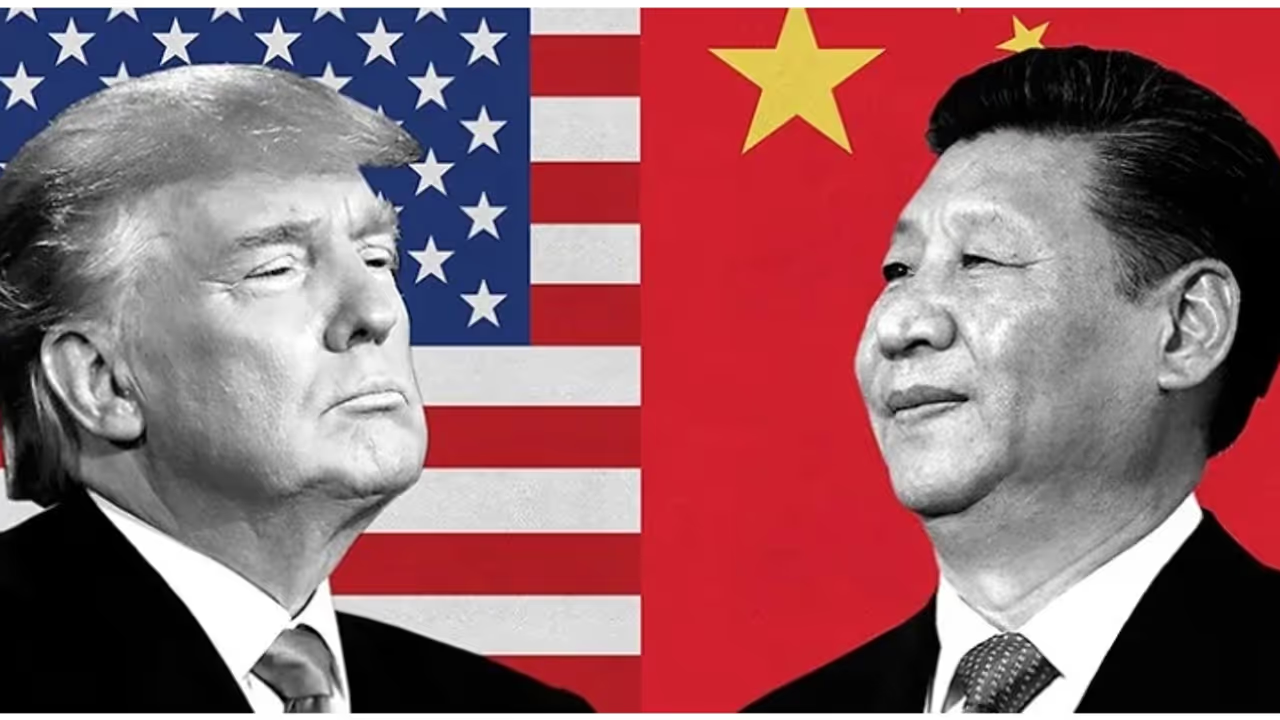
China played a significant behind-the-scenes role in the recent US-Iran ceasefire, an involvement President Trump hinted at. As Iran's largest trading partner, Beijing used its economic leverage to push for de-escalation. China's actions were motivated by its need for regional stability to protect its trade and energy interests.
China appears to have played a behind-the-scenes but significant role in bringing about the recent ceasefire between the United States and Iran, with US President Donald Trump hinting that Beijing helped push Tehran towards negotiations.

The two-week truce, which paused a rapidly escalating conflict, came after intense diplomatic efforts involving multiple countries. While Pakistan has been widely credited for direct mediation, China’s influence is now emerging as a key factor in persuading Iran to come to the negotiating table.
Trump Hints At China’s Role
Speaking about the ceasefire, Trump acknowledged China’s possible involvement in nudging Iran towards talks. When asked if Beijing played a role, he said: “I hear yes.”
The remark has drawn attention to China’s quiet diplomatic outreach during the conflict. Beijing, which shares strong economic ties with Tehran, is believed to have used its leverage to encourage de-escalation at a critical moment when tensions were close to boiling over.
Also Read: ‘Draft’ Tag In Pakistan PM Shehbaz Sharif’s Iran Post Triggers ‘Scripted’ Message Debate
Beijing’s Strategic Interests In Peace
For China, stability in the region is crucial. As Iran’s largest trading partner and a major buyer of its oil, Beijing has a direct stake in preventing prolonged disruption, especially in the Strait of Hormuz — a vital global energy route.
There is also a geopolitical dimension. Trump is expected to visit Beijing in May for talks with Chinese President Xi Jinping, and a continued war could have complicated those plans. Analysts say China had strong incentives to ensure tensions cooled before the high-profile meeting.
Beyond direct influence, China also worked through diplomatic channels, engaging countries like Pakistan, Turkey and Egypt to promote dialogue and push for a ceasefire framework.
Quiet Diplomacy, Big Impact
China’s approach has largely been low-key, focusing on persuasion rather than public intervention. Unlike the United States’ aggressive posture during the conflict, Beijing positioned itself as a stabilising force advocating negotiations over military action.
Also Read: Pakistan's role in US-Iran ceasefire: Mediator or China's mouthpiece?
Reports suggest China, along with Pakistan, had earlier floated proposals aimed at ending hostilities, including reopening the Strait of Hormuz and initiating structured talks.
The ceasefire, though temporary, has eased immediate fears of a wider war and brought some relief to global markets. However, uncertainty remains over whether the truce will hold and evolve into a long-term agreement.
China’s role, while not officially detailed, highlights its growing influence in global diplomacy — particularly in conflict zones where it seeks to balance economic interests with strategic positioning.
