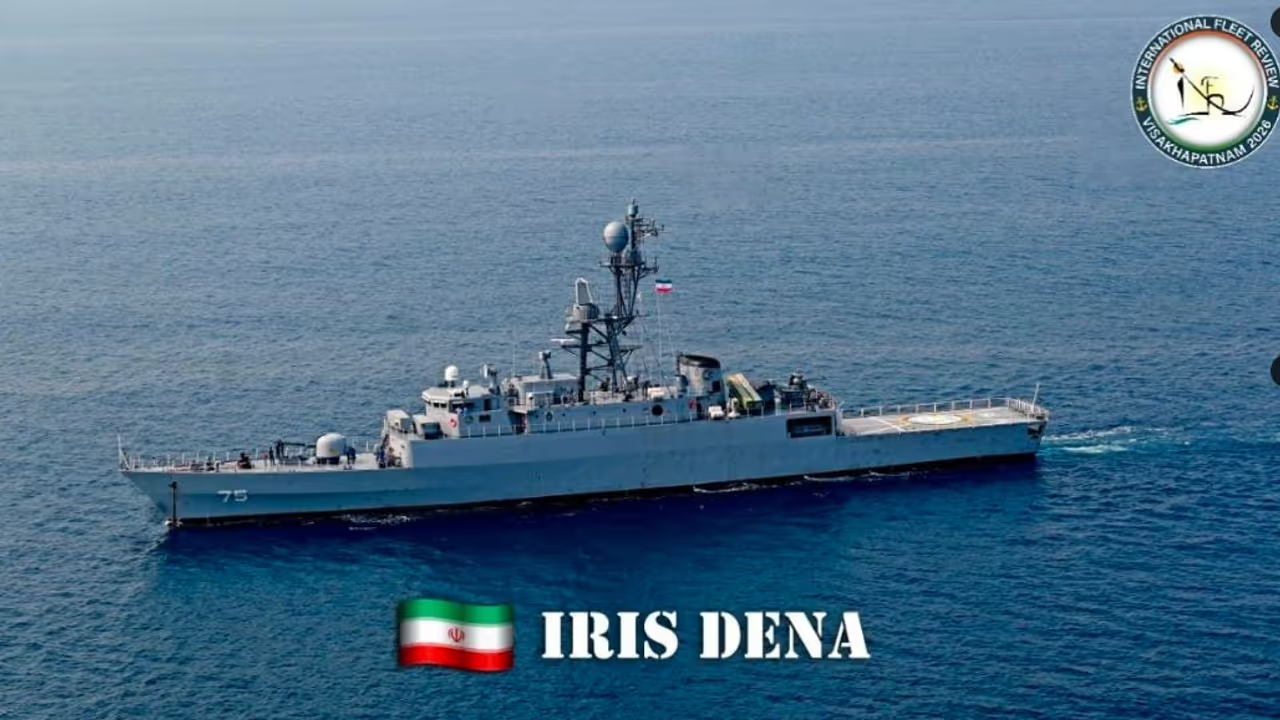
An Iranian sailor aboard the warship IRIS Dena reportedly told his father that US forces issued two warnings asking the crew to abandon the vessel before a submarine strike near Sri Lanka. The sailor later died in the attack. The account challenges Iran’s earlier claim that the ship was hit without warning.
A new report has revealed fresh details about the sinking of the Iranian warship IRIS Dena near Sri Lanka. According to the report by Iran International, an Iranian sailor who later died in the attack told his father that United States forces had warned the crew twice to abandon the vessel before the strike. The information was reported by Iran International, which said the sailor called his father shortly before the attack. During the call, he reportedly said that American forces had issued two warnings asking the crew to leave the ship.

This version of events is different from Iran’s earlier statement that the warship was attacked without any warning. Iran had earlier accused the US of attacking without warning
After the strike, Iranian officials strongly criticised the United States. Iran’s Foreign Minister Seyed Abbas Araghchi claimed that the ship was attacked in international waters without any prior warning.
Related Articles

He described the attack as an “atrocity at sea” and accused the United States of acting aggressively against Iranian naval forces.
However, the latest account from the sailor’s family suggests that warnings may have been given before the strike happened.
Also Read: What Sparked the Political Storm Over President Droupadi Murmu's Visit to West Bengal?
Sailor said commander refused to allow evacuation
According to a source close to the sailor’s family, the crew had been warned about the danger before the attack.
The sailor reportedly told his father that US forces asked the crew to abandon the ship twice. But the warship’s commander allegedly refused to allow the sailors to leave the vessel.
The source said that some crew members argued with the commander because they were worried about the threat.
Despite the warning, the crew remained on the ship. Shortly afterwards, the attack took place.
US submarine torpedoed the warship
The Iranian navy warship IRIS Dena was torpedoed by a US submarine in the Indian Ocean on Wednesday. The attack happened about 19 nautical miles off the southern Sri Lankan port city of Galle. The strike killed dozens of sailors and caused the warship to sink in the sea.
The incident marked a major escalation in tensions between the United States and Iran.
US War Secretary Pete Hegseth described the strike as a “quiet death”, referring to the use of a submarine torpedo.
He also said it was the first time since the Second World War that the United States had sunk an enemy warship using a submarine.
Rescue operations launched after distress signal
After the attack, a distress signal was received by nearby authorities. Sri Lankan officials quickly launched a search and rescue operation in the area. Rescue teams later recovered 87 bodies from the sea. They also managed to rescue 32 survivors from the sinking warship.
Many of the sailors who survived were able to escape using lifeboats before the ship completely sank. The report also said that these survivors were mainly among the sailors who managed to leave the vessel early.
India also joined rescue efforts
The incident also drew attention in India because the Iranian frigate had recently visited the Indian port city of Visakhapatnam. The ship had taken part in the International Fleet Review 2026 and the multinational naval exercise MILAN 2026 hosted by the Indian Navy.
After receiving the distress signal, the Indian Navy also helped with search and rescue efforts. A long-range maritime patrol aircraft was sent to assist in the search operations already being carried out by Sri Lanka.
Another aircraft equipped with air-droppable life rafts was kept ready in case it was needed. The Indian naval ship INS Tarangini, which was operating nearby, was also deployed to support the rescue mission.
Another vessel, INS Ikshak, sailed from Kochi to assist with the operations.
US asks Sri Lanka not to repatriate survivors
Meanwhile, the United States reportedly asked Sri Lankan authorities not to immediately send the surviving Iranian sailors back to Iran. According to a Reuters report citing an internal US State Department cable dated March 6, Washington requested Sri Lanka to hold the survivors.
The request includes the 32 sailors rescued from the IRIS Dena and 208 sailors rescued from another Iranian naval support ship called IRIS Booshehr. The cable suggested the US wanted Sri Lanka to delay repatriating the sailors after the incident.
The sinking of the Moudge-class frigate IRIS Dena has drawn international attention and increased tensions between the United States and Iran. It also highlights how the conflict between the two countries is expanding beyond the Middle East into wider international waters.