
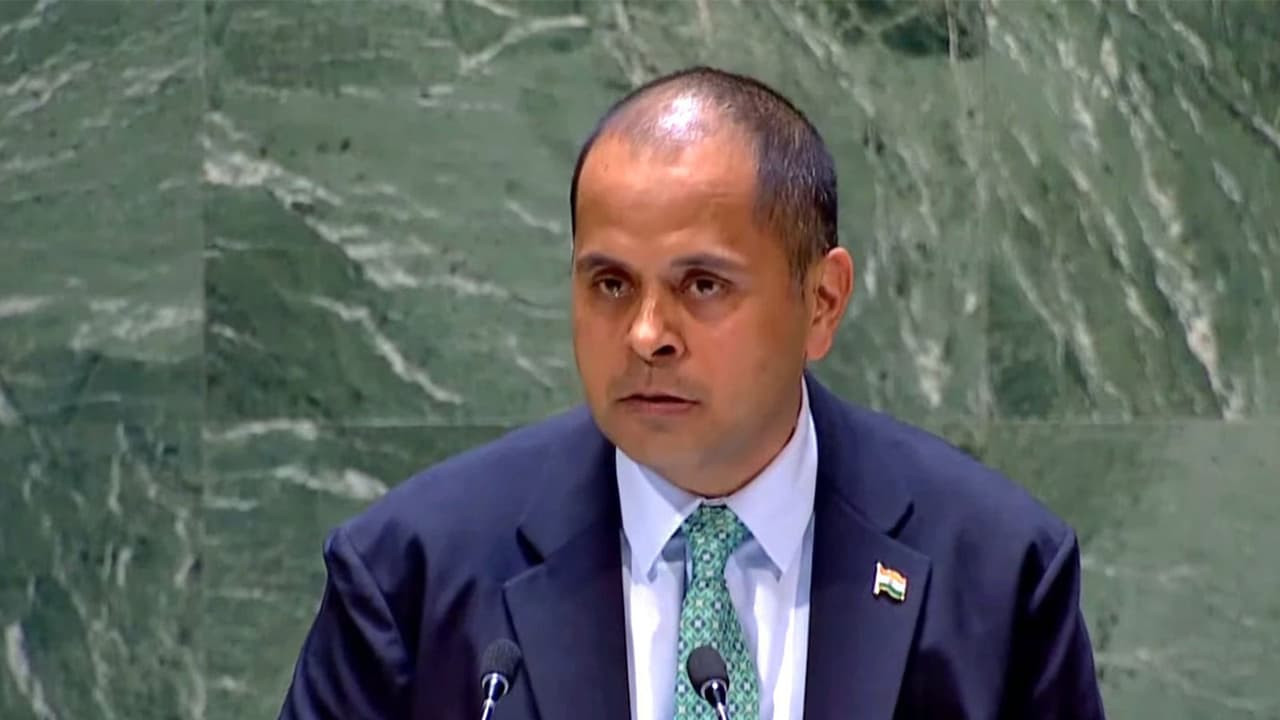
India's AI Impact Summit 2026 is a statement of strategic intent, showcasing the country's shift from AI adoption to system-building, says Consul General Pratik Mathur. India aims to be a principal AI system-builder with a full-stack ecosystem.
A Statement of Strategic Intent
India's AI Impact Summit 2026 is not simply a technology event but a statement of strategic intent, Pratik Mathur, the country's Consul General in Shanghai has said in an article in a leading Chinese media outlet Caixin Global, noting that the next phase of global artificial intelligence race will be shaped by countries who can build large-scale, reliable and socially embedded AI ecosystems that integrate parameters such as data and real-world development.

In his op-ed in Caixin Global, Pratik Mathur said that at the upcoming AI Impact Summit in New Delhi, India will demonstrate that it has moved beyond AI adoption toward building end-to-end infrastructure and capacity for the technology.
"The next phase of the global artificial intelligence (AI) race will not be decided by laboratory breakthroughs alone. It will be shaped by who can build large-scale, reliable and socially embedded AI ecosystems, those that integrate computing power, data, talent, regulation and real-world deployment," Mathur said.
"In this context, India's AI Impact Summit 2026 is not simply a technology event. It is a statement of strategic intent: that India is positioning itself as one of the world's principal AI system-builders," he added.
India's 'Full-Stack' AI Ecosystem
Mathur outlined how India is emerging as a global AI system-builder with the AI Impact Summit 2026 showcasing its integrated ecosystem.
He said the Yangtze River Delta already functions as one of the world's most intensive zones of digital production, combining manufacturing, logistics, financial technology and platform-based services but as the global AI economy matures, the competitive frontier is moving from application-layer deployment to control over computing infrastructure, data platforms, foundation models and talent pipelines.
"It is precisely in these areas that India is now making its most consequential moves, Mathur said in his commentary for Caixin Global.
He said India's global standing in AI is no longer aspirational and at the centre of India's AI strategy is the IndiaAI Mission, approved by the cabinet with a financial outlay of over 103 billion rupees ($1.2 billion) over five years.
"Unlike many national AI plans that focus narrowly on R&D grants or pilot projects, IndiaAI is structured as a full-stack ecosystem, covering compute, data, models, skills, startups and governance. Its most consequential achievement so far has been the expansion of India's AI computing capacity."
Mathur said that by building a nationally accessible GPU backbone, India is ensuring that AI development is not monopolized by a small number of large firms.
"This is a structural intervention that directly underpins India's ability to host a meaningful global AI summit," he said in his commentary in Caixin Global.
He said that through AIKosh, India has assembled a national platform that now hosts more than 5,500 datasets and 251 AI models across 20 sectors, ranging from agriculture and health care to governance and climate.
Mathur said India is also investing heavily in sovereign foundation models.
"This architecture explains why the AI Impact Summit is more than a showcase. It is the first time India will present itself internationally as a country with end-to-end AI capacity: from compute and datasets to models, applications and workforce," the commentary said.
A Differentiated Model for Mass-Scale Deployment
Mathur said in his commentary in Caixin Global that Eastern China's technology ecosystem is deeply integrated into global AI supply chains, particularly in hardware, manufacturing automation, and applied industrial AI.
"But India's approach offers a different model: one where AI is embedded in digital public infrastructure and mass-scale service delivery."
Mathur said India is not piloting AI for thousands of users, it is deploying AI for hundreds of millions and noted that India's talent pipeline reinforces this ambition.
He said AI Impact Summit 2026 will therefore be judged not by speeches but by what it demonstrates: a country that has moved from AI adoption to AI system-building.
"For international partners, including those in Eastern China, it will offer a concrete view of how India is organizing compute, data, models, skills and governance into a coherent national AI architecture," he said in his commentary in Caixin Global.
"In the coming decade, global influence in AI will belong not only to those who invent algorithms, but to those who can deploy them at scale, govern them responsibly, and integrate them into everyday economic life. AI Impact Summit 2026 is India's way of showing that it intends to be one of those countries," he added.
Summit Structure and Key Focus Areas
India is set to host the India AI Impact Summit from February 16-20, 2026 at Bharat Mandapam here bringing together governments, industry leaders, researchers, startups, students and citizens from across the world.
The Summit is envisioned as a pivotal global platform to shape a future-oriented agenda for inclusive, responsible and impactful AI and aims to move beyond high-level discussions and deliver tangible outcomes that can support economic growth, social development and sustainable use of AI.
The Summit will be structured around three core pillars--People, Planet and Progress--with discussions focusing on employment and skilling, sustainable and energy-efficient AI, and economic as well as social development.
Seven thematic working groups, co-chaired by representatives from the Global North and Global South, will present concrete deliverables, including proposals for AI Commons, trusted AI tools, shared compute infrastructure and sector-specific compendiums of AI use cases.
Participants will also gain insights into how AI is impacting various professions and industries, the new skills required in the evolving job market, opportunities for startups to engage with investors and partners, and the role of AI in supporting farmers, small businesses and service providers.
Sessions will address AI safety, governance, ethical use, data protection and India's approach to sovereign AI, including the development of indigenous foundation models for strategic sectors.
A key component of the Summit will be the AI Impact Expo, which will showcase practical applications of AI across sectors such as healthcare, agriculture, education, climate action, energy efficiency and accessibility. These demonstrations are intended to help citizens understand how AI can solve real-world problems and improve service delivery.
The Summit will also highlight national skilling initiatives such as "Yuva AI for All", a free and accessible course designed to build basic AI awareness among students and professionals. (ANI)
(Except for the headline, this story has not been edited by Asianet Newsable English staff and is published from a syndicated feed.)
