
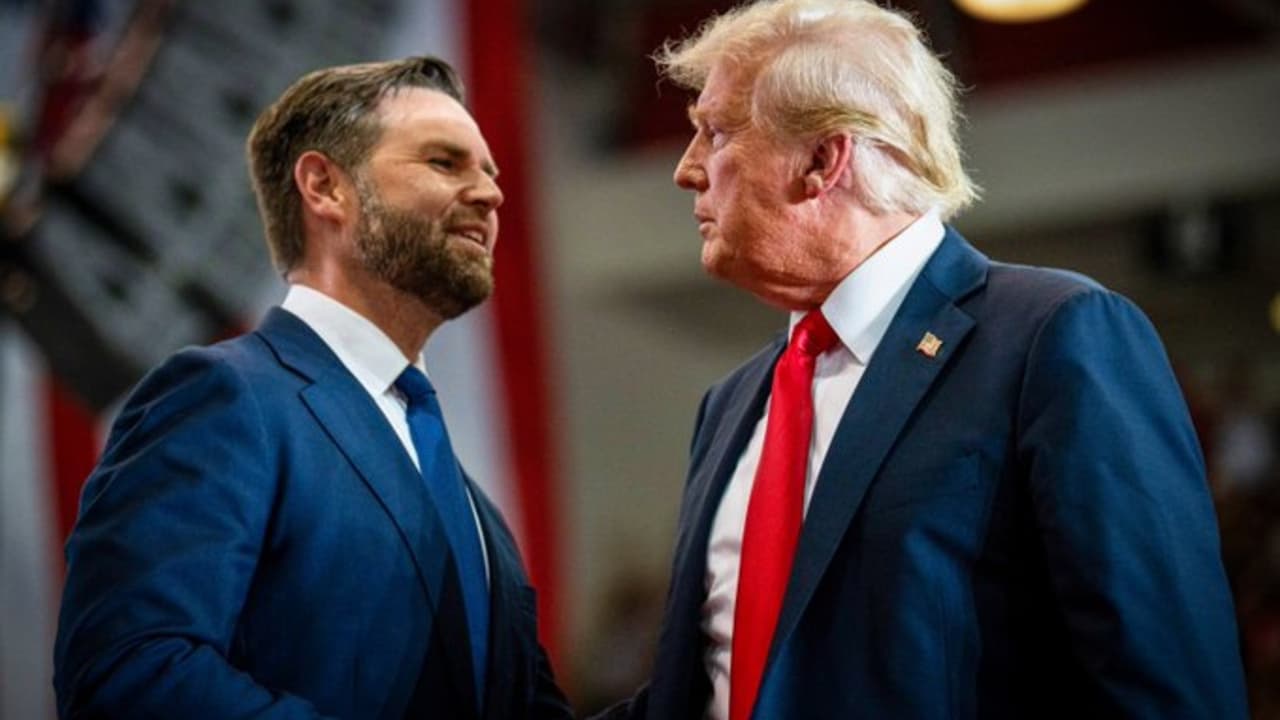
Attempted shooting at the White House Correspondents’ Dinner, attended by President Trump and VP Vance, sparked a debate on presidential succession. The incident highlights vulnerability of having many top officials in one location. If both the President and VP were killed, the Speaker of the House would assume office, followed by other officials.
Why The White House Dinner Shooting Raised Succession Questions
The attempted shooting at the White House Correspondents’ Dinner has triggered a nationwide debate over an issue many Americans rarely think about — what happens if both the President and Vice President are killed at the same time. The attack at the Washington Hilton did not just place President Donald Trump in danger. Vice President JD Vance, several cabinet secretaries, senior lawmakers and key administration officials were all gathered in the same room when gunfire erupted outside the ballroom. Secret Service agents quickly evacuated the leadership, but the incident exposed how vulnerable the government could become when so many officials in the presidential chain of command are present at one event.

According to reports, a large portion of the constitutional line of succession was at the venue when the suspect attempted to breach security. That immediately raised concerns over continuity of government and whether a “designated survivor” should have been chosen before the event. Some officials later confirmed that such discussions did happen beforehand, although the White House reportedly decided not to formally isolate one official because several cabinet members in the succession line were already absent from the event.
The question became urgent online after social media users began asking: if both Trump and Vance had been assassinated, who exactly would have become the next President of the United States?
Under the US Constitution, presidential succession is governed by the Presidential Succession Act of 1947, which creates a fixed order to ensure there is always someone available to assume office. The system is designed to prevent a constitutional vacuum during a national emergency.
Also Read: Cole Tomas Allen charged with attempting to assassinate Donald Trump
Who Would Have Become President?
If President Donald Trump had been killed in the attack, Vice President JD Vance would automatically have become President. That is the first and simplest step in the succession process.
But if both Trump and Vance had died or become incapacitated at the same time, the presidency would not go to another elected official from the White House. Instead, it would move to the next eligible official in the statutory order of succession.
At the time of the incident, the order looked like this:
Order Office Role In Succession
1. Vice President JD Vance
2. Speaker of the House Mike Johnson
3. President Pro Tempore of Senate Chuck Grassley
4. Secretary of State Marco Rubio
5. Treasury Secretary Scott Bessent
6. Defense Secretary Pete Hegseth
7. Attorney General Todd Blanche
8. Interior Secretary Doug Burgum
9. Agriculture Secretary Brooke Rollins
10. Commerce Secretary Howard Lutnick
If both Trump and Vance had died, the presidency would first pass to House Speaker Mike Johnson because the Speaker of the House is next in line after the Vice President. If Johnson had also been unable to serve, then the office would move to Senate President Pro Tempore Chuck Grassley, followed by the cabinet secretaries in the order their departments were created.
Also Read: Trump WHC Dinner Shooter Names Kash Patel as Only Official Off Target List
However, each person must meet constitutional requirements to become president:
• Must be a natural-born US citizen
• Must be at least 35 years old
• Must have lived in the US for 14 years
• Must not be under impeachment disqualification
If any official in the line fails those requirements, the presidency skips to the next eligible person.
The Designated Survivor Rule And Why It Matters
The shooting also renewed focus on the little-known designated survivor rule, a continuity measure used during events where many top officials gather in one place. A designated survivor is usually one cabinet member who is kept at a secure undisclosed location away from the event so that someone in the line of succession remains alive if catastrophe strikes.
This practice became more important during the Cold War, when fears of a nuclear attack on Washington led planners to worry about the entire federal leadership being wiped out in one strike. Since then, designated survivors have often been assigned during:
• State of the Union addresses
• Presidential inaugurations
• Major national security meetings
• Large ceremonial gatherings
After the White House dinner attack, critics questioned why both Trump and Vance attended alongside multiple cabinet members. One report noted that more than a dozen officials in the line of succession were either inside the ballroom or elsewhere at the hotel during the incident.
White House officials later explained that because several cabinet secretaries were already absent for personal reasons, the administration believed the line of succession was sufficiently protected even without naming a formal designated survivor.
Still, the incident has reignited debate over whether future high-profile events should more strictly separate top officials. Constitutional scholars argue the line of succession works only if enough eligible leaders remain alive and reachable in a crisis.
The White House dinner shooting ultimately ended without a constitutional emergency. But it served as a stark reminder that behind every public event involving national leaders lies a carefully constructed system designed to answer one unsettling question: who governs if the unthinkable happens?
