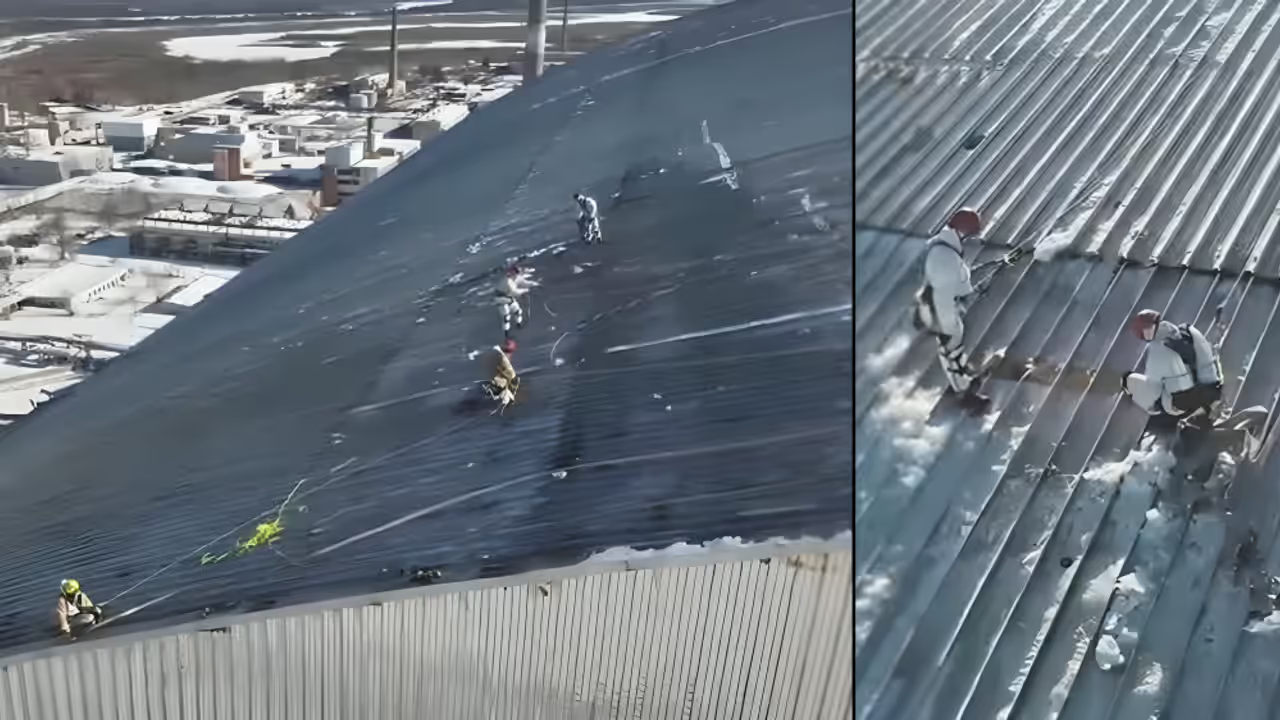
Chernobyl’s $2 billion protective dome has been badly damaged by a drone strike, raising fears of radioactive leaks. IAEA confirmed shelter has lost key safety functions and needs urgent repairs. Beneath it lie dangerous nuclear remains from 1986.
Fresh fears have been raised about nuclear safety at Chernobyl after experts confirmed serious damage to the huge protective dome covering the remains of the reactor that exploded in 1986. The shelter, built to stop radioactive material from escaping, has been hit during the ongoing war, leading to urgent calls for repairs, according to a report by Daily Mail.

The damage has sparked global concern because massive amounts of radioactive waste still lie beneath the structure, almost four decades after the world’s worst nuclear disaster.
What is the damaged structure at Chernobyl?
The damaged structure is officially called the New Safe Confinement (NSC). It is a giant steel dome built over Reactor 4, which exploded on 26 April 1986.
Related Articles

The NSC was completed in 2016 at a cost of more than $2 billion. It was designed to last for at least 100 years. Its main job is to trap radioactive dust and material, stop leaks, and allow workers to safely dismantle the destroyed reactor in the future.
The dome is one of the largest movable structures ever built and is critical to long-term nuclear safety at Chernobyl.
Drone strike caused the damage, says IAEA
The International Atomic Energy Agency (IAEA), the United Nations’ nuclear watchdog, confirmed this month that the NSC was badly damaged during a Russian drone strike in February.
IAEA experts carried out a safety inspection earlier this month. Their findings were worrying. They said the shelter has lost its main safety role, including its ability to fully confine radioactive material.
IAEA Director General Rafael Mariano Grossi said that while some temporary fixes have been made to the roof, these are not enough.
“Timely and comprehensive restoration remains essential to prevent further degradation and ensure long-term nuclear safety,” he said, according to Daily Mail.
Why the damage is dangerous
Although inspectors confirmed that the main structure of the dome is still standing, the damage has weakened its protective function.
Under the shelter lies radioactive debris from the 1986 explosion, including melted nuclear fuel and contaminated materials. If the dome fails further, radioactive dust could be released into the air.
Experts have warned that the site remains a serious long-term risk, especially during conflict, when maintenance and repairs become harder.
Call for urgent repairs and upgrades
The IAEA has called for urgent repair work at the site. It also recommended major upgrades to keep the reactor remains safe. These include:
- Better control of humidity inside the shelter
- Advanced systems to monitor corrosion
- High-tech automatic tools to manage radioactive materials
- The agency said these steps are vital to prevent further damage and reduce risks.
The damage to the dome is part of a wider problem. Since September last year, power substations near the site have been increasingly affected by the conflict.
Grossi stressed that these substations are essential for nuclear safety.
“They are absolutely indispensable for providing the electricity all nuclear power plants need for reactor cooling and other safety systems,” he said.
Without stable power, even basic monitoring becomes dangerous.
Repair plans set for 2026
With support from the European Bank for Reconstruction and Development (EBRD), further temporary repair work is planned for 2026. These repairs aim to restore the shelter’s ability to contain radioactive material. Full restoration will only be possible once the conflict ends.
The IAEA, which has a team permanently based at Chernobyl, said it will continue supporting all efforts to protect the site.
Remembering the 1986 disaster
The Chernobyl disaster began on 26 April 1986, when Reactor 4 exploded during a failed safety test. It caused the largest release of radioactive material in human history.
Around 30 to 50 people died in the first few months due to the blast and acute radiation sickness.
To protect lives, thousands of people were evacuated from nearby towns and villages. The area became known as the Chernobyl Exclusion Zone (CEZ).
Long-term death toll remains debated
The long-term impact of radiation exposure is still debated. The UN Chernobyl Forum estimated that up to 4,000 people may eventually die from radiation-related cancers among the most exposed groups.
However, some organisations, including Greenpeace, believe the true number could be much higher. Experts agree that measuring the full impact is extremely difficult.
A strange new world inside the exclusion zone
With humans gone, nature slowly returned to the CEZ. Wildlife has flourished in the absence of people, despite radiation levels that remain unsafe for humans.
Radiation in the zone is around 11.28 millirem, which is six times higher than what is allowed for human workers. Animals such as wolves, birds, and wild horses now roam freely through abandoned towns and forests.
Mutated dogs show signs of adaptation
One of the most surprising discoveries has been the stray dogs of Chernobyl. A study published in 2023 found that dogs living in the exclusion zone have developed genetic changes that help them survive radiation, pollution, and heavy metals.
Scientists studied 116 semi-feral dogs living near the nuclear plant and in Chernobyl city, about 10 miles away.
How scientists studied the dogs
The research was led by Norman J Kleiman, an environmental health scientist at Columbia University.
Blood samples were collected during sterilisation and vaccination programmes run by the Clean Futures Fund in 2018 and 2019. The samples were later analysed in the United States. Scientists found that the dogs form two genetically distinct groups, different from dogs outside the zone.
Researchers identified nearly 400 unusual genetic markers and 52 genes that may be linked to long-term exposure to contamination.
These changes suggest that the dogs have adapted over generations to survive in one of the most toxic environments on Earth.
“Somehow, two small populations of dogs managed to survive in that highly toxic environment,” Kleiman said.
The damage to the protective dome is a clear reminder that Chernobyl is not a closed chapter. Even after nearly 40 years, the site remains dangerous and needs constant care.
Experts warn that protecting Chernobyl is not just about the past, it is about preventing another disaster in the future.