- Home
- World
- Middle East Explodes: War Fears Grip Oil Markets, US Bases in Crosshairs, Refugee Crisis Warning
Middle East Explodes: War Fears Grip Oil Markets, US Bases in Crosshairs, Refugee Crisis Warning
West Asia tensions surge after strikes by United States and Israel on Iran trigger missile threats across Gulf states, raising fears of a wider war, attacks on US bases, and disruptions in the Strait of Hormuz that could shake global oil markets.
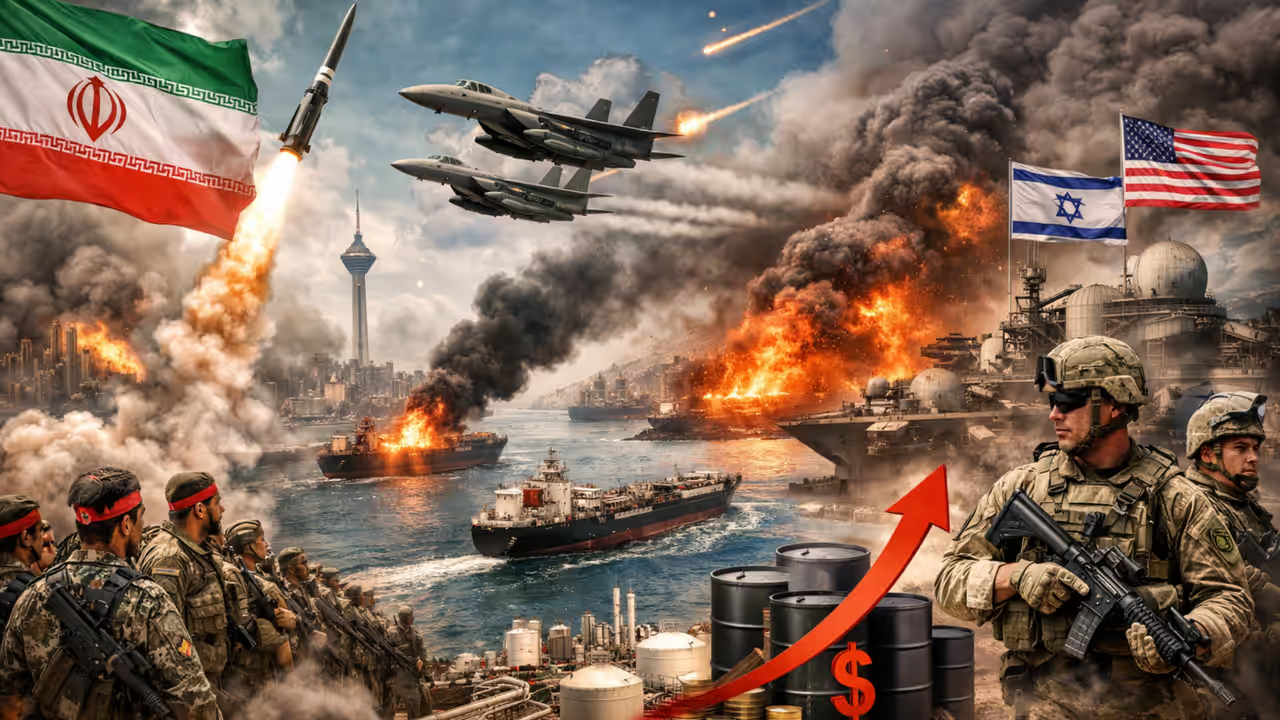
Middle East on the brink of war?
Tensions across West Asia are escalating rapidly after coordinated strikes by the United States and Israel on Iran on Saturday, with regional powers now bracing for a wider conflict that could reshape security, migration patterns and global energy markets.
The situation intensified further after Iran warned it would respond decisively, Israel reinforced its military nationwide, and Gulf states reported intercepting missiles — developments that underscore how quickly the confrontation is spreading across the region.


Iran vows decisive retaliation
Tehran has issued a strong warning following the strikes, signalling that a response is inevitable.
"The Armed Forces of the Islamic Republic of Iran will respond decisively to the aggressors," a foreign ministry said in a statement, insisting Iran had done "everything necessary to prevent war".
"Just as we were ready for negotiations, we are now more prepared than ever to defend the Iranian nation," it said.
The statement comes as tensions spike following the joint operation and amid fears that retaliation could target American forces, Israeli territory or regional allies hosting US bases.
Israel reinforces forces across all sectors
Soon after Iran’s warning, the Israeli military announced a major reinforcement of its forces.
"The Operations Directorate has begun a large-scale reinforcement of ground forces across all sectors and regional commands, as well as the reinforcement and deployment of special forces, as part of strengthening readiness for various offensive and defensive scenarios," the military said in a statement.
"In addition, significant reinforcements will be carried out in the Air Force and Navy, alongside the bolstering of all firepower arrays," it added.
The move signals that Israel is preparing for both immediate retaliation and the possibility of a prolonged confrontation.
Gulf states come under missile threat
The conflict appeared to widen further when Gulf countries reported incoming missile threats linked to the escalation.
The United Arab Emirates said it intercepted Iranian missiles and warned it could respond.
"The Ministry of Defence announced that the United Arab Emirates was subjected today to a blatant attack by Iranian ballistic missiles. The UAE's air defences responded with high efficiency and successfully intercepted a number of the missiles," it said in a statement.
Abu Dhabi said it "reserves its full right to respond" while condemning the strikes as "a dangerous escalation".
Meanwhile, Kuwait also confirmed defensive action. Kuwait's Chief of Staff said in a statement that "air defence systems engaged incoming missiles detected in the airspace".
Several explosions were also heard across Doha as Qatar's defence ministry said it had intercepted several missile attacks targeting the Gulf state. Blasts were heard over central Doha and near the Al-Udeid military base, the largest US military facility in the region.
A centre for the US Fifth Fleet headquarters in Bahrain has been hit in a "missile attack", Bahrain said. "The Fifth Fleet's service centre was subjected to a missile attack. We will provide you with details later," Bahrain's National Communication Centre said, in a statement.
Jordan's armed forces also shot down two ballistic missiles targeting the kingdom's territory, a military official said. "They were successfully intercepted by Jordanian air defence systems," the official said.
These developments highlight the growing risk that the confrontation could spread beyond Iran and Israel, drawing more regional actors into the conflict.
Also read: Iran-Israel Conflict: List of Countries Closing Airspace Amid Gulf Missile Intercepts
Neighbours fear a wider regional escalation
Even before the latest strikes and missile interceptions, countries surrounding Iran had warned that any attack could destabilise the entire region.
"If the United States strikes, Iran will retaliate and the crisis will spread throughout the region, with the Strait of Hormuz blocked and actions by its proxies," a diplomatic source from a country bordering Iran told AFP.
"The chaos in Iran would affect Turkey and the European Union, potentially leading to a massive influx of refugees," the source added.
For Gulf governments, the threat is not only military but also economic. Critical infrastructure — including energy facilities, desalination plants and power stations — could become targets.
In June 2025, Iran attacked the American Al-Udeid base in Qatar in response to US air strikes on Iranian nuclear facilities during the 12-day war triggered by an Israeli attack.
Earlier this year, Qatar, Saudi Arabia and Oman reportedly urged the administration of US President Donald Trump to delay potential military action amid fears of a regional fallout.
Analysts say Gulf states know how exposed they are.
"The Gulf states know they are vulnerable because the Iranians have enough basic, intermediate-range missiles to hit vital infrastructure -- desalination plants, hydrocarbon hubs, power stations," said Pierre Razoux, research director at the Mediterranean Foundation for Strategic Studies.
Risk of chaos inside Iran
Another major concern is what could happen if the strikes weaken or destabilise Iran internally.
Some intelligence officials warn that externally driven regime change could trigger a prolonged conflict inside the country.
"If there is to be regime change, it has to come from inside the country," a senior official in a European intelligence service said.
"If the Americans or the Israelis force regime change, they risk provoking the opposite effect," similar to what happened in Libya, the intelligence officer said.
The fall of longtime Libyan leader Muammar Gaddafi after a NATO-backed uprising led to years of instability — a scenario regional governments fear could unfold on a much larger scale in Iran.
A weakened Iranian state could also embolden militant groups operating across borders.
"With the previous Iranian protests, Turkey wanted Iran to remain intact... and worried that if something happened to the regime, the Kurdish groups would capitalise on that and create problems for Turkey," Gonul Tol of the Middle East Institute told AFP earlier.
Turkey fears "chaos on the borders, more refugees into Turkey... and the PKK-linked groups getting more active," Tol said.
Pakistan could face similar consequences.
"Pakistan in particular would be seriously affected if there is a spillover across its border," analyst and former diplomat Maleeha Lodhi said.
At the same time, Iran’s allies in the region — including the Houthis in Yemen and Hezbollah in Lebanon — could step in, potentially widening the conflict even further.
Could a new refugee crisis emerge?
Beyond military escalation, governments are increasingly worried about a humanitarian fallout.
Experts warn that instability inside Iran could trigger refugee flows comparable to those seen during Syria’s civil war.
"The cross-border shocks are likely to be an order of greater magnitude... given the size, population, heterogeneity of the country," said Sinan Ulgen, a visiting scholar at Carnegie Europe.
Countries such as Turkey, Azerbaijan and Armenia are seen as likely destinations for refugees.
For smaller states, analysts warn, such sudden population movements could "threaten the stability of the whole country easily."
Oil markets on edge as supply risks grow
One of the most immediate global consequences of the strikes could be felt in energy markets.
Iran remains among the world’s top oil producers and is part of OPEC. Today, the country produces about 3.1 million barrels per day — a sharp drop from its peak in the 1970s but still significant for global supply.
"In 1974, Iran was the third-biggest producer in the world after the US and Saudi Arabia, and ahead of Russia, producing some six million barrels per day," said Arne Lohmann Rasmussen, chief analyst at Global Risk Management.
Iran is also believed to hold the world’s third-largest crude reserves, reinforcing its strategic importance in global energy markets.
Its crude is particularly attractive because it is cheap to produce — with extraction costs estimated at around $10 per barrel. By comparison, producers in countries like the United States and Canada often face costs between $40 and $60 per barrel.
Iran exports between 1.3 and 1.5 million barrels of oil daily, with more than 80 percent of those shipments heading to refineries in China, often at discounted prices because of sanctions.
Analysts warn that the real danger for global markets lies not just in Iran’s own production but in the vulnerability of the Strait of Hormuz.
Around 20 million barrels of crude oil passed through the strait daily in 2024 — nearly one-fifth of global oil consumption.
"Even a doubt about security in the Strait would prompt many vessels, for insurance reasons, to face difficulties transiting, as premiums would rise sharply," Rasmussen said.
Only Saudi Arabia and the United Arab Emirates have limited infrastructure that can bypass the strait, with a maximum alternative capacity of around 2.6 million barrels per day — far below the volumes normally transported through the route.
If flows are disrupted, oil prices could surge sharply, raising inflation risks globally and affecting economies worldwide.
Why the Strait of Hormuz is so critical
The narrow waterway linking the Gulf to the Indian Ocean has long been central to global energy security.
About one-fifth of global oil and petroleum consumption — as well as roughly one-fifth of global liquefied natural gas trade — passes through it.
Its geography makes it particularly vulnerable: roughly 50 kilometres wide and relatively shallow, which means shipping routes can be easily disrupted during conflict.
Iran has repeatedly threatened to close the strait during periods of heightened tensions, though it has never fully done so.
History shows how dangerous the area can become during conflict. During the Iran-Iraq war in the 1980s, attacks on shipping in what became known as the "Tanker War" damaged or destroyed more than 500 vessels.
US bases in the firing line across the Middle East
Another major concern is the safety of American troops stationed across the region under US Central Command.
Tens of thousands of US military personnel are deployed across multiple bases — several of which could become targets if Iran retaliates.
In Bahrain, the Naval Support Activity base hosts the headquarters of the US Navy’s Fifth Fleet and US Naval Forces Central Command. The deep-water port can accommodate major vessels including aircraft carriers.
In Kuwait, the United States operates several installations, including Camp Arifjan, which serves as the forward headquarters for the US Army component of Central Command. Ali al-Salem Air Base hosts the 386th Air Expeditionary Wing, described by the US military as a key airlift hub for regional operations.
Qatar hosts Al Udeid Air Base — one of the largest US military facilities in the Middle East — which includes the forward components of Central Command along with major air operations units.
Iran previously fired missiles at Al Udeid following US strikes on Iranian nuclear facilities last year.
The United States also maintains forces in Iraq’s autonomous Kurdish region as part of the international coalition against the Islamic State group, though their mission is scheduled to end by September under an agreement with Baghdad.
In the United Arab Emirates, Al Dhafra Air Base hosts the US 380th Air Expeditionary Wing along with surveillance and drone operations.
Meanwhile, American forces in Syria are in the process of withdrawing, with sources indicating the exit could be completed within weeks.
Given the geographic spread of these bases and the latest missile activity in the Gulf, analysts warn that any escalation could quickly draw US forces deeper into the conflict.
Israeli operation marks a major escalation
Earlier, the Israeli military confirmed that the strikes on Iran involved extensive coordination with Washington.
"The strike (on Iran) targeted dozens of military targets and was carried out as part of a broad, coordinated, and joint operation against the regime," the Israeli army said.
"In the months preceding the strike, close and joint planning was conducted between the IDF and the US military, enabling the execution of the broad strike in full synchronisation and coordination between the two militaries," it added.
The operation — named "Roaring Lion" — aims to degrade Iran’s military capabilities and remove what Israel describes as long-term threats.
Missile barrages launched from Iran triggered air raid sirens and explosions over Jerusalem, though emergency services reported no confirmed impacts.
A region on the edge
With Iran promising retaliation, Israel reinforcing its military and Gulf states already responding to missile threats, the crisis is evolving quickly.
From direct military confrontation and proxy warfare to refugee flows and global energy shocks, the consequences of the US-Israel strikes on Iran could stretch far beyond the immediate battlefield — potentially reshaping the strategic and economic landscape of the Middle East and the wider world.
(With Inputs from AFP)
Check the Breaking News Today and Latest News from across India and around the world. Stay updated with the latest World News and global developments from politics to economy and current affairs. Get in-depth coverage of China News, Europe News, Pakistan News, and South Asia News, along with top headlines from the UK and US. Follow expert analysis, international trends, and breaking updates from around the globe. Download the Asianet News Official App from the Android Play Store and iPhone App Store for accurate and timely news updates anytime, anywhere.