
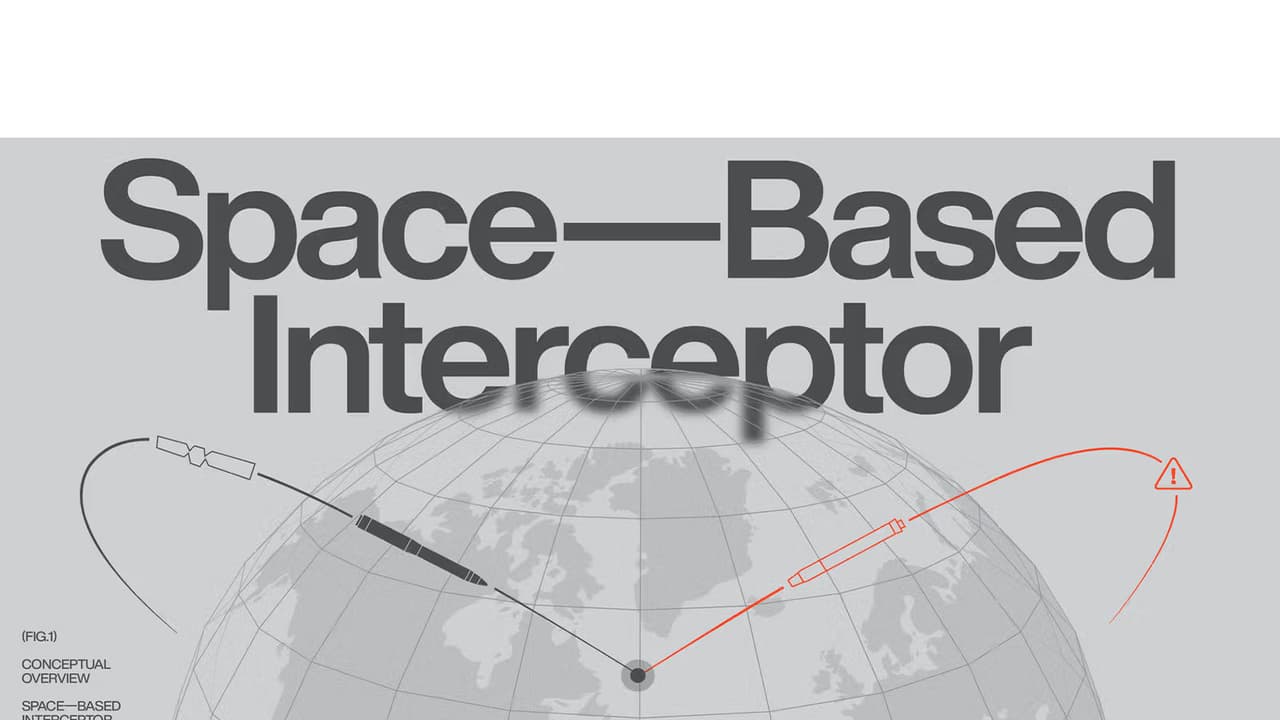
Defence tech firm Anduril Industries will lead industry partners to develop space-based interceptors for the US Space Force's "Golden Dome" missile defence initiative, aimed at countering rapidly evolving aerial threats like hypersonic weapons.
Defence technology company Anduril Industries said that it will lead a group of industry partners to develop space-based interceptors for the US Space Force under the "Golden Dome" missile defence initiative, aimed at countering rapidly evolving aerial threats.

In a statement on Tuesday, Anduril Industries, a defence company known for building advanced autonomous systems and defence technologies to support US and allied forces, said it is leading a consortium to develop, test, and deliver affordable, scalable solutions for the Space-Based Interceptor (SBI) programme.
Highlighting the growing threat landscape, the company noted that near-peer adversaries have significantly advanced their capabilities, including ballistic missiles, hypersonic weapons and advanced cruise missiles, enabling faster and more complex attacks on the US homeland.
Industry Collaboration for Next-Gen Defence
"As part of the Department of War's Golden Dome for America initiative, Anduril is leading a team of industry partners that is on contract to develop, test, and deliver affordable solutions to support the US Space Force's Space-Based Interceptor programme," the statement read.
The company added that it will combine its in-house capabilities with technologies from across the commercial space sector to deliver scalable solutions capable of countering next-generation missile threats.
As part of the collaboration, Anduril is integrating technologies from companies including Impulse Space, Inversion Space, K2 Space, Sandia National Laboratories and Voyager Technologies.
Eric Romo, President and COO of Impulse Space, said the programme demands advanced and rapid solutions. "Not only has our team proven its capability to do hard things quickly, but our spacecraft has too. We're excited to work on missions that are technically challenging and globally meaningful," he said, as quoted in the statement.
Justin Fiaschetti, co-founder and CEO of Inversion Space, said the partnership will accelerate next-generation defence capabilities designed for operational deployment at speed and scale. "As a team focused on advanced capabilities, we're building systems designed for speed, scale, and real operational use," he said.
Karan Kunjur, co-founder and CEO of K2 Space, said the company's satellite technologies will contribute to enhancing national security capabilities.
While Sandia National Laboratories highlighted its decades of experience in advanced weapons development. "We proudly bring our decades of experience in advanced weapons development to bear as we partner to create new systems," said Scott McEntire, Senior Manager for Hypersonics at Sandia National Labs.
Voyager Technologies also underscored the urgency of the programme, with its official stating that space-based interceptors are critical for addressing threats that allow little to no reaction time.
According to Anduril, the SBI programme reflects growing demand for integrated missile defence systems combining hardware and software to detect, track and neutralise threats effectively.
The company emphasised that the initiative aligns with its broader mission to rapidly deliver mission-ready systems to address emerging national security challenges, adding that work on the programme is already underway.
About the 'Golden Dome for America' Initiative
The "Golden Dome for America" initiative, originally introduced as the "Iron Dome for America", is a flagship programme of the second administration of US President Donald Trump aimed at building a comprehensive air and missile defence architecture.
The initiative was formally unveiled through an Executive Order signed on January 27, 2025, outlining plans to develop an integrated "system of systems" capable of defending the United States against a wide spectrum of aerial threats.
According to a US Department of War release issued in May 2025, the Golden Dome programme is designed to combine multiple defence capabilities into a unified network to protect the US homeland from attacks originating from any adversary.
During that time, Trump estimated the cost of the Golden Dome programme at around USD 175 billion. However, several independent observers have suggested that the total expenditure could be substantially higher, with some projections running into the trillions of dollars, especially if space-based interceptors are fully incorporated into the system.
The US Congressional Budget Office has separately assessed that even a limited space-based interceptor framework--designed to address relatively smaller-scale threats--could exceed USD 500 billion in cost.
The programme is expected to integrate advanced technologies across air and space domains, reflecting the evolving nature of modern missile threats and the need for a layered, responsive defence system. (ANI)
(Except for the headline, this story has not been edited by Asianet Newsable English staff and is published from a syndicated feed.)