
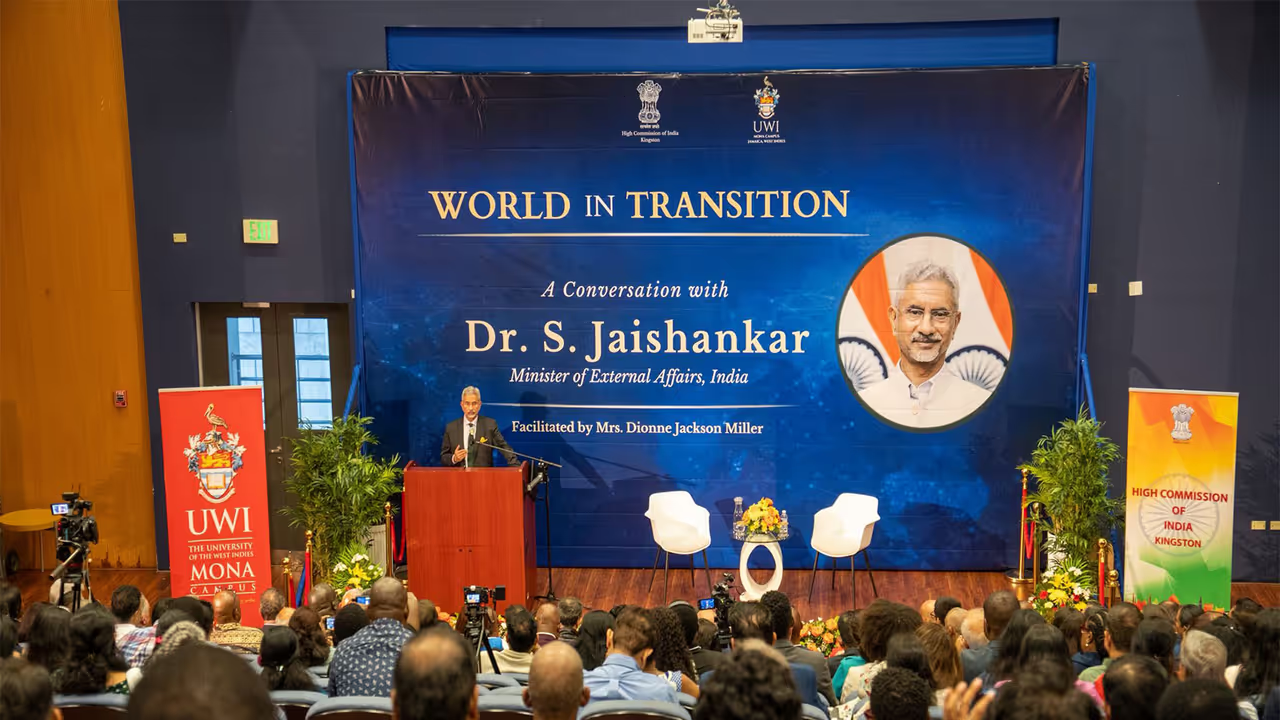
EAM S Jaishankar, speaking in Jamaica, described the current global order as a 'world in transition' marked by geopolitical instability, economic uncertainty, and shifting power dynamics, outlining India's response to these challenges.
'A World in Transition'
External Affairs Minister S Jaishankar outlined India's approach to a rapidly changing global order, describing the current phase as a "world in transition" marked by geopolitical instability, economic uncertainty and shifting power dynamics. Speaking at the University of the West Indies in Kingston, on Tuesday, as part of his three-nation visit to the Caribbean, on the theme "A World in Transition", Jaishankar said the international system is undergoing "extraordinary times", driven by ongoing conflicts, economic disruptions and technological change.

"We seem to be passing through extraordinary times," he said, pointing to multiple ongoing conflicts and global disruptions. He pointed to multiple global crises, including the prolonged war in Ukraine, tensions in West Asia, and conflicts in Africa, noting that such simultaneous flashpoints would have been difficult to foresee a few years ago.
"A few years ago, we would have all assumed that serious wars involving major powers were probably out of the question. If it happened, it would happen for a short while. So, when you think that there's a war going on in Ukraine, which is now in its fifth year, and you have today a conflict in Iran and the Gulf, which is shorter, hopefully will end sooner, but nevertheless, it's not something most of us would have foreseen just a little while ago," Jaishankar observed, underscoring the scale of current geopolitical tensions.
Economic and Technological Disruptions
He also highlighted disruptions in global supply chains, unpredictable trade conditions, and rapid advancements in technologies such as artificial intelligence and drones as key factors reshaping the global landscape. "If one looks at the economic side, there are very deep worries about supply chains, and then, you know, once you start obsessing about the supply side, then you start worrying about the demand side because market access becomes very unpredictable in an era where tariff rates become very difficult to predict. Then you look at the technology side and, you know, people worry about what the era of AI portends. In fact, not just AI, drones, space, and underwater. And, you know, the combination of all of this - and this is the dramatic side," the EAM said.
Jaishanak added that volatility and unpredictability have become defining features of the international system and further argued that the world is experiencing the accumulated impact of long-term changes in global power structures, production systems, and economic influence. He noted that existing global institutions have struggled to respond effectively to contemporary crises, reflecting growing strain in multilateral frameworks.
"We are actually today sitting on 80 years of pent-up change in the international system. 80 years where production centres have changed, consumption patterns have changed, and the relative weight of countries, societies, and regions vis-a-vis each other has changed," he said. "Every time in recent history that kind of pressure built up on the global system, either it would lead to a very major conflict, which is why we had two World Wars in a century within decades of each other, or you would have some other form of significant change in a disaggregated way because we tend to think of all these events in an isolated manner," the EAM added.
India's Constructive Response
Outlining India's response, Jaishankar said New Delhi is working to balance national interests with global responsibility while contributing actively to international stability and development. The minister also highlighted India's contributions during global crises, including the COVID-19 pandemic and recent climate-related disasters, citing assistance provided to vulnerable countries, particularly in India's neighbourhood and the Caribbean region.
He further pointed to emerging economic trends such as Global Capability Centres and India's expanding network of free trade agreements as part of its strategy to navigate a more fragmented global economy. On India's economic role, he highlighted its rising contribution to global growth and its expanding engagement with global markets and trade frameworks.
Strengthening the Global South
Jaishankar also emphasised India's efforts to strengthen the Global South, noting initiatives aimed at improving coordination among developing nations. He said India has worked to amplify collective voices through platforms such as the "Voice of the Global South", enabling developing countries to better engage in global decision-making.
"India has made a political contribution by organising regular meetings of what are called 'Voice of Global South' so that the countries of the Global South are able collectively to take a better position and set themselves up for better bargains and better outcomes in the international order," he said.
On global cooperation, he stressed that India seeks to demonstrate a constructive model of engagement in a fragmented world, adding that countries are increasingly prioritising self-interest. However, he underlined that India's approach seeks to bridge national priorities with broader global outcomes, stressing India's commitment to shared global progress.
"We are looking at a world where there is an instinctive desire to de-risk, a natural tendency to hedge, and where countries tend to look out for themselves in a somewhat extreme manner. And it's good to set out a different model, a different pattern of behaviour, to show that national interest and global good are not contradictory. That you can contribute to the world even while looking after yourself. And that is really the Indian reaction in a way to the world in transition," the EAM added.
The EAM is currently on a three-nation tour to Jamaica, Suriname and Trinidad and Tobago as part of his official visit to the Caribbean nations from May 2 to May 10. (ANI)
(Except for the headline, this story has not been edited by Asianet Newsable English staff and is published from a syndicated feed.)