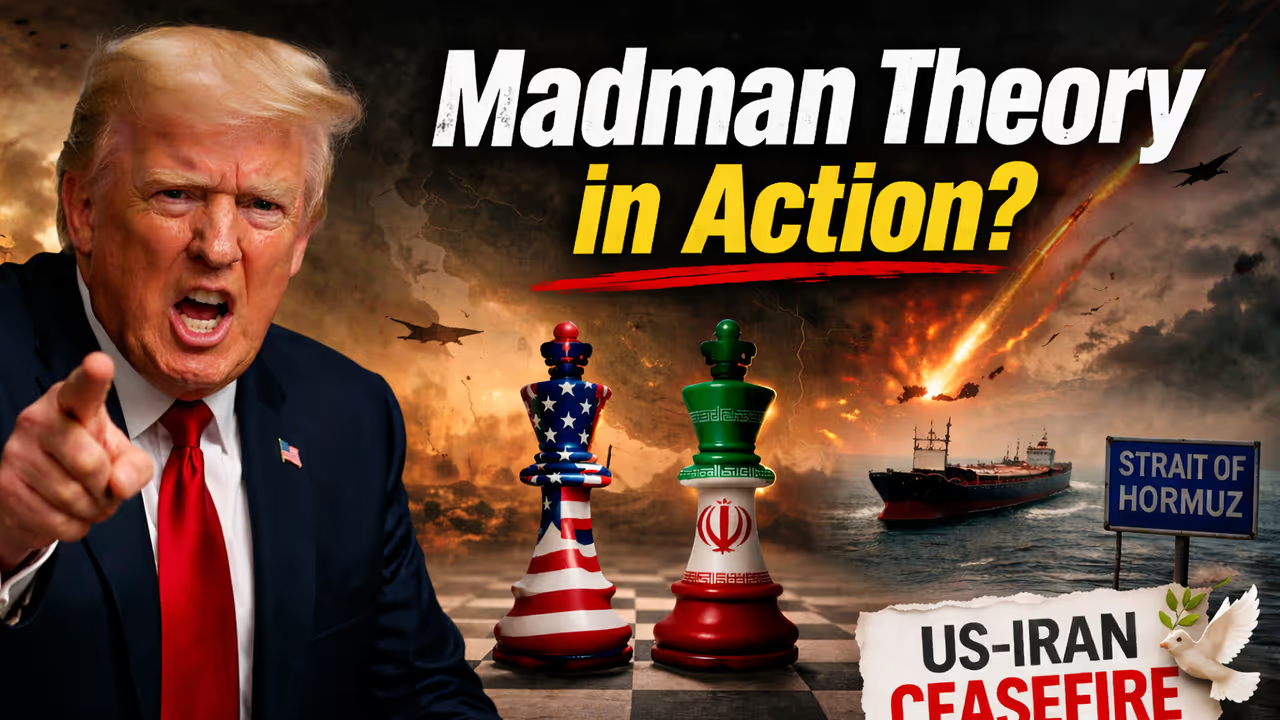
Did Trump’s shocking threats trigger the Iran ceasefire? A deep dive into the Madman Theory, its roots in Nixon-era strategy, and whether calculated chaos forced Tehran to step back.
In the final hours before a potentially catastrophic escalation, US President Donald Trump delivered a chilling warning: “The whole civilisation will die tonight.”

The statement, issued after Iran rejected ceasefire talks, wasn’t just another diplomatic threat—it sent shockwaves across the world. Within hours, however, the narrative flipped. A two-week ceasefire was suddenly on the table.
Was this chaos… calculated?
Related Articles

Also read: Trump’s Iran Ceasefire: Everyone’s Calm — Except Gold. Why?
What Is the Madman Theory?
At the heart of this moment lies a controversial geopolitical idea: the Madman Theory.
First articulated by Thomas Schelling and Daniel Ellsberg in The Strategy of Conflict, the theory suggests that a leader can gain leverage by appearing irrational, volatile—even dangerous.
The logic is simple, but unsettling: If your opponent believes you are capable of doing anything, including the unthinkable, they may back down to avoid triggering disaster.
The theory gained prominence during the Vietnam War, when Richard Nixon reportedly told his aide:
“I call it the Madman Theory, Bob. I want the North Vietnamese to believe that I've reached the point that I might do anything to stop the war.”
Nixon even attempted to signal nuclear readiness—less to act, more to intimidate.
Trump and the Performance of Chaos
Fast forward to 2026, and echoes of that strategy appear strikingly familiar.
Trump’s rhetoric in the Iran conflict has been anything but measured. From threatening to destroy infrastructure to issuing expletive-laden warnings, his language has often crossed into territory many consider reckless.
One post warned of attacks on Iran’s power plants and bridges if the Strait of Hormuz remained closed. Another hinted at devastation so vast it could invite accusations of war crimes.
To many observers, this wasn’t just diplomacy—it looked like instability.
But according to international law expert Al Gillespie, there may be method behind the madness.
Speaking to Radio New Zealand, Gillespie suggested: “Such actions would technically amount to war crimes, but he believed there was a deeper strategy at play.”
In other words, Trump might not be losing control—he might be performing it.
Did It Work? The Ceasefire Puzzle
Here’s where things get complicated.
Despite Iran initially rejecting negotiations, a ceasefire emerged at the last possible moment:
- The US agreed to suspend attacks for two weeks
- Iran agreed to reopen the Strait of Hormuz
- Talks are expected to follow, possibly mediated by Pakistan
Trump called it a “total and complete victory.”
The timing has fueled speculation: Did the fear of an unpredictable US president push Iran to step back?
For a brief moment, the world seemed to believe Trump might go further than anyone expected—even flirt with nuclear escalation. The White House had to clarify that nuclear weapons were “not on the menu.”
That perception—of a leader at the brink—may itself have been the leverage.
But There’s a Catch: The Theory’s Biggest Weakness
The Madman Theory has always had critics—and for good reason.
Its success depends on one critical assumption: That the opponent is rational enough to fear consequences.
Gillespie warns that this may not apply to Iran.
“The issue with Trump's use of the strategy in the case of Iran is that it relies upon a rational opposition.”
Post-1979, Iran’s political system—shaped by revolution and religious ideology—operates differently from traditional state actors. Decisions are not always driven by conventional cost-benefit calculations.
Gillespie adds: “In the case of either religious regimes or autocratic regimes, they often don't have that fear. And then there's the concern that they don't actually believe the person making the threat.”
In fact, he argues that Trump’s extreme rhetoric may have had the opposite effect:
“Iran feels emboldened by Mr. Trump's increasingly extreme rhetoric. I think they almost want it right now.”
A Strategy or a Gamble?
There’s another uncomfortable truth beneath the headlines: Trump may have needed the ceasefire more than Iran did.
His demands have shifted repeatedly—from “unconditional surrender” to more flexible negotiation terms. That inconsistency raises a key question:
Was the unpredictability strategic—or simply reactive?
Julie Norman captured this uncertainty perfectly:
“It is very hard to know what's coming from day to day, and that has always been Trump's approach.”
The Human Cost Behind the Strategy
Lost in the theory and strategy is the human reality.
The Strait of Hormuz—through which one-fifth of the world’s oil passes—had become a choke point affecting millions globally. Energy prices surged. Markets trembled. Entire regions braced for escalation.
Trump’s words—whether strategic or not—weren’t just signals to Iran. They were signals to the world.
And when a leader says “the whole civilisation will die tonight,” even as a tactic, the psychological impact is real.
So, Did the Madman Theory Succeed?
The answer isn’t clear-cut.
Yes, a ceasefire was achieved. Yes, Iran made concessions—at least temporarily.
But:
- The truce is only for two weeks
- Core disagreements remain unresolved
- Regional tensions, including in Lebanon, continue
If this was the Madman Theory in action, it may have delivered a short-term pause—but not a long-term solution.
Fear as a Tool of Diplomacy
The Madman Theory sits at the uncomfortable intersection of psychology and power. It weaponises uncertainty, turning fear into leverage.
In Trump’s case, the world is left wondering:
Was this a masterstroke of coercive diplomacy—or a dangerous gamble that nearly spiraled out of control?
Perhaps the most unsettling part is this: For the theory to work, no one—including allies—can be entirely sure which it is.