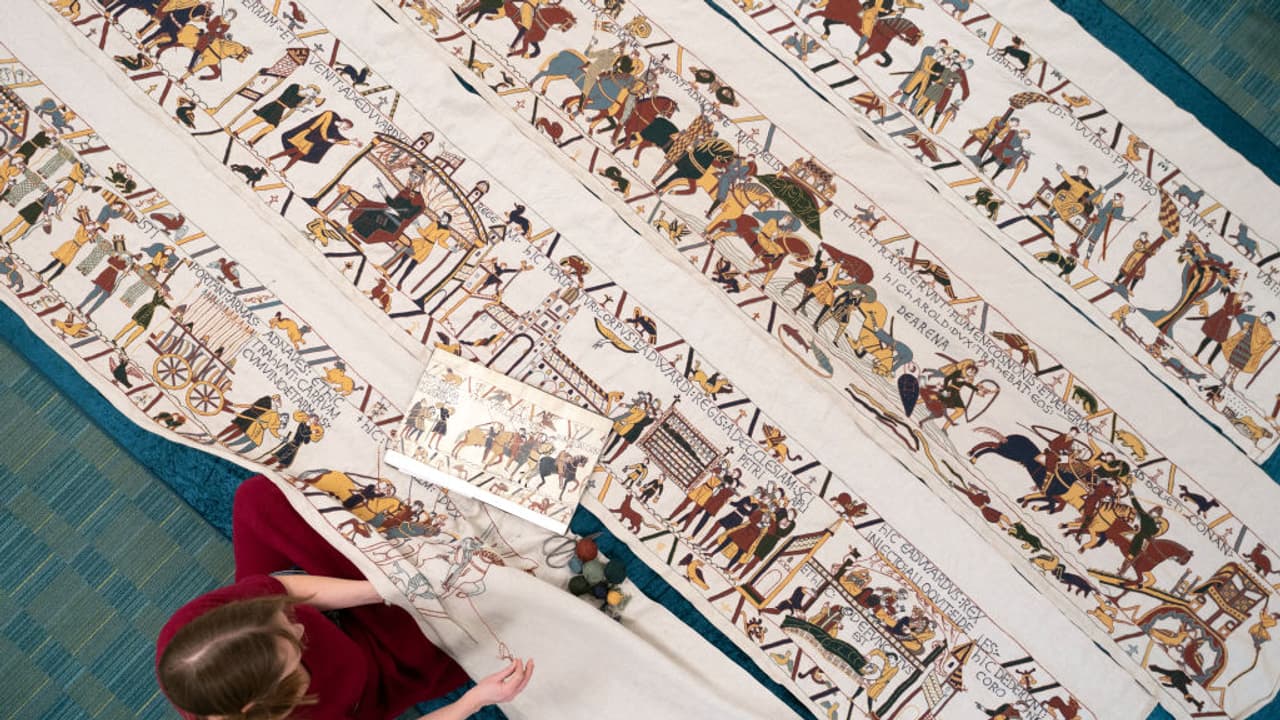
New research suggests Bayeux Tapestry may have been designed for a monastery dining hall. A professor argues it could have hung in refectory of St Augustine's Abbey. The idea helps explain long-standing questions about Tapestry's purpose and audience
The Bayeux Tapestry is a famous embroidered cloth from the 11th century. It tells the story of the events that led to the Norman Conquest of England. Nearly 70 metres long, it shows the struggle for the English throne between William, Duke of Normandy, and King Harold II. The story ends with the Battle of Hastings in 1066.

A new study by a British historian has offered an interesting new idea about one of history's greatest mysteries, the original purpose of the Bayeux Tapestry. The research suggests that the famous medieval artwork may have been created to hang in a monastery dining hall, where monks would look at it while eating their meals.
The study was carried out by Professor Benjamin Pohl from the University of Bristol. His paper was published this week in the academic journal Historical Research.
Related Articles

What is the Bayeux Tapestry?
The Bayeux Tapestry is one of the most famous works of medieval art in the world. It is not a tapestry in the usual sense, but a long piece of embroidered cloth. It is about 68 metres long and weighs around 350 kilograms.
The embroidery tells the story of the events that led to the Battle of Hastings in 1066. This was the battle in which William, Duke of Normandy, invaded England and defeated King Harold II, becoming King William I of England.
The Tapestry shows battles, ships, kings, soldiers and everyday life in the 11th century.
A mystery that has lasted centuries
Although the Bayeux Tapestry has been studied for hundreds of years, many basic questions remain unanswered. Historians still do not know exactly where it was first displayed. There are also questions about who it was made for, who was meant to look at it, and what message it was meant to send.
The first written record of the Tapestry only appears in 1476, when it was listed in an inventory at Bayeux Cathedral in France. Before that date, there are no clear records showing where it was kept or even if people knew it existed.
A new idea: a monastery dining hall
Professor Pohl's research focuses on where the Tapestry may have been designed to be shown. He suggests that the most suitable place may have been the refectory, or dining hall, of St Augustine’s Abbey in Canterbury.
A refectory was where monks ate together in silence while listening to readings. Visual stories on walls could support these readings and help monks reflect on moral lessons and history.
Professor Pohl believes the Tapestry’s long shape and detailed scenes would have worked well in such a space.
Why St Augustine's Abbey?
Many historians already agree that the Bayeux Tapestry was likely designed at St Augustine's Abbey in the 1080s. At that time, the abbey was led by Abbot Scolland, a Norman monk who had come from Mont Saint-Michel in Normandy.
There is also strong agreement that Odo, Bishop of Bayeux and half-brother of William the Conqueror, was involved in some way. However, experts still debate how direct his role was.
St Augustine's Abbey was an important religious centre and had the skills and resources needed to produce such a complex work.
Students helped shape the theory
Professor Pohl said the idea developed during a seminar with his students. Together, they studied the Bayeux Tapestry and discussed different theories about where it may have been displayed.
They looked at many large rooms inside a monastery, such as the church, dormitory, chapter house and refectory. The refectory stood out as a place where people would have time to look closely at the scenes and think about their meaning.
Solving old contradictions
One reason Professor Pohl supports the refectory theory is that it helps answer long-standing questions. Scholars have often argued about whether the Tapestry was meant for a religious or secular audience. Others have questioned whether viewers needed to be able to read Latin to understand it.
There has also been debate about whether the story supports the English, the Normans, or neither side. Professor Pohl argues that all these questions make sense if the audience was a group of educated monks.
No proof, but strong reasoning
Professor Pohl is clear that there is no physical proof that the Bayeux Tapestry was ever displayed at St Augustine’s Abbey. He suggests one possible reason for this lack of evidence.
The abbey’s new refectory may not have been finished until the 1120s, even though the Tapestry was likely made in the 1080s. This could mean the Tapestry was put into storage for many years and later forgotten, according to Daily Mail.
It may only have reappeared centuries later, eventually ending up in Bayeux.
Why mealtimes mattered in the Middle Ages
In the Middle Ages, mealtimes were important social moments. They were times for shared identity, learning and reflection. Professor Pohl believes the Bayeux Tapestry would have fit perfectly into this setting.
The monks could view the scenes while thinking about history, power, loyalty and faith.
Returning to Britain after 1,000 years
Next year, the Bayeux Tapestry will go on display at the British Museum. This will be the first time it has been shown in the UK since it was made nearly 1,000 years ago.
The exhibition is expected to attract huge public interest. Professor Pohl’s research adds fresh meaning to how modern audiences may understand the Tapestry.
A mystery that still invites debate
There is still no final answer to where the Bayeux Tapestry was first displayed. Professor Pohl accepts that the mystery may never be fully solved.
However, his research offers a thoughtful, new idea and reminds us that even famous historical objects can still surprise us.