
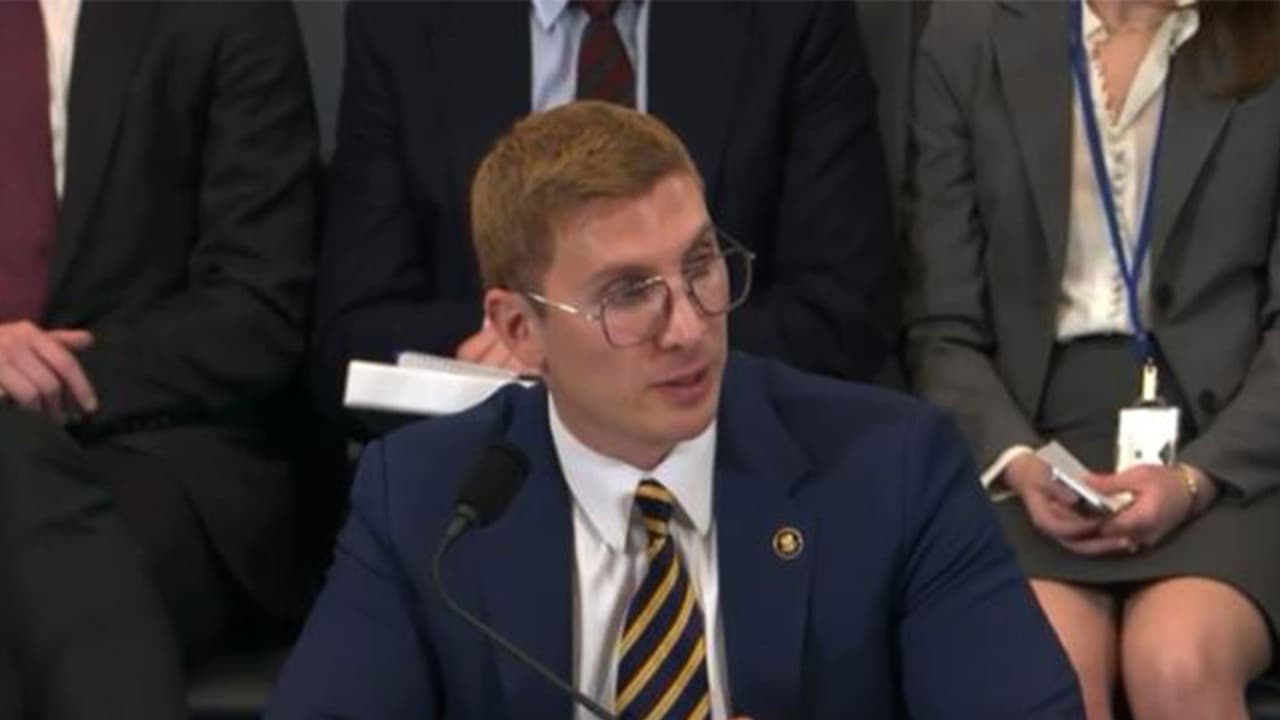
US Under Secretary Jacob Helberg reaffirmed the $500 billion US-India trade goal set by PM Modi and President Trump, expressing confidence in the trade relationship despite challenges from secondary sanctions on Russia affecting Indian interests.
US Official Confident in $500 Billion Trade Trajectory
US Under Secretary of State for Economic Affairs, Jacob Helberg, on Tuesday (local time) said that Prime Minister Modi and US President Donald Trump set a goal to increase trade between the US and India to 500 billion dollars. During the congressional hearing, Helberg expressed strong confidence in the future of US-India trade. He also outlined the administration's "maximum pressure" policy on Russia aimed at ending the war in Ukraine.

"The administration has instated a policy of maximum pressure on Russia. The goal of the administration is very much to bring about an end to the war in Ukraine. That included the instatment of secondary sanctions which had the effect of affecting a number of different Indian interests. Ultimately, the reaching of the bilateral joint statement on trade between the US and India has brought about positive resolutions and discussions," Helberg said.
"The content of the bilateral statement on trade include historic purchases by India from the US on energy, historic cross-border investment and I believe it was in the first quarter of the President's administration, PM Modi and President Trump set a goal of increasing overall bilateral trade flows to 500 billion dollars. So, I am incredibly confident in the trajectory of the US-India relationship...Our new ambassador there (in India) is doing an unbelievable job," he said.
Framework for Interim Trade Agreement Reached
This comes after the United States and India announced that they have reached a framework for an Interim Agreement regarding reciprocal and mutually beneficial trade. The framework reaffirmed the countries' commitment to the broader US-India Bilateral Trade Agreement (BTA) negotiations, launched by President Donald Trump and Prime Minister Narendra Modi on February 13, 2025, which will include additional market access commitments and support more resilient supply chains.
The Interim Agreement includes India eliminating or reducing tariffs on various US industrial goods, food, and agricultural products, while the US applies a reciprocal 18 per cent tariff on certain Indian-origin goods under an existing executive order, with provisions for removals upon successful conclusion of the agreement.
Trump Imposes New Tariffs After Supreme Court Ruling
Meanwhile, the US Supreme Court on Friday ruled against most of Trump's sweeping tariff measures. Trump later signed an order making 10 per cent global tariff on all countries, effective "almost immediately". The Court ruled 6-3 that the administration exceeded its authority by using the International Emergency Economic Powers Act (IEEPA) of 1977 to impose broad-based import tariffs, affirming that the power to levy taxes resides primarily with Congress.
Following the ruling, Trump announced a new 10 per cent global tariff on all countries under Section 122 of the Trade Act of 1974, describing it as a temporary import surcharge (up to 15%) allowed for 150 days to address balance-of-payments deficits. He later raised it further to the "fully allowed, and legally tested, 15% level," effective immediately.
In a Truth Social post, Trump stated that this adjustment responds to the Supreme Court's "ridiculous, poorly written, and extraordinarily anti-American decision," while his administration would determine new, legally permissible tariffs in the coming months to continue "Making America Great Again." (ANI)
(Except for the headline, this story has not been edited by Asianet Newsable English staff and is published from a syndicated feed.)