
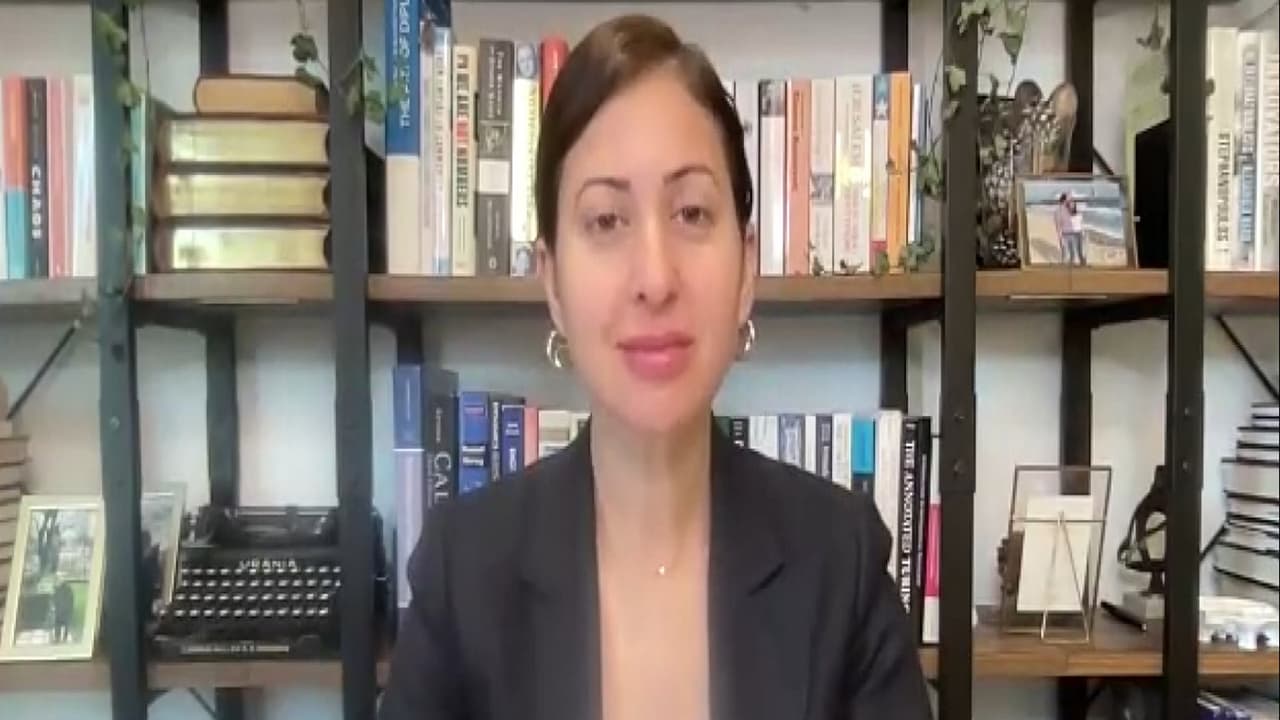
Ex-Pentagon advisor Jasmine El-Gamal says JD Vance's involvement in West Asia talks signals a new US approach. She predicts US and Israeli interests will diverge, as the US opposes Israel's preference for weak neighbors in the region.
Jasmine El-Gamal, Former Pentagon Middle East advisor and CEO of Averos Strategies said on Thursday that with the involvement of US Vice President JD Vance in the negotiations for the West Asia conflict, there will be a different approach than previous mediators. Gamal, in a conversation with ANI, said that there will come a point in this war when US interests and Israeli interests begin to diverge.

Diverging US and Israeli Interests
"And one thing I'll say is the fact that it's potentially JD Vance, the vice president, that's going into these talks in Pakistan on Friday could mean that there's a bit of a different approach from the previous mediators, Steve Witkoff and Jared Kushner, who have been involved in negotiations in the past," she said. Gamal said that the things that Israel wants out of the region are not the things that the US necessarily wants out of the region.
"There will come a point in this war when US interests and Israeli interests begin to diverge. From the beginning, those interests may have been overlapping in some ways, but were not exactly 100% overlapping. The things that Israel wants out of the region are not the things that the US necessarily wants out of the region," she said.
Gamal said that Israel wants to be the most powerful in the Middle East, but the US doesn't concur with this view. "Just as an example, this Israeli government would prefer, as they have stated themselves, for the countries in the region around them to be weak. They've said that about Syria, they've said that about Lebanon, and certainly Iran. And so that is not in the interest of the United States. A weak and fragile Middle East is more prone to instability. It's more prone to non-state actor and terrorist activity, and extremism. So these are not things that are good for the US or its allies," she said.
Pressure on Israel and Iran Strategy
Gamal said that one has to wait and watch id the US puts pressure on Israeli Prime Minister Benjamin Netanyahu for ceasefire in Lebanon. "So you've hit the nail on the head really with this question, which is what happens with Israel now that the U.S. and Iran are going to be engaging in these talks? Already Israel said that the ceasefire doesn't apply to Lebanon. So we'll have to wait and see what kind of pressure the US puts on Prime Minister Netanyahu to stop the attacks on Lebanon. He may or may not listen. So that's one thing we'll watch out for," she said.
"And also just in terms of long-term strategy, whether Israel will continue to seek regime change in Iran, which is Prime Minister Netanyahu's stated goal, or whether it will fall in line with the US and accept an Iranian regime that stays in place but tries to limit its activities and attacks against Israel," she added.
Gulf Countries' Concerns
Gamal said that the gulf countries were against the war, because they were aware about the consequences. "The Gulf countries really suffered greatly from this war between Israel, Iran, and the US. First of all, they did not want this war. They were trying desperately to get President Trump not to go to war with Iran, precisely because they were worried about the consequences. But I think even they did not expect Iran to go as far as it did in terms of hitting critical energy infrastructure and civilian infrastructure in the Gulf. It has broken, I don't want to say bonds of trust because there was never really trust between Iran and the Gulf countries," she said.
Gamal said that there was a kind of understanding that collective security in the region was in the interest of all parties in the Gulf before the war. But now, the situation has changed for Iran. "But there was at least an understanding. There was a detente between Saudi Arabia and Iran brokered by the Chinese. There were trade agreements and cooperation between the UAE and Iran, for example, maritime agreements. So there was a kind of understanding that collective security in the region was in the interest of all parties. And they feel that Iran has completely broken that pact and attacked them in a way that is simply unacceptable for them. And that will be very hard for Iran to recover from," she said.
Seeking Security Guarantees
Now there are reports of Gulf countries asking the US to guarantee their security. "So that's why you see reports of Gulf countries asking the US to make sure, even though again, they did not want this war, to make sure that at least if the war ends, please make sure that it ends in a way where Iran is not essentially holding us hostage in this region. That it's not able to close the Strait of Hormuz at a whim, that it's not able to attack the Gulf, or that at least it knows there will be a higher cost imposed on it for attacking Gulf countries in the future, and so on," she said.
Gamal said that now the gulf countries will be very invested in peace talks. "And so that's what the Gulf countries are going to be looking for. They're going to be in contact with the US mediators and other mediators--Egypt, Pakistan, Turkey, Oman--to make sure that the final arrangement, if there is a final arrangement, because remember, none of this is guaranteed, that it includes guarantees of future Gulf security baked into that final agreement," she said.
US Stance on Strait of Hormuz
Earlier on Wednesday, US White House Press Secretary also emphasised on the need for an open Strait of Hormuz. "We have seen an uptick of traffic in the Strait today, and I will reiterate the President's expectation and demand that the Strait of Hormuz is reopened immediately, quickly, and safely," she said during her press briefing. (ANI)
(Except for the headline, this story has not been edited by Asianet Newsable English staff and is published from a syndicated feed.)