
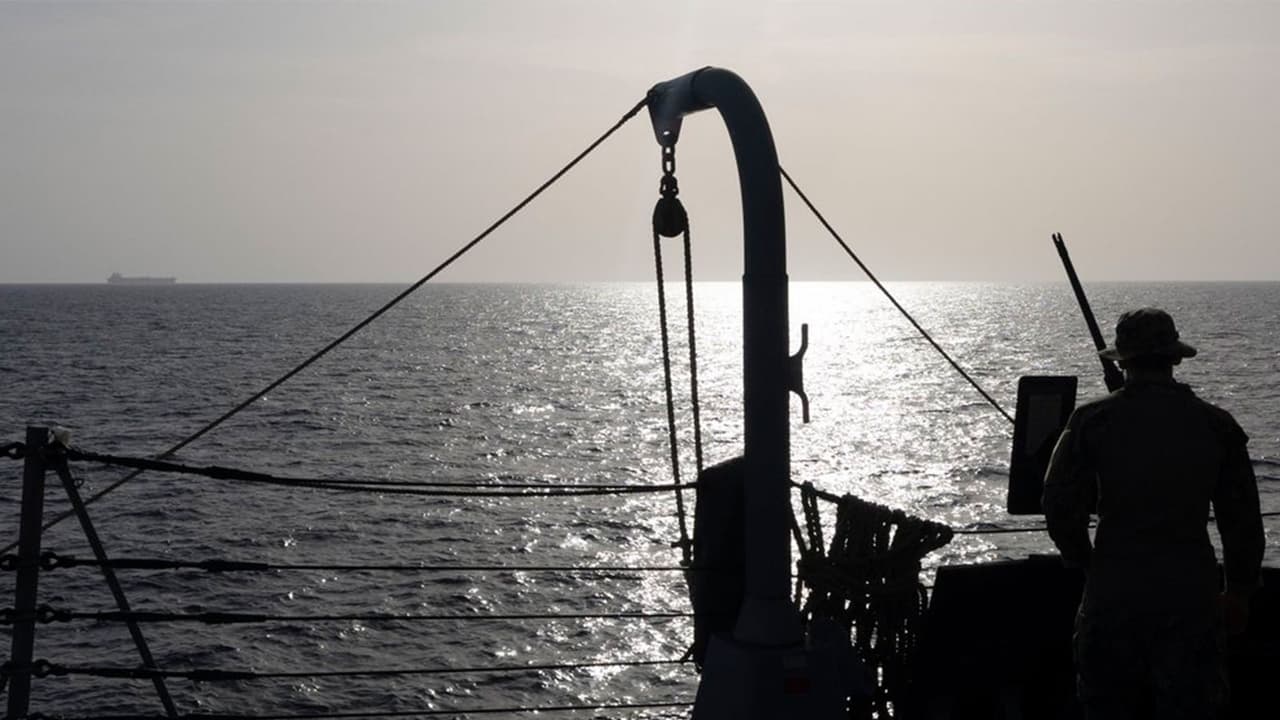
US CENTCOM is enforcing a maritime blockade on Iran, turning away 38 ships. In response to the pressure and stalled peace talks, Iran's Foreign Minister has flown to Russia for high-level meetings, while a new proposal aims to end the crisis.
US Enforces Strict Maritime Blockade
The United States Central Command (CENTCOM) has announced that American forces are maintaining a strict maritime restrictive operation in the region, continuing to enforce a blockade against Iranian ports. According to official statements, these forces are actively preventing ships from entering or exiting Iranian waters as part of a sustained effort to monitor and control movement into strategic coastal hubs. The enforcement comes as the military closely monitors maritime traffic to ensure compliance with the ongoing restrictions. Highlighting the scale of the operation, a post on X confirmed that "American forces have directed 38 ships to turn around or return to port." A U.S. Sailor watches a commercial ship as U.S. forces continue to enforce a blockade against Iranian ports, preventing ships from entering or exiting. American forces have directed 38 ships to turn around, or return to port. pic.twitter.com/Trtc41NZyp — U.S. Central Command (@CENTCOM) April 27, 2026

Tehran Engages Russia as US Diplomatic Efforts Stall
Against the backdrop of this intense maritime squeeze and a persistent deadlock in Tehran-Washington peace negotiations, Iranian Foreign Minister Abbas Araghchi arrived in Russia on Monday for a high-level meeting with President Vladimir Putin. This visit to Moscow marks a significant intensification of Iran's diplomatic outreach, following Araghchi's recent high-stakes consultations in Islamabad and Muscat. The diplomatic push in the Russian capital is expected to deepen, as the Foreign Minister is also set to meet with his Russian counterpart, Sergey Lavrov.
These discussions come at a critical juncture, particularly after US President Donald Trump's decision on Saturday to cancel a scheduled visit to Islamabad by his envoys Steve Witkoff and Jared Kushner. The cancellation appeared to stall direct mediation efforts at a time when regional tensions are at a peak. Despite this diplomatic setback, communications between the two adversaries appear to remain active through back-channels. According to the Fars news agency, Tehran has transmitted "written messages" to the Americans via Pakistan. These communications reportedly define specific red lines regarding Iran's nuclear programme and the strategic situation in the Strait of Hormuz.
Hormuz Closure Sparks Global Economic Fears
The urgency of these exchanges is underscored by the broader regional instability and its severe global fallout. While the ceasefire involving the United States, Israel, and Iran has generally remained intact, Iran's decision to shut the Strait of Hormuz has crippled the global movement of oil, gas, and fertiliser. This disruption has led to a surge in prices and escalating fears of food insecurity in developing countries.
New Peace Proposal Emerges Despite Setbacks
Initial hopes for a second round of negotiations in Pakistan were closely linked to the proposed visit by Witkoff and Kushner. However, those prospects were dampened when President Trump abruptly cancelled the mission, dismissing the potential for progress by describing the process as "sitting around talking about nothing."
Nevertheless, following the cancellation of the high-profile Islamabad talks last week, "fresh signs" of diplomatic movement have surfaced. According to a report by Axios, which cited a US official, Tehran has reportedly provided Washington with a "new proposal" aimed at the dual objectives to "reopen the Strait of Hormuz and end the war." As part of this diplomatic framework, Iran has also suggested a move to "postpone nuclear negotiations" until a subsequent phase of the peace process, offering a potential pathway to de-escalate the maritime and economic crisis. (ANI)
(Except for the headline, this story has not been edited by Asianet Newsable English staff and is published from a syndicated feed.)