The UN Security Council sanctions committee on North Korea is to give exemptions for humanitarian aid projects in the impoverished country, diplomatic sources in Seoul told AFP on Friday.
The UN Security Council sanctions committee on North Korea is to give exemptions for humanitarian aid projects in the impoverished country, diplomatic sources in Seoul told AFP on Friday. The nuclear-armed country is under multiple sets of UN sanctions over its weapons programmes and has long struggled with its moribund state-managed economy and chronic food shortages.

The 17 humanitarian assistance projects are all being implemented by major international organisations such as UNICEF, or by NGOs from South Korea and the United States, the sources said.
Humanitarian assistance to the nuclear-armed state can only proceed with approval from a UN sanctions committee, on which Washington has for months blocked clearances.
Related Articles

Analysts say the move would allow those groups to provide humanitarian aid, such as nutritional supplements, medical equipment and water purification systems, to North Korea.
The North has long been criticised for prioritising the military over adequately providing for its people.
Elizabeth Salmon, the UN special rapporteur on human rights in North Korea, said on Friday that food shortages remain a key humanitarian concern in the country.
A foreign ministry official said Seoul has made "various efforts" to ensure that humanitarian aid reaches the North, regardless of politics.
"We hope that North Korea will respond positively to our government's efforts for peaceful coexistence on the Korean Peninsula," the official said.
The sources spoke hours after a senior South Korean official said "new progress" on North Korea could come within days.
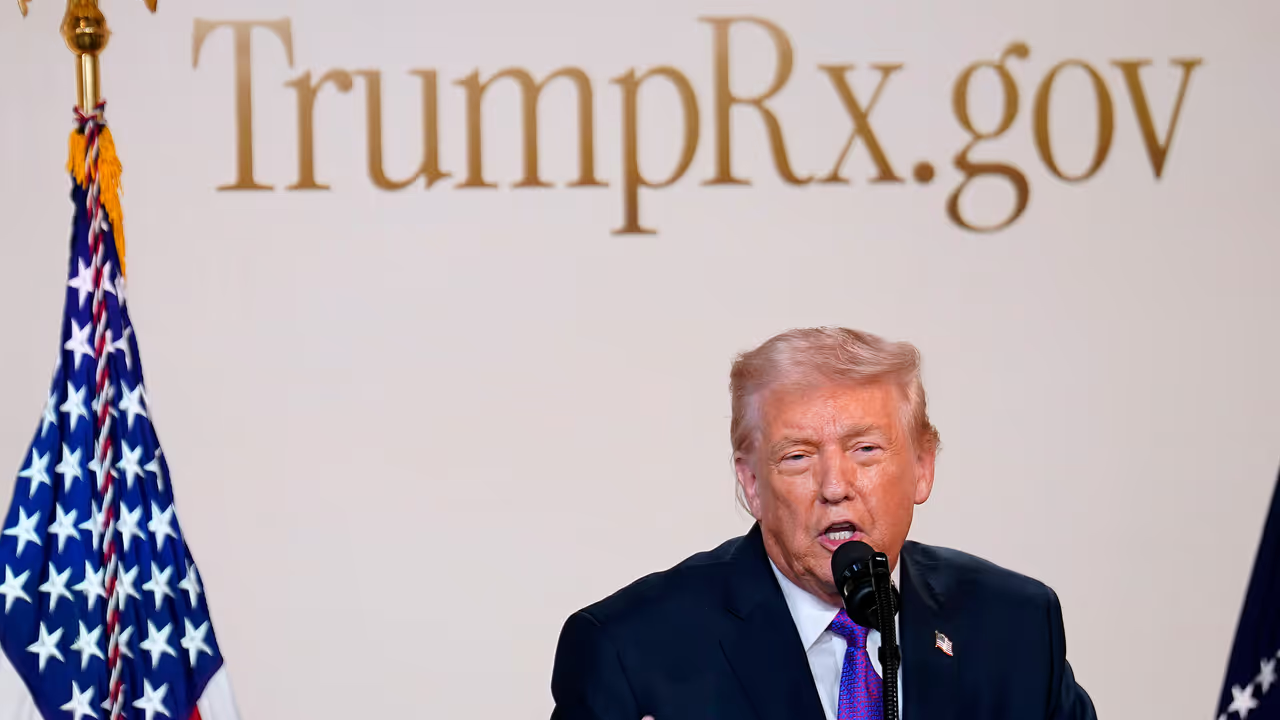
The foreign ministry official's comments came while discussing US President Donald Trump's scheduled trip to China in April.
Reports have suggested both Seoul and Washington are keen to use Trump's upcoming China trip as an opportunity to restart dialogue with Pyongyang.
The US leader made repeated overtures to Pyongyang's leader Kim Jong Un during a tour of Asia last year, saying he was "100 percent" open to a meeting.
"Trump stands to gain politically from meeting Kim — even without concrete results, the optics alone, including photo opportunities with Kim in North Korea, would carry value," Lim Eul-chul, a professor at the Institute for Far Eastern Studies at Kyungnam University, told AFP.
He even bucked decades of US policy by conceding that North Korea was "sort of a nuclear power".
North Korea did not respond to Trump's offer, and has repeatedly said it will never give up its nuclear weapons.
Landmark congress
Trump met North Korea's Kim three times during his first term, once declaring that they were "in love", in an effort to reach a denuclearisation deal.
However, a planned summit in Hanoi in 2019 fell through over differences about what Pyongyang would get in return for giving up its nuclear weapons, and no progress has been made between the two countries since then.
Seoul and Washington reaffirmed their commitment this week to North Korea's "complete denuclearisation" and cooperation on Seoul's nuclear-powered submarine plan, a move that has previously drawn an angry response from the North.
Pyongyang has also drawn much closer to Moscow, with its deployment of troops to aid Russia's war against Ukraine.
It has sent thousands of troops to fight for Moscow and analysts say Russia is giving North Korea military technology, food and energy supplies in return, allowing it to sidestep tough international sanctions.
North Korea is set to hold a landmark congress of its ruling party soon, its first in five years.
Kim ordered the "expansion" and modernisation of the North's missile production ahead of the gathering.
(Except for the headline, this story has not been edited by Asianet Newsable English staff and is published from a syndicated feed)