
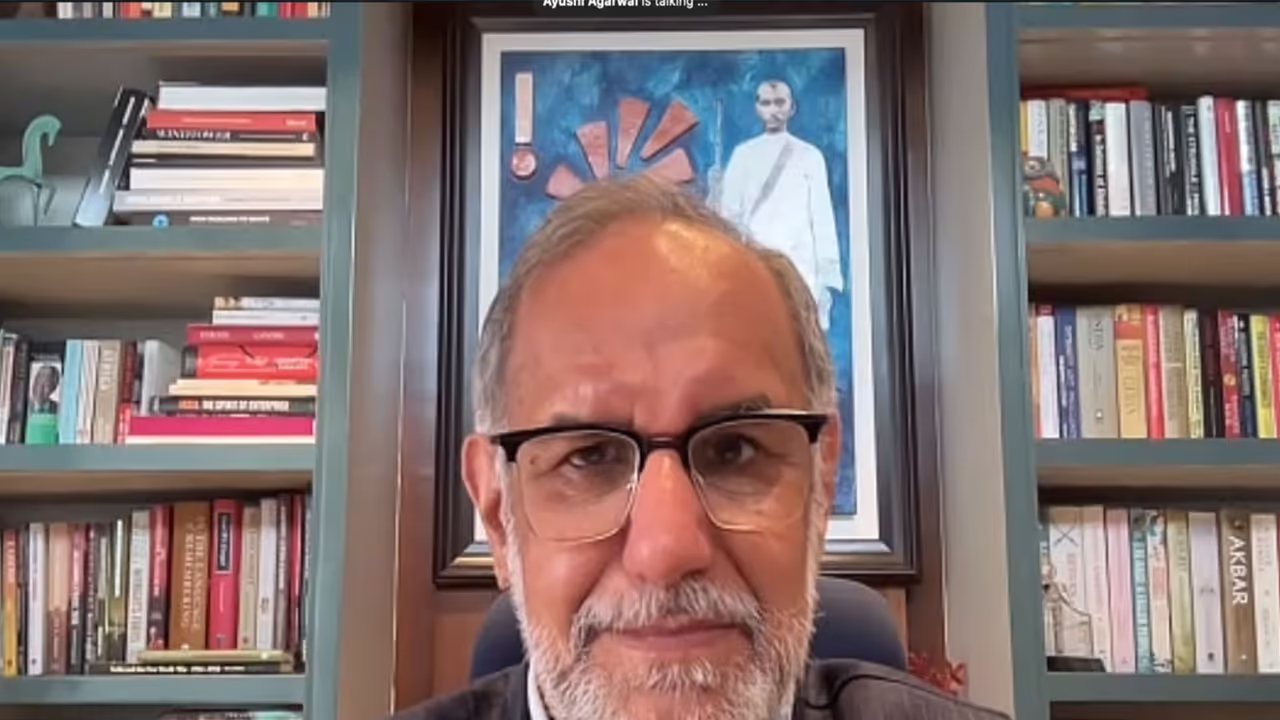
The UAE's exit from OPEC is unsurprising, stemming from 2021 disputes over production quotas, says ex-envoy Navdeep Suri. The move aims for strategic autonomy and will help fund its non-oil economy, potentially benefiting India.
Navdeep Singh Suri, Former Indian Ambassador to United Arab Emirates said that the UAE's exit from the OPEC is hardly surprising. Suri, in a conversation with ANI, said that the unhappiness was from 2021, when their quota was pegged at 2.7 million barrels a day when their capacity to produce was much higher.

"I think it is a very significant development. I must say that it hasn't really come as too much of a surprise because for those of us who have been watching the region, the signs had been there at least since 2021. The UAE was not happy when OPEC was cutting quotas. At that time, their quota was pegged at 2.7 million barrels a day when their capacity to produce was much higher. So, even as far back as July 2021, the UAE was indicating to Saudi Arabia and others that it was not happy with the state of affairs," he said.
Aiming for Strategic Autonomy
Suri said that the exit would help them be nimbler with their outputs. "Now they have finally executed their decision to part ways with OPEC. They joined in 1967, even before the union of the UAE emerged. I think they are aiming for a much greater degree of strategic autonomy and flexibility regarding how much they produce, perhaps to be much nimbler in changing output according to market requirements," he said.
He further said that the UAE wishes to capitalize in non-oil sector like AI, semiconductors, etc. "The timing of announcing it on the day of the GCC summit in Riyadh may have been tactical, but the decision itself is something the UAE has been mulling over for quite a period. They see that right now there is a considerable and looming shortage of oil. Once the Strait of Hormuz reopens, as and when it happens, there will be a need to ramp up production. The UAE's long-term strategy is that they have the capacity to produce more. They are a low-cost producer and they want to monetize that resource to fund their very ambitious plans to create a non-oil economy--diversifying into AI, data centers, free zones, and trade," he said.
Geopolitical Frustrations
Suri further said that during the US-Iran war, not many GCC countries stood with the UAE, which upset it. "The UAE has been targeted by almost 3,000 missiles, projectiles, rockets, and drones--probably more than the rest of the GCC countries put together and certainly much more than Israel itself. There is a degree of anger in the UAE over being targeted, as well as anger that its GCC neighbors and Arab allies haven't really stood up to be counted in condemning the Iranian attacks or giving meaningful support. Dr. Anwar Gargash, the diplomatic advisor to the president, has said on more than a couple of occasions that this is a time when the UAE is seeing who is the friend who stands by them and who is the bystander," he said.
How India Stands to Benefit
Suri said that after the exit, India stands to benefit with the UAE. "Deepening the bilateral energy relationship is something I invested a lot of time in when I was Ambassador to the UAE from 2016 to 2019. We signed our first oil concession for Lower Zakum, opened the doors for subsequent concessions in Abu Dhabi, and executed our first strategic petroleum reserves in Padur and Mangalore. Given the very special relationship that India has with the UAE, we should benefit from this move in two ways," he said.
"One, once the war ends and things return to normal, the UAE will be able to produce more, which should have a calming effect on oil prices. India, as one of the world's largest importers, will benefit from any moderation in prices. Secondly, because of our relationship, we may be able to do bilateral deals with the UAE in a way that we cannot while the UAE remains within the "straitjacket" of OPEC," Suri explained.
The United Arab Emirates has announced its decision to quit OPEC and OPEC+ to focus on "national interests", dealing a heavy blow to the oil-exporting groups at a time when the US-Israel war on Iran has caused a historic energy shock and rattled the global economy, as per Al Jazeera. (ANI)
(Except for the headline, this story has not been edited by Asianet Newsable English staff and is published from a syndicated feed.)