
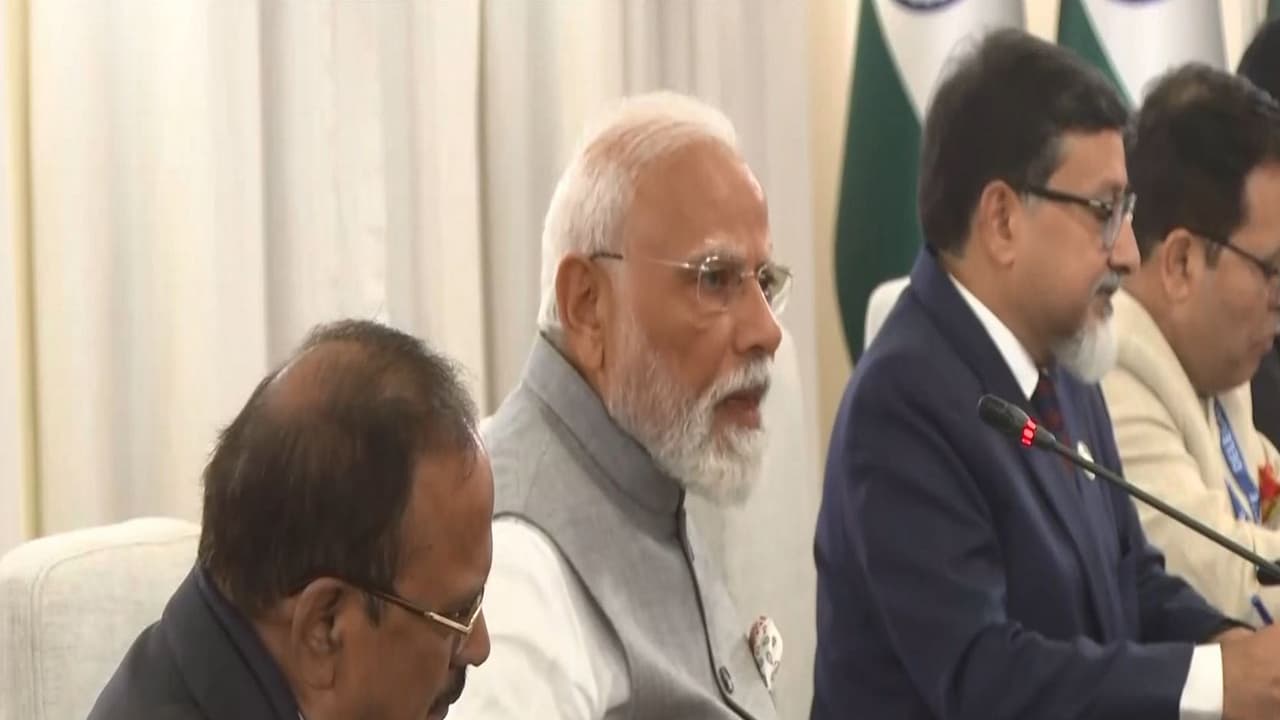
PM Narendra Modi thanked Ethiopian PM Abiy Ahmed Ali for his support following the Pahalgam terror attack. During delegation-level talks in Addis Ababa, Modi placed security cooperation at the centre of bilateral discussions.
Security Cooperation and Counter-Terrorism
Prime Minister Narendra Modi on Tuesday thanked his Ethiopian counterpart Abiy Ahmed Ali for his support and solidarity following the April 22 Pahalgam terror attack, stressing that backing from friendly nations "means a lot" for India's fight against terrorism. PM Modi held delegation-level talks with the Ethiopian Prime Minister during his official state visit to Addis Ababa and placed security cooperation at the centre of bilateral discussions.

During the meeting, Prime Minister Modi conveyed India's appreciation for Ethiopia's solidarity following the Pahalgam terrorist attack and acknowledged Addis Ababa's support in India's efforts to counter terrorism. "We express gratitude to you for your sympathies over Pahalgam terrorist attack and for your support in our fight against terrorism," Prime Minister Modi said.
Underscoring the importance of international cooperation in addressing security challenges, the Prime Minister highlighted the value of partnerships with friendly nations. "The support of friendly nations in our fight against terrorism means a lot," he said.
The remarks came against the backdrop of the April 22 Pahalgam terror attack, in which 26 tourists, including 25 Indian nationals and one Nepalese citizen, were killed by Pakistan-backed terrorists in the name of religion. In response, the Indian Armed Forces launched Operation Sindoor in the early hours of May 7, carrying out precision strikes on terror camps operated by Jaish-e-Mohammed and Lashkar-e-Taiba in Pakistan and Pakistan-Occupied Kashmir (PoK). India also repelled subsequent Pakistani escalation and targeted its airbases.
Strengthening Diplomatic Ties
The delegation-level talks were held as part of Prime Minister Modi's State visit to Ethiopia on December 16-17, which reflects India's expanding diplomatic engagement with Africa, the Global South and the enlarged Brics grouping.
The two-day visit, undertaken at the invitation of Ethiopian Prime Minister Abiy Ahmed Ali, marks Prime Minister Modi's first official visit to Ethiopia and his third visit to Africa this year.
The timing of the visit is notable, as India is set to assume the chairmanship of BRICS on January 1, 2026, placing a premium on coordination and dialogue among member countries, including Ethiopia.
The Ethiopia visit forms the second leg of Prime Minister Modi's three-nation tour, following his visit to Jordan and preceding his scheduled visit to Oman.
Focus on BRICS and Global Cooperation
India and Ethiopia share a relationship that predates formal diplomatic ties, with historical links rooted in trade, education and long-standing people-to-people connections. Highlighting the importance of the visit, India's Ambassador to Ethiopia, Anil Kumar Rai, noted that no Indian prime minister has travelled to Ethiopia in the past 15 years.
Speaking ahead of the visit, Rai outlined the strategic depth of bilateral ties and the agenda expected to feature in discussions between the two leaders. "Both countries are members of BRICS. And we are very important partners when it comes to cooperating on international issues, such as UN reforms and regional issues, and also there are agendas which we discuss at the regional level, particularly at the level of BRICS. India is going to be the chair of BRICS in 2026, with Ethiopia being an important member. So all those issues will come up during the discussions," Rai told ANI. (ANI)
(Except for the headline, this story has not been edited by Asianet Newsable English staff and is published from a syndicated feed.)