
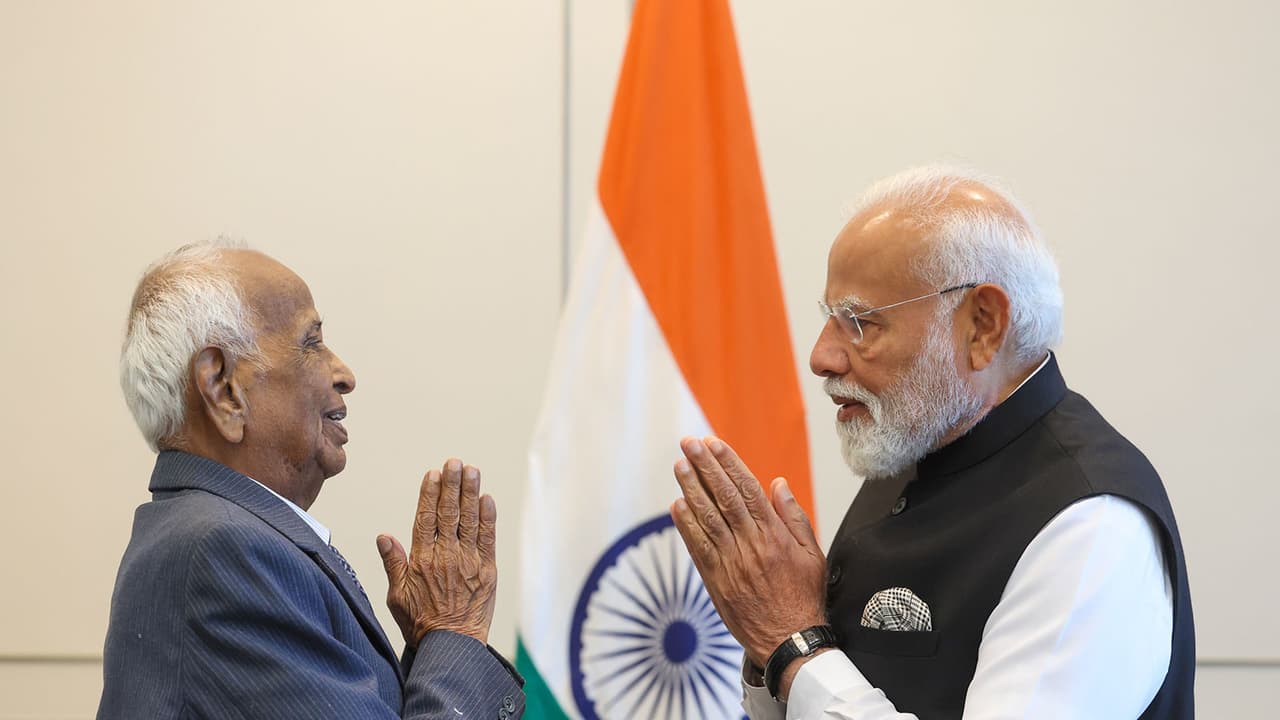
PM Modi met INA veterans in Malaysia, describing his interaction with Jeyaraj Raja Rao as 'deeply inspiring.' Modi paid homage to Netaji Subhas Chandra Bose and the INA, highlighting their valour and enduring legacy in India's freedom struggle.
PM Modi on Sunday interacted with veterans of the Azad Hind Fauj, also known as the Indian National Army (INA), during his two-day official visit to Malaysia, highlighting the force's historic role and its enduring legacy among the Indian community in Southeast Asia. As part of the interaction, PM Modi met INA veteran Jeyaraj Raja Rao and described the meeting as deeply inspiring. Sharing photographs on X, the Prime Minister said, "It was very special to meet INA veteran Shri Jeyaraj Raja Rao. His life is marked by immense courage and sacrifice. Listening to his experiences was very inspiring."

A 'Deeply Inspiring' Interaction
It was very special to meet INA veteran Shri Jeyaraj Raja Rao. His life is marked by immense courage and sacrifice. Listening to his experiences was very inspiring. We remain forever indebted to Netaji Subhas Chandra Bose, the brave women and men of the INA, whose valour helped… pic.twitter.com/dVkiDgCKGL — Narendra Modi (@narendramodi) February 8, 2026 Reflecting on the interaction, Jeyaraj Raja Rao described his meeting with PM Modi as a memorable and deeply fulfilling experience. Speaking about their conversation, he said, "It was an extremely wonderful and pleasurable blessing that I had. The Prime Minister was looking so young, and he could recollect the past of Netaji Subhash Chandra Bose with a whim. I had the pleasure of meeting him, and I was even garlanded by him. We were talking about the progress of India since the early days, and I humbly congratulated the Prime Minister for being firm and developing India in many areas."
During the interaction, PM Modi also paid homage to the Indian National Army and its founder, Netaji Subhas Chandra Bose, recalling the sacrifices made by its members during India's freedom struggle. "We remain forever indebted to Netaji Subhas Chandra Bose and the brave women and men of the INA, whose valour helped shape India's destiny," he added.
Honouring the INA and Netaji's Legacy
Underscoring the significance of the interaction, Ministry of External Affairs Secretary (East) Periasamy Kumaran described the meeting as a memorable moment during the Prime Minister's visit. "His meeting with two surviving veterans of the Indian National Army, INA, headed by Netaji Subhas Chandra Bose, was truly special," Kumaran said while briefing the media.
The interaction with INA veterans followed PM Modi's address to members of the Indian diaspora in Malaysia on Saturday, where he acknowledged the sacrifices made by people of Indian origin in the region during India's struggle for independence. "To make India a free country, thousands of your ancestors made great sacrifices. Many of them had never seen India. But they were among the first to join Netaji Subhas Chandra Bose's Indian National Army," he said. Referring to efforts undertaken in Malaysia to honour Netaji's legacy, PM Modi said, "In his honour, we renamed the Indian Cultural Centre in Malaysia after Netaji Subhas Chandra Bose. I also take this moment to salute the efforts of the Netaji Service Centre and Netaji Welfare Foundation in Malaysia."
Historical Context: The INA in Southeast Asia
Providing historical context, Netaji Subhas Chandra Bose assumed leadership of the Indian National Army in Southeast Asia in 1943 and revitalised the force after his arrival from Germany. Operating from bases in Singapore and Malaya, now Malaysia, he reorganised and expanded the INA by mobilising Indian civilians and prisoners of war captured during World War II.
On October 21, 1943, Bose announced the formation of the Provisional Government of Azad Hind, which held symbolic significance in India's independence movement. The legacy of the INA remains closely linked to the Indian diaspora in present-day Malaysia and Singapore, where the organisation was largely built and sustained. While prisoners of war initially formed the trained core of the force, large numbers of Indian civilians across Southeast Asia volunteered to strengthen the movement.
The Rani of Jhansi Regiment
One of the most prominent units of the INA was the Rani of Jhansi Regiment, an all-women contingent comprising Indian women living in Southeast Asia. Many of these women had never visited India but retained a deep connection to Indian heritage, culture and values passed down through generations. The regiment emerged as a powerful symbol of women's participation and empowerment in India's freedom struggle and continues to hold an important place in the history of the Indian National Army. (ANI)
(Except for the headline, this story has not been edited by Asianet Newsable English staff and is published from a syndicated feed.)