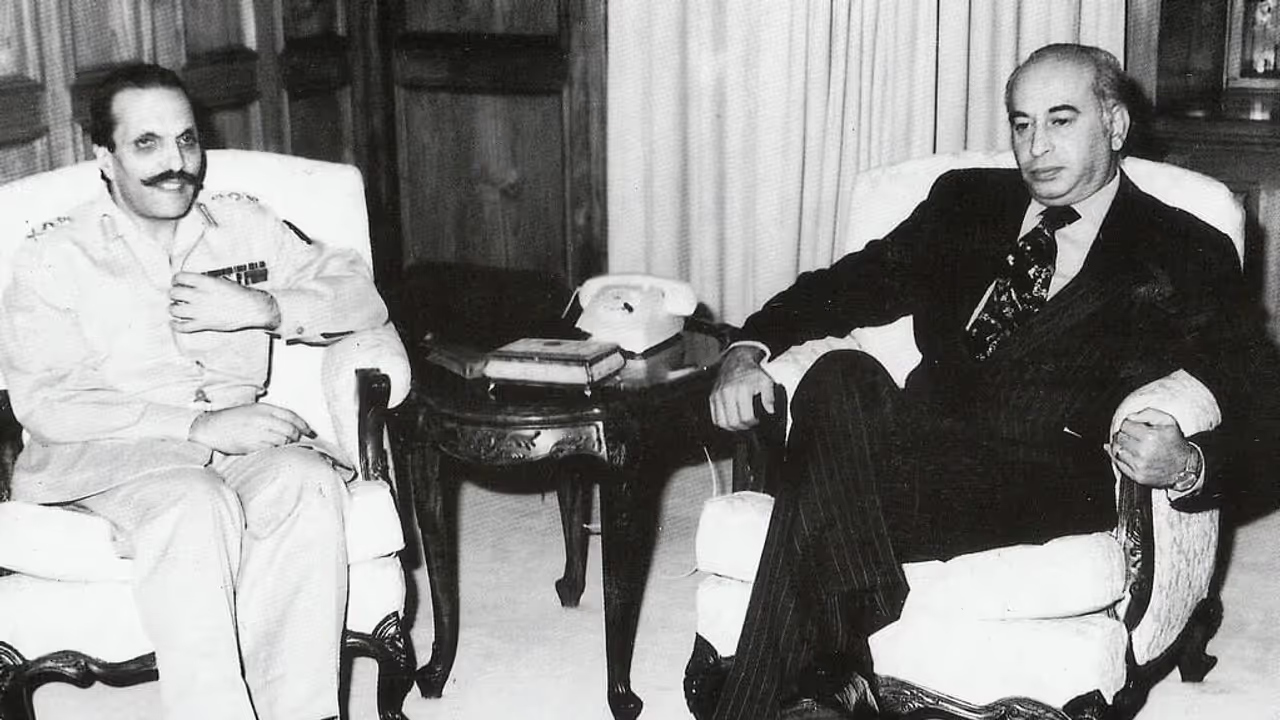
In Pakistan, no case demonstrates this more clearly than the execution of Zulfikar Ali Bhutto. Whatever Bhutto was in life; vain, populist, divisive, and deeply flawed in office, General Zia-ul-Haq’s regime ensured that he would not remain merely a politician to be debated.
New Delhi: Authoritarian states imagine power in blunt arithmetic: arrest the man, silence the voice, bury the memory, and the movement will die with him. But politics is not mathematics.

Repression does not subtract meaning; it often multiplies it.
In Pakistan, no case demonstrates this more clearly than the execution of Zulfikar Ali Bhutto. Whatever Bhutto was in life; vain, populist, divisive, and deeply flawed in office, General Zia-ul-Haq’s regime ensured that he would not remain merely a politician to be debated.
Related Articles

By hanging him after a deeply controversial trial, the state converted a contested leader into something far more durable: a political martyr, a hereditary symbol, and a permanent accusation against Pakistan’s own institutions.
Decades later, even Pakistan’s Supreme Court has acknowledged that Bhutto did not receive a fair trial. That belated admission only confirms what history had already concluded: Zia did not eliminate Bhutto. He canonized him.
This is the central stupidity of authoritarian calculation. Bhutto, in power, was vulnerable. He could be attacked for excess, blamed for misjudgements, criticized for centralization, and opposed over the 1977 election crisis and the allegations of rigging that fed unrest before the coup. A living politician can be argued with; a dead one, especially a dead one killed by the state, is transfigured.
Execution performs an alchemy that ordinary politics cannot. It strips away administrative failure and leaves behind spectacle, sacrifice, and grievance. Zia’s military regime may have believed it was ending Bhutto’s relevance by removing him from the field.
In reality, it relieved him of the burdens of governance and handed him the moral advantage of victimhood. The rope did what the ballot and the opposition had not: it made Bhutto larger than his own record.
That is why suppression so often amplifies what it seeks to erase. States assume fear is stronger than memory. They are repeatedly wrong. Once repression becomes visible, memory hardens into identity. The victim no longer belongs only to his party or supporters; he becomes a vessel for wider anger about injustice, humiliation, and stolen political choice. The harsher the state acts, the cleaner the symbol becomes.
Pakistan’s military establishment wanted Bhutto removed from history. Instead, it wrote him into Pakistan’s political mythology with permanent ink. His death was not the end of Bhuttoism; it was its purification. What might have faded into mixed historical judgment was recast as an unfinished wrong, one passed from generation to generation as both emotional inheritance and political mobilisation.
The clearest evidence is the survival of the Pakistan Peoples Party itself. Parties built around one charismatic founder often wither after repression. The PPP did not. After Bhutto’s execution, Benazir Bhutto was elevated as head of the party, endured detention and exile, returned as the face of resistance to dictatorship, and twice became prime minister. After her assassination, the dynasty did not collapse either: Bilawal Bhutto Zardari became party chairman, extending the same line of political inheritance into a third generation.
The point is not that dynastic politics is healthy; it often is not. The point is that dynastic continuation proves the mechanism. Zia’s regime did not destroy the Bhutto name. It made the Bhutto name indispensable to the PPP’s survival and to Pakistan’s democratic vocabulary, however compromised that democracy has remained. In trying to decapitate a movement, the state gave it a bloodline.
This pattern is not unique to Pakistan. South Africa’s apartheid regime tried to disappear Nelson Mandela through long imprisonment, censorship, and isolation. Instead, Mandela’s legend expanded in captivity; by the 1980s he had become a global symbol of the injustice the regime was trying to normalize, and after 27 years in prison he emerged not as a forgotten radical but as the indispensable figure in South Africa’s transition.
Chile offers a different variation. Salvador Allende died during the 1973 coup that destroyed his government, but Pinochet’s seizure of power did not erase Allende from national memory.
It elevated him into a lasting emblem of democratic rupture and resistance to military rule. Different countries, different ideologies, same mistake: coercion can seize institutions, but it often forfeits the battle over meaning.
What makes Pakistan especially damning is that the state has never fully reckoned with this machinery. Bhutto’s execution was not an unfortunate excess at the margins of the system; it was the system revealing itself.
The military decided who could rule, the judiciary supplied formal cover, and the state expected legality to sanitize political vengeance. That formula did not restore legitimacy. It corroded it. Every later Pakistani lecture about constitutionalism, due process, or democratic order has had to speak through the echo of 1979. A state that kills an elected leader through a compromised process does not display strength. It advertises insecurity. It confesses that persuasion has failed and only the costume of law remains.
Zia wanted Bhutto forgotten, reduced, and neutralized. He achieved the reverse.
He helped turn Bhutto from a flawed politician into an untouchable symbol, from a partisan figure into a martyr, and from a leader with a contested record into a dynasty that still structures Pakistani politics. That is the martyrdom mechanism: states fearful of political memory try to extinguish it by force, and in doing so, they consecrate it. Pakistan did not simply execute Bhutto. It made Bhutto a legend and then spent decades living under the shadow of the symbol it created. That is not a Pakistani exception. It is an authoritarian habit, repeated across continents: regimes mistake the destruction of a body for the destruction of an idea, and then act surprised when the grave becomes a banner.