
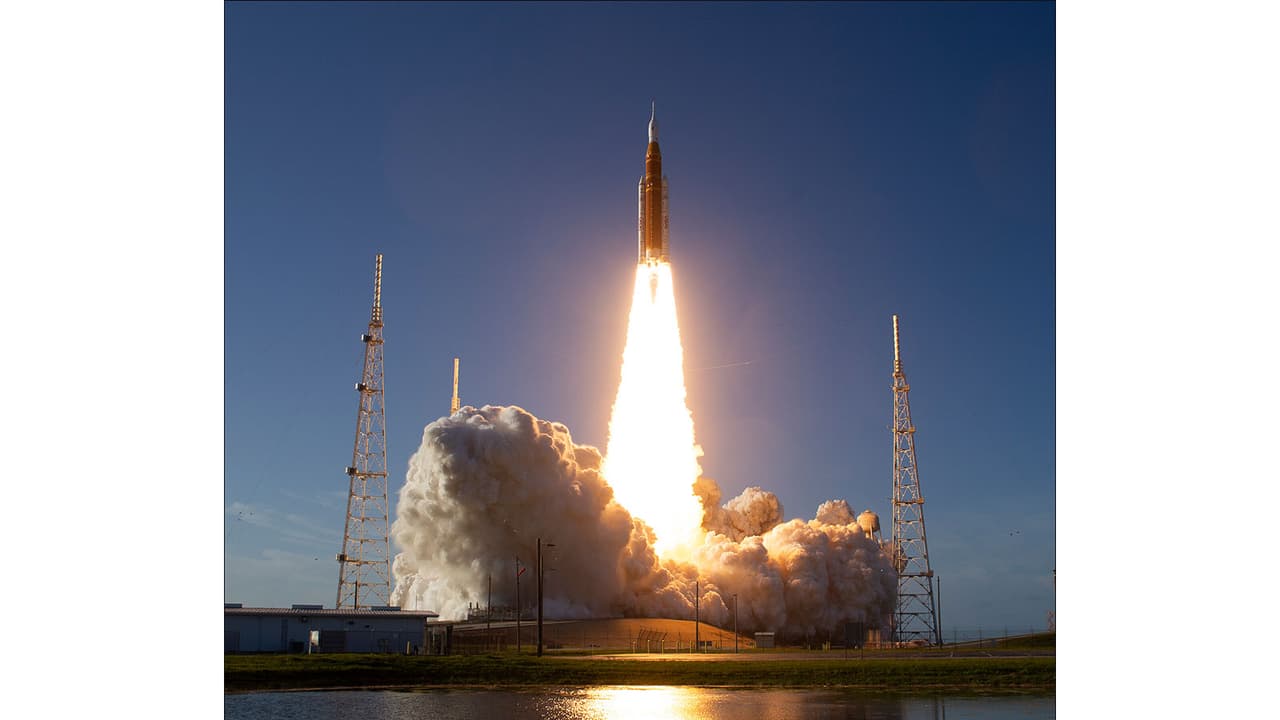
NASA's Artemis II crew has successfully left Earth's orbit and is heading toward the Moon. The Orion spacecraft performed a critical translunar injection burn, setting it on course for the first crewed lunar flyby since the Apollo era.
The crew of the National Aeronautics and Space Administration (NASA) Artemis II mission on Friday successfully cleared Earth's orbit and is now on course toward the Moon, marking a historic step in humanity's return to deep space exploration.

Successful Burn Puts Crew on Lunar Trajectory
According to NASA, the Orion spacecraft executed a critical translunar injection burn, igniting its main engine for approximately six minutes to propel the crew beyond Earth's gravitational influence and set them on a trajectory for a lunar flyby. The manoeuvre generated about 6,000 pounds of thrust, placing the spacecraft on a precise path toward Earth's nearest celestial neighbour.
NASA confirmed that the Artemis II mission management team gave a unanimous "Go" for the burn, which lasted five minutes and 49 seconds. The successful execution of this manoeuvre officially puts the astronauts on course to travel around the Moon for the first time since the historic Apollo 17 mission in 1972.
In a statement shared on X, NASA Administrator Jared Isaacman said, "Nominal translunar injection burn complete. The Artemis II crew is officially on the way to the Moon." Isaacman further described the milestone as a defining moment for the space agency, stating, "America is back in the business of sending astronauts to the Moon. This time, farther than ever before."
Meet the Crew and Mission Activities
The Artemis II crew comprises NASA astronauts Reid Wiseman, Victor Glover, and Christina Koch, along with Canadian Space Agency astronaut Jeremy Hansen. The four astronauts began their first full day in space with routine mission activities, including preparations for the engine burn and onboard exercise sessions designed to maintain physical fitness in microgravity. Mission control marked the start of the crew's day by playing the song Green Light, setting the tone for a day of critical operations aboard the spacecraft.
Testing Critical Systems for Future Landings
The Orion spacecraft's service module engine, capable of delivering significant thrust, ensured the precise acceleration required to send the crew toward the Moon. The upcoming lunar flyby will test critical systems needed for future missions, including those aimed at landing astronauts on the lunar surface under NASA's Artemis program.
Historic Launch and Mission Plan
Earlier on Thursday, NASA's Artemis II mission was successfully launched, sending astronauts on a historic journey around the Moon for the first crewed lunar flyby in more than 50 years. The agency's Artemis II mission lifted off aboard the Space Launch System rocket from Launch Pad 39B at Kennedy Space Center in Florida.
Upon completion of the lunar flyby, an approximately 10-day mission, the crew is expected to return to Earth, concluding the mission with a splashdown in the Pacific Ocean.
(Except for the headline, this story has not been edited by Asianet Newsable English staff and is published from a syndicated feed.)