
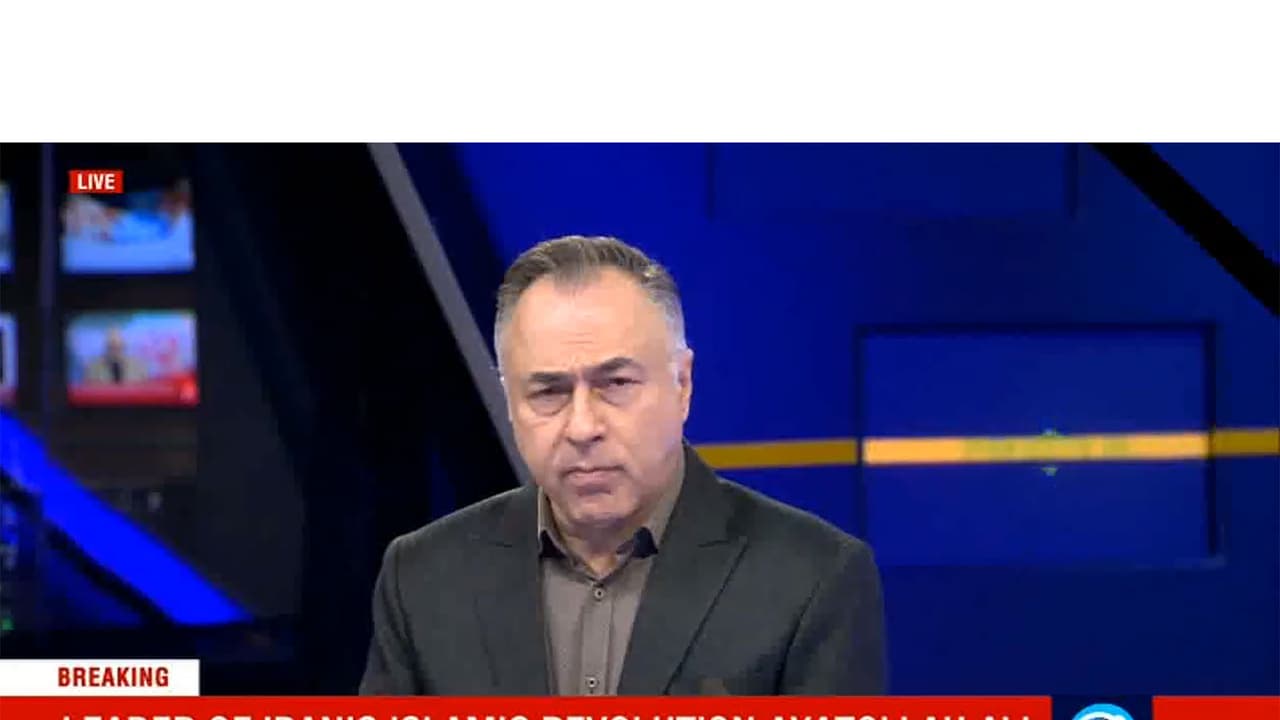
Iran's state media announced the assassination of Supreme Leader Ali Khamenei, with an emotional broadcast confirming his 'martyrdom'. The government declared 40 days of mourning and vowed revenge against the US and Israel for the fatal strikes.
Emotional Announcement on State TV
A presenter on Iran's state-affiliated broadcaster Press TV got emotional on air and took visible pauses while announcing what the channel described as the "martyrdom" of Supreme Leader Ali Khamenei, according to footage aired by Press TV. The network reported that Khamenei was killed in what Iranian authorities characterised as an assassination. The visibly emotional anchor struggled to maintain composure while delivering the breaking news, referring to him as the "Leader of the Islamic Revolution."

He described the news of the death as "confirmed". Press TV also aired visuals from the Imam Hussein Shrine in Karbala, where pilgrims were seen reacting with grief upon hearing the announcement. In Tehran, people gathered at Enghelab Square to mourn, with crowds holding portraits and chanting slogans, the broadcaster reported.
Iran Declares Mourning, Vows Retaliation
According to Press TV, Iran's government issued a statement warning that the "crime of assassination of the Leader of the Islamic Revolution will not go unpunished" and asserting that the "pure blood of the martyred Leader will uproot the criminal regimes of the US and Israel."
Iran is observing 40 days of public mourning following the death of Ayatollah Ali Khamenei, Reuters reported, citing Iranian state media. In Shia Islam, the 40th day after death (Arba'een) holds immense spiritual weight. The death occurred following strikes by the US and Israel (Operation Epic Fury/Lion's Roar) on Saturday. By announcing exactly 40 days of mourning, the government is leaning into a powerful cultural script, providing the clerical establishment time to manage the transition behind closed doors.
Succession Uncertainty Amid Aftermath
The country's Supreme Leader's office has declared a period of national mourning, with flags flying at half-mast and public gatherings planned to pay respects, marking the closing of a 37-year chapter in the Islamic Republic's history. Ayatollah Khamenei was the successor to the Revolution's founder, Ruhollah Khomeini. Since 1989, his "story" was one of unwavering defiance against Western influence.
Authorities have heightened security across the country, particularly in major cities like Tehran, to prevent unrest and ensure public safety. Attention is focused on the process of selecting Khamenei's successor, with speculation about potential candidates and the impact on Iran's future leadership. However, meeting under wartime conditions is difficult, and the question remains, who "owns" the future of the Republic--the clerics or the Revolutionary Guard-- the most urgent cliffhanger.
'Martyrdom of the Guardian'
His death is being portrayed by state media as the Martyrdom of the Guardian, framing his end not as a defeat, but as a final sacrifice for the sovereignty of the nation.
The official Farsi account of Ayatollah Ali Khamenei acknowledged his death and posted a verse from the Quran on X in the early hours of Sunday. As per Tasnim News, Khamenei was killed while at the workplace in the early hours of Sunday. The official Farsi page posted on X a verse from Surah Al-Ahzab, 33:23, which translates to "Among the believers are men who have been true to the covenant they made with Allah. Some of them have fulfilled their vow [by death], and some are still waiting, and they have not changed [their commitment] in the least." (ANI)
(Except for the headline, this story has not been edited by Asianet Newsable English staff and is published from a syndicated feed.)