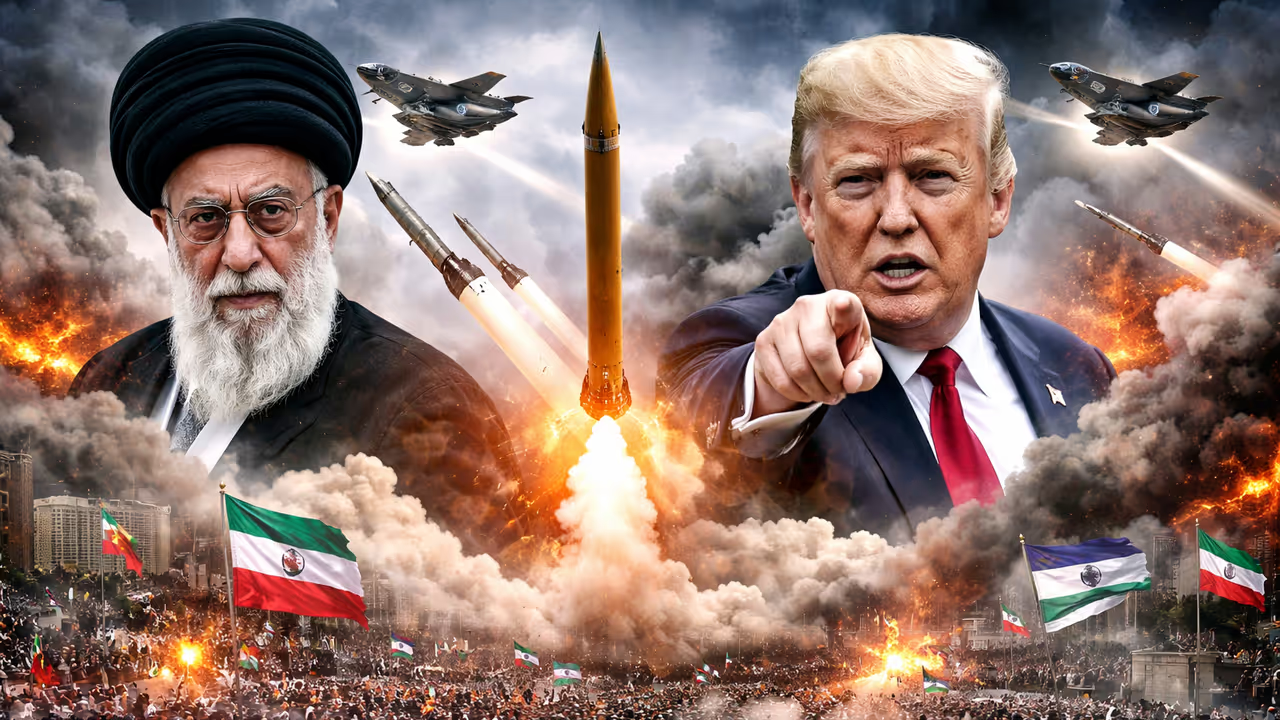
Donald Trump launched a massive US-Israel strike on Iran, resulting in the death of Supreme Leader Khamenei. The operation signals a shift from nuclear talks to regime change, amid Iranian unrest and regional tensions.
Launching a major attack alongside Israel against Iran, US President Donald Trump is openly pursuing the goal he once adamantly rejected -- regime change. Trump said that the bombing campaign -- which followed a massive military buildup in the Middle East unseen since the 2003 invasion of Iraq -- killed Iran's supreme leader Ayatollah Ali Khamenei, a US nemesis in power since 1989.

For weeks Trump had suggested a more limited goal of forcing a deal to end Tehran's contested nuclear program, and joined Israeli Prime Minister Benjamin Netanyahu in calling on Iranians to topple the Islamic republic.
"This is the single greatest chance for the Iranian people to take back their Country," he said in a statement announcing Khamenei's death, which has not been confirmed by Iran.
Related Articles

Indicating coordination, the son of Iran's late pro-Western shah, who was overthrown in the 1979 Islamic revolution, released statements near-simultaneously to Trump's announcements -- first confirming the operation and then Khamanei's death.
After Khamenei, the Islamic republic "will soon be consigned to the dustbin of history," Reza Pahlavi said.
While there are differences between the two situations, Trump's language evoked that of president George W. Bush when he invaded Iraq in 2003, with talk of the need for pre-emptive action and pointing to disputed weapons allegations to justify overthrowing a government.
Trump himself said that the Iraq war was a historic mistake by Bush, who went to Congress and spent much more time than Trump laying out his case for war to the public.
"In the end, the so-called nation-builders wrecked far more nations than they built, and the interventionists were intervening in complex societies that they did not even understand themselves," Trump said in a speech last year in Saudi Arabia, now being hit by Iranian counter-attacks.
Trump billed himself as the peace candidate and has loudly campaigned for the Nobel Peace Prize, saying he deserves it for assorted US mediation drives around the world.
His close aide Stephen Miller in social media posts during the 2024 campaign charged that "millions die" if rival Kamala Harris wins.
"Trump said warmongering neocons love sending your kids to die for wars they would never fight themselves," Miller wrote, posting: "Kamala = WWIII. Trump = Peace."
In December, the Trump administration released a national security strategy that called for the United States to address threats in the Middle East "without decades of fruitless 'nation-building' wars."
Also read: US not trying to conquer Iran like Russia did Ukraine: Ex-Pentagon official
Changing equation in Iran
Much has changed in Iran since Trump's earlier statements.
Mass demonstrations, initially triggered by concerns over the cost of living, started building in late December and posed the greatest threat ever to the Islamic republic.
Authorities crushed the demonstrations ruthlessly, with thousands of people killed.
Trump also showed a willingness to use force in Venezuela, ordering a January 3 attack in which US forces snatched leftist leader Nicolas Maduro.
But Trump's previous operations have been one-off strikes that he has quickly framed as victories.
In Venezuela, Trump has worked with Maduro's vice president and successor Delcy Rodriguez, threatening her with violence if she does not cooperate, rather than moving to install the democratic opposition long supported by Washington.
Marjorie Taylor Greene, a former staunch Trump ally who resigned from Congress after falling out with him, said Trump was no different from previous presidents in launching "another foreign war for foreign people for foreign regime change."
"But it feels like the worst betrayal this time because it comes from the very man and the admin who we all believed was different and said, no more," she wrote on social media.
Brandan Buck, a research fellow at the libertarian Cato Institute, said that Trump, in urging the downfall of the Islamic republic, had offered "no clear conception of victory."
"Instead, the President is repeating the same pattern of strategic self-deceit that has ensnared his predecessors -- promising limited action while inviting prolonged conflict."
Most Republicans lined up to support the attack, with many issuing calls for freedom and democracy more reminiscent of Bush than Trump.
Republican Senator John Cornyn said that Iran's government has carried out an "all-out assault on the West and our values" and voiced hope that through Trump's actions Iranians “will finally be free.”
(Except for the headline, this story has not been edited by Asianet Newsable English staff and is published from a syndicated feed.)