
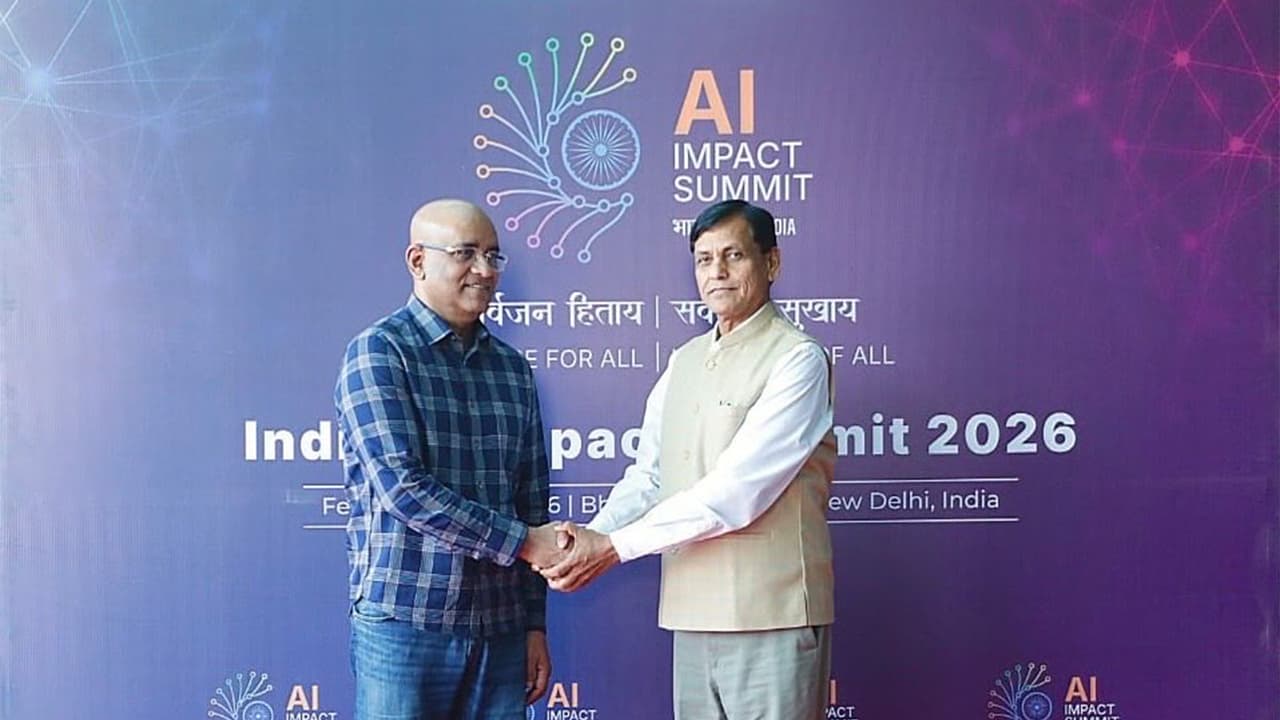
Guyana's Vice President Bharrat Jagdeo arrived in New Delhi for the India AI Impact Summit, a visit the MEA says will strengthen bilateral ties. The summit also featured discussions on converging AI and decarbonization for climate action.
Vice President of Guyana, Bharrat Jagdeo on Tuesday arrived in Delhi for attending the India AI Impact Summit. Official Spokesperson for the Ministry of External Affairs, Randhir Jaiswal lauded the visit, saying that it will strengthen the partnership between both the nations.

In a post on X, the MEA said, "Warm welcome to the Vice President of Guyana Dr. Bharrat Jagdeo. He was received by Minister of State for Home Affairs Nityanand Rai on his arrival in New Delhi for the India-AI Impact Summit. The visit of Vice President Dr. Jagdeo will further strengthen the historic and multifaceted India-Guyana ties, rooted in strong people to people linkages." Warm welcome to the Vice President of Guyana Dr. Bharrat Jagdeo. He was received by Minister of State for Home Affairs @nityanandraibjp on his arrival in New Delhi for the India-AI Impact Summit. The visit of Vice President Dr. Jagdeo will further strengthen the historic and… pic.twitter.com/pUxQHHS1vy — Randhir Jaiswal (@MEAIndia) February 17, 2026
AI and Decarbonization: The 'Double Helix'
Meanwhile, from data ethics to a profound environmental and geopolitical challenge, global policy experts agree that AI cannot exist in a vacuum and must be synchronised with the global drive for decarbonization and regional cooperation. Participating in a panel discussion on Tuesday at the ongoing AI India Impact Summit in the national capital, energy expert Arunabha Ghosh argued that the Artificial-Intelligence revolution and the Green revolution are two strands of the same "double helix."
Ghosh, the CEO of the Council on Energy Environment and Water (CEEW) said, "I see this as a double helix. There is a digital revolution going on and a decarbonization revolution going on at different speeds with different momentums and different geographies."
He said that the two technologies should converge to save the planet. "But the two will have to come together. These can't be parallel tracks. These have to come together. When they come together properly, then AI becomes one more general-purpose technology to impact another general-purpose technology, which, in my opinion, is climate action," Ghosh said.
The Duality of AI
He highlighted how AI can optimize solar and wind integration into power grids, provide hyper-accurate flood forecasting, and increase agricultural resilience. However, he warned of the "duality" of AI -- noting that massive data centres are incredibly thirsty for power and water for cooling. (ANI)
(Except for the headline, this story has not been edited by Asianet Newsable English staff and is published from a syndicated feed.)