
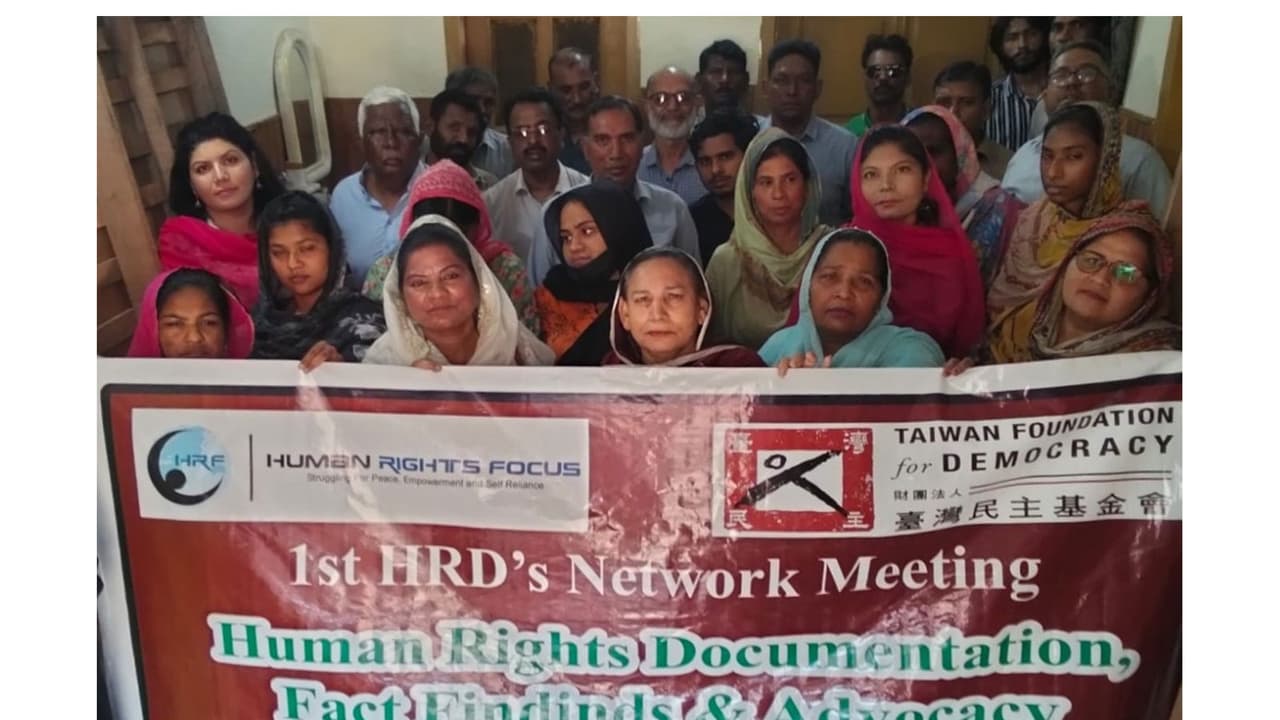
Human Rights Focus Pakistan (HRFP) and the Taiwan Foundation for Democracy (TFD) have launched a project to bolster human rights advocacy in Pakistan, focusing on documentation, fact-finding, and legal aid for marginalised communities nationwide.
Project Launched to Bolster Human Rights Advocacy
Human Rights Focus Pakistan (HRFP), in partnership with the Taiwan Foundation for Democracy (TFD), has initiated a project's activities aimed at strengthening human rights advocacy across Pakistan. Titled "Human Rights Documentation, Fact-Finding, and Advocacy for the Marginalised-II," the initiative seeks to advance human rights, democratic values, and the rule of law, according to an official statement.

The project was formally introduced during an orientation session held on April 24, 2026, at Vision Hall in Faisalabad. The event brought together members of the Human Rights Defenders (HRDs) Network, including civil society representatives, community leaders, and activists. Participants discussed the project's goals, strategies, and anticipated impact. The session focused on planning key activities under the project, defining roles and responsibilities, and identifying practical interventions to ensure effective outcomes. Attendees also shared field experiences, highlighted challenges, and explored ways to address them during implementation.
HRFP, in collaboration with TFD and the HRDs Network, plans to hold monthly meetings to review progress, share case updates, and tackle emerging challenges. These regular engagements will also facilitate legal assistance, address urgent needs, and strengthen advocacy efforts to ensure justice for affected individuals and communities. Cases requiring in-depth inquiry will be examined through dedicated fact-finding missions conducted by trained teams of volunteers, staff, and network members. The project will also include capacity-building initiatives and awareness sessions to enhance advocacy skills and knowledge.
Phase II Aims for Nationwide Outreach
Speaking at the event, Naveed Walter, President of Human Rights Focus Pakistan (HRFP), stated that the organisation's fact-finding missions to incident sites have had a significant impact on case resolution and policy reform, particularly during the "Human Rights Documentation Project - Phase I (2025)." However, he noted that the project's reach remained limited, as many cases could not be addressed due to constraints such as limited resources, time limits, and other challenges. He further explained that under the "Human Rights Documentation Project - Phase II (2026)," aims to expand its outreach to cover more cases nationwide. This phase will also prioritise extending activities to additional regions, especially districts in Punjab and Sindh.
Naveed Walter, President of HRFP, stated further that while the project will operate in target areas across Pakistan, Faisalabad will serve as the central hub due to the organisation's main office being located there. He emphasised that HRDs Network meetings will play a key role in implementing strategies and achieving project objectives. He noted that the network includes a diverse group of stakeholders, community leaders, activists, educators, lawyers, women, youth, and political representatives who will actively contribute to advancing the project's mission. He added that these forums will also address cases of human rights violations and promote democratic values aligned with the United Nations 2030 Agenda and its 17 Sustainable Development Goals (SDGs).
He further explained that specialised fact-finding teams will be formed to document violations in targeted areas. Additionally, an HRDs Advocacy Group will compile reports and engage with policymakers, local authorities, and government officials to pursue resolutions. Naveed Walter reiterated that the project is designed to uphold fundamental rights, protect vulnerable populations, and advocate for freedoms such as expression, religion, and equal access to opportunities, education, and a healthy environment. He also stressed the importance of accountability and the fulfilment of basic human needs.
Members of the HRDs Network, including Naseem Haroon, Nusrat Samuel, John Victor, Ejaz Ghauri, James Lal, Lawrance Thomas, and Sohail Emmanuel, expressed their commitment to collaborative action. They emphasised the need to strengthen democratic practices and condemned human rights violations and undemocratic tendencies that undermine the rule of law.
24/7 Helpline Supports Religious Minorities
Field Coordinator Hamdosh Samuel (Staff), HRFP Program Coordinator Shadman John (Staff), and HRFP Research Officer Nadeem Walter (Volunteer) highlighted the organisation's ongoing efforts to support religious minorities through its 24/7 REAT Helpline, operational since 2013 at the Faisalabad office. The toll-free service (0800-0-9494) handles a significant number of cases annually. In 2025, REAT Helpline recorded above 1200 and in 2024, 1198 complaints related to human rights violations, with a particular focus on issues concerning religion, belief, and democratic freedoms. The REAT Helpline aligns with Articles 18 to 22 of the International Covenant on Civil and Political Rights, addressing rights related to expression, assembly, association, and thought, including freedom of religion. Reported cases are reviewed and responded to through the HRFP Help Desk to ensure appropriate support and action. (ANI)
(Except for the headline, this story has not been edited by Asianet Newsable English staff and is published from a syndicated feed.)