
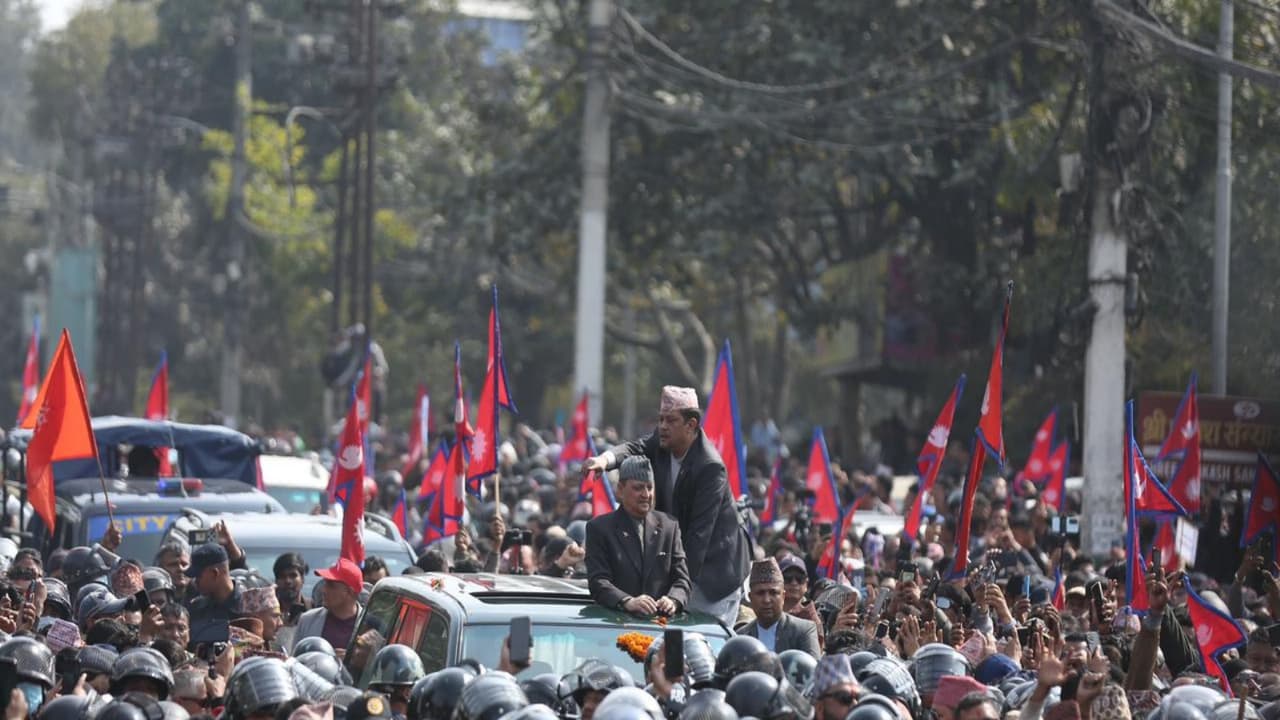
Former Nepali King Gyanendra Shah called for an all-side consensus before the March 5 election, stating in a video message that polls alone cannot resolve the nation's problems and describing the country as being in a 'painful situation'.
Ex-King Calls for Consensus Ahead of Polls
Former Nepali King Gyanendra Shah has called for all-side consensus before holding the House of Representatives election slated for March 5. Issuing a video statement on Wednesday evening the former king stated that the upcoming election alone cannot resolve all of Nepal's problems.

The video message which comes on the eve of Democracy Day, the former monarch said Nepal is currently in the most painful situation in its history and insisted that elections by themselves would not provide a solution under the present circumstances. "Although periodic elections to select representatives are a natural process in a democratic system, the prevailing public sentiment at this time is that national problems should first be resolved before proceeding with the upcoming electoral process. Keeping in mind that there should be no conflict, unrest, or disputes after the elections, it would have been the right path to move forward through national consensus and an inclusive understanding before holding elections."
'Nation's Identity Under Threat'
In the eight-minute video message, former King Shah also said that at present, the entire nation is caught in an unnatural vortex of restlessness. "Every patriotic Nepali feels that the country's identity and existence are under threat. In the past, movements and struggles were carried out under various names, and changes were made on the strength of those struggles. However, the time has now come to introspect on what those various changes have actually delivered to Nepal and the Nepali people?" the former monarch said in the video message.
In the video, he also urged all sides to promote a political culture of harmony and unity in the country. "Our enemies are poverty and instability. Yet we have encouraged an undesirable culture in which one Nepali regards another as an adversary. As a result, the country has reached the most painful and grave situation in its history. Therefore, in today's difficult circumstances, let us put a full stop to politics based on hatred and conflict, and instead promote a political culture of harmony and unity," said the former king.
Vision for Governance and Unity
Former King Shah also said that in the current "sad situation" where there is a growing tendency to demand rights without considering duties, the country cannot gain new momentum through a mindset of "let us divide and share the spoils in turns," but only through a sense of duty that says, "let us work together." "In a democracy, the people themselves should become awakened and take the lead in the noble work of serving society and the nation. Yet, we have been bound in the chains of a coercive system where we must please someone and dictated by others. Only a system and governance suited to the country's geography and nature of its society can it deliver sustainable and positive outcomes."
The former king also emphasized on a foundation for all kinds of ideas and traditions. "A democratic system that serves the overall welfare of the general public and uphold dignity of Nepalis before the world is what truly suits Nepal. We must adopt and retain the good and positive aspects of any system, while discarding and rejecting it's bad and harmful elements," the former monarch said.
Pro-Monarchist Party Contests Election
The Himalayan Nation is gearing up for the election on March 5. The right-wing, pro-monarchist Rastriya Prajatantra Party (RPP) is also contesting the election with an agenda of bringing back the monarchy.
Historical Context of RPP and Monarchy
Nepal in the year 2006 had abolished centuries old constitutional monarchy after then King Gyanendra seized power and imposed emergency sending all the leaders under house arrest. The movement also referred as "People's Movement II" witnessed a bloodshed with dozens killed in crackdown against protestors by the government. After weeks of violent protest and increasing international pressure, Gyanendra gave up and reinstated the dissolved parliament, the dawn of new democracy is highlighted as Lokantantra (People's Rule).
Formed in the 1990's after lift of ban in formation of political parties by then monarchical system, the Rastriya Prajatantra Party (RPP) since then serves as the force always supporting the Kingship. It also has been taking part in periodic elections and presenting its demands forth.
In the year 2008 right after the overthrow of monarchy rule from Nepal, the Rastriya Prajatantra Party (RPP) had secured 8 seats in then Constituent Assembly out of the 575 seated strong parliament. In the 2013 election it was able to secure 13 seats while in the year 2017 it fell down to 1 seat while it bounced back in the election of 2022 with 14 seats.
The party since its inception has been supporting Hindu State and the Kingship as interdependent in the tiny nation buffered between two giants India and China. The Himalayan Nation of Nepal has a population of 30.55 million has a Hindu population of 81.19% as per the census of 2022. Though former king is not taking part in the polls but the RPP, has fielded its candidate for the March 5 election.
The 'Gen-Z Uprising' and Early Elections
Nepal's periodic election which wasn't due until 2027 is called early after the Gen-Z revolution of 2025 following the dissolution of the parliament. The September 8 and 9 revolt deposed then Prime Minister KP Sharma Oli. A total of 76 people have died in the crackdown by the security forces. The two-day protest commonly referred as "Gen-Z uprising" was against the corruption and social media ban has now changed the course of Nepali politics. (ANI)
(Except for the headline, this story has not been edited by Asianet Newsable English staff and is published from a syndicated feed.)