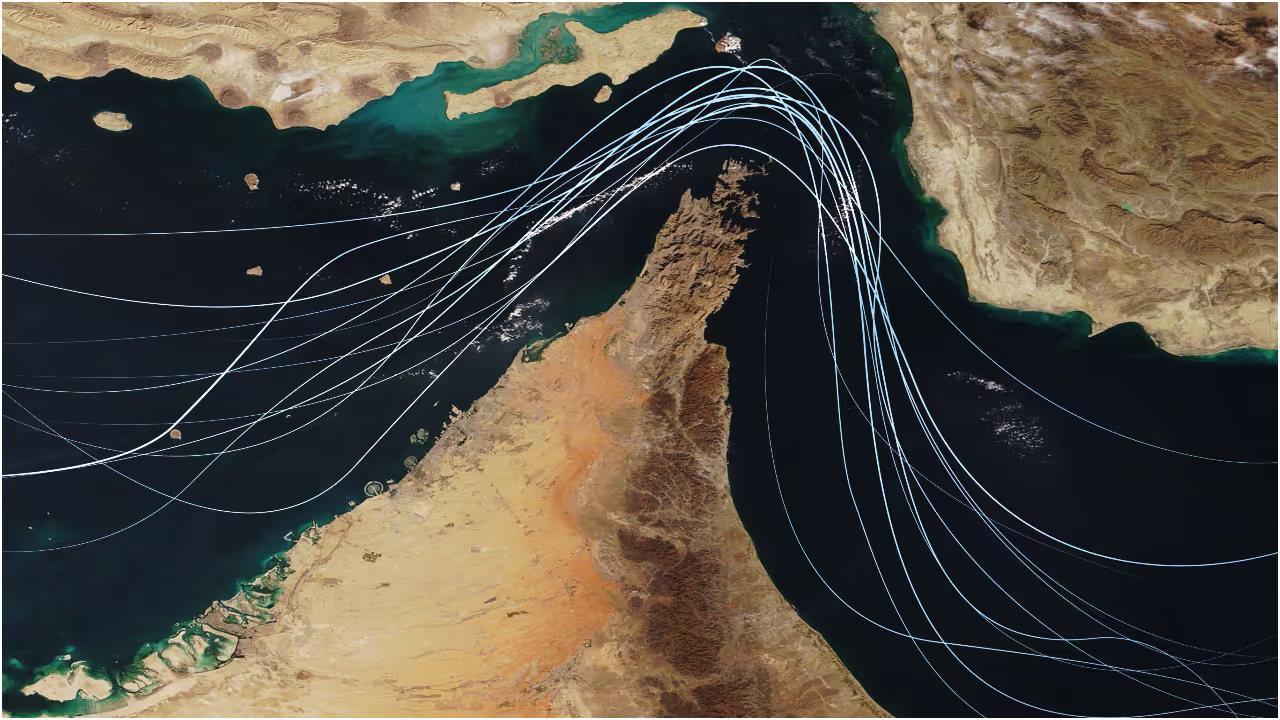
Oil prices fell slightly after some tankers crossed Strait of Hormuz, offering brief relief amid the ongoing Middle East war. However, tensions remain high as Israel strikes Iran and Iran responds with attacks. The conflict has disrupted global oil supply, raised fuel costs and forced countries to find new routes. Talks of a ceasefire continue.
Oil prices showed a small drop on Monday, giving slight relief to global markets. This came as some oil tankers managed to pass through the Strait of Hormuz, a key route for global energy supply. The main Brent oil price fell by 0.8 percent to $108.20 per barrel. The US benchmark, West Texas Intermediate, dropped 1.4 percent to $110.01. Experts said this small fall does not mean the crisis is over. It only shows that some movement of oil has restarted, even though the situation remains tense.

The Strait of Hormuz is one of the most important shipping routes in the world. A large share of global oil passes through this narrow waterway. Since the war began on February 28, Iran has mostly blocked the strait. This caused oil and gas prices to jump sharply from around $60 per barrel before the conflict.
Because of this, countries across the world are facing rising costs and supply worries.
Related Articles

Some ships manage to pass
There are signs of slight improvement. Turkey confirmed that a third Turkish-owned oil tanker safely crossed the strait. The ship, named Ocean Thunder, was carrying oil from Iraq to Malaysia. It had loaded crude oil from Basra in Iraq.
Two other ships also passed through safely over the weekend.
A Japanese shipping company, Mitsui O.S.K. Lines, said an Indian-flagged LPG tanker owned by its unit also crossed the strait safely. These movements gave some hope to markets, even though normal traffic has not returned.
War continues to escalate
Despite these signs, the war situation remains serious. Israel carried out strikes on Iran’s largest petrochemical complex in Assaluyeh. This site is very important, as it produces about half of Iran’s petrochemical output.
At the same time, Iran launched drone and missile attacks on Israel, Kuwait and the United Arab Emirates. A senior commander of Iran’s Revolutionary Guards was also killed in strikes.
The conflict continues to grow, with both sides attacking each other.
Strong warnings and threats
The situation became more tense after strong words from US President Donald Trump. He warned Iran to reopen the Strait of Hormuz or face attacks on civilian infrastructure.
Iran responded by saying that even stronger attacks would follow if such actions were taken. Iran’s Revolutionary Guards also warned that conditions in the strait will never return to normal, especially for the US and Israel.
These statements show how serious and dangerous the situation has become.
Talks of a possible ceasefire
Amid rising tensions, there are also signs of possible talks. Reports say that a 45-day ceasefire plan is being discussed. Countries like Pakistan, Egypt and Turkey are said to be helping with these efforts.
Egypt’s Foreign Minister confirmed that discussions are taking place with several governments. However, Iran has denied that it is in direct talks with the US or Israel.
This means peace is still uncertain.
Global economic impact
The war is not only affecting the region but also the entire world economy. Oil supply disruptions have caused problems in many sectors, especially aviation.
Indonesia has already increased fuel charges and allowed airlines to raise ticket prices. Air Asia X has also raised fares by up to 40 percent.
Higher fuel costs are making travel more expensive for people.
Countries look for new routes
To avoid risks in the Strait of Hormuz, some countries are changing their oil supply routes. South Korea plans to send ships to Saudi Arabia’s Red Sea port of Yanbu to collect oil.
Taiwan is also planning to use the same route. These changes show how serious the disruption has become.
Rising costs hit nations
Countries that depend heavily on imported oil are feeling the pressure. Sri Lanka has increased cooking gas prices sharply due to rising global costs. The country has warned that a long war could damage its economy further.
Many nations are now worried about inflation and slower economic growth.
Stock markets show mixed reaction
Stock markets in Asia showed mixed trends. Tokyo and Seoul markets closed higher, rising by 0.6 percent and 1.4 percent.
Singapore also saw small gains, while Jakarta slipped slightly. Many markets in Europe and Asia were closed due to holidays, which kept trading activity low.
Daily life amid conflict
Even as tensions rise, life continues in many places.
In Tehran, some people were seen enjoying normal activities like flying kites and spending time in parks. However, attacks have also hit residential areas in different countries.
In Israel, a missile strike killed four people in a residential building in Haifa. In Kuwait and the UAE, attacks caused injuries and damage.
Jordan has even started plans to compensate people whose homes were damaged by falling debris.
Wider regional impact
The conflict has also spread to other areas. In Lebanon, the group Hezbollah has been involved in attacks against Israel.
Israel has responded with strikes and ground action in parts of southern Lebanon. Smoke was seen rising over parts of Beirut after an Israeli strike. This shows how the conflict is spreading beyond just two countries.
The situation remains uncertain. Oil prices may continue to change depending on how the conflict develops. If more ships pass through the Strait of Hormuz, markets may stabilise. But if fighting increases, prices could rise again sharply.
Experts say the world is watching closely, as this conflict affects energy, trade and daily life across countries.
(With inputs from agencies)