
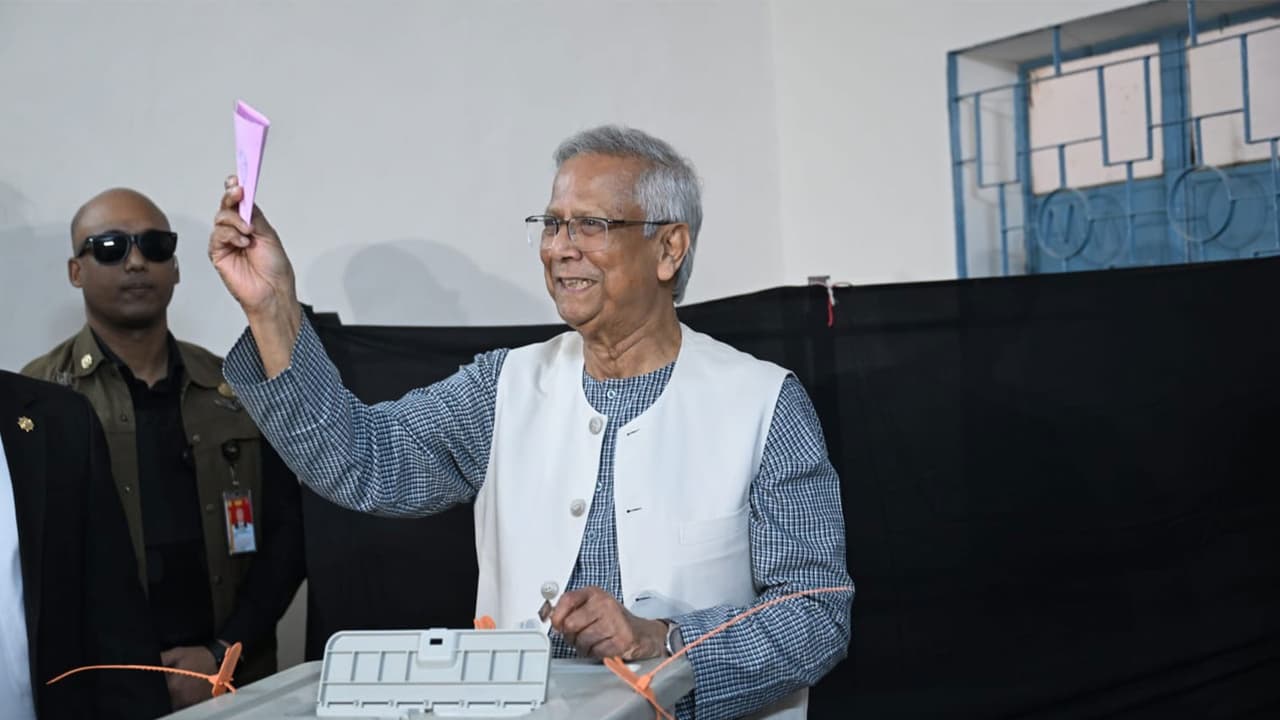
Interim Chief Adviser Muhammad Yunus cast his vote as Bangladesh's 13th parliamentary election and constitutional referendum commenced. The poll is seen as a key step in restoring democracy after last year's political upheaval.
Bangladesh's interim Chief Adviser Muhammad Yunus cast his ballot at the Gulshan Model School and College polling station in Dhaka on Thursday morning as the 13th national parliamentary election and constitutional referendum got underway. Yunus, who heads the interim government overseeing the poll, voted around 10:00 am (local time), joining millions of Bangladeshis participating in the country's first election in the wake of last year's political upheaval. The vote is widely seen as a pivotal step in restoring democratic governance after last year's uprising and changes in political leadership. The voting for Bangladesh's 13th Parliamentary elections marks a critical moment in the country's political history as it enters a new phase.

BNP Leader Expresses Hope
Earlier, Bangladesh Nationalist Party (BNP) Chairperson Tarique Rahman said that the country had been waiting for the election day to exercise their right to vote. He made the remarks after casting his vote at the Gulshan Model High School and College in Gulshan-2. "I have exercised my constitutional right to vote. For more than a decade, the people of Bangladesh have been waiting for this day," he said.
He added, "I have not yet received updates from across the country, but last night we received reports of some undesirable incidents from different areas, which were unexpected. We firmly believe that law enforcement agencies acted strictly to suppress these incidents, as we saw on television until late at night and early this morning. Personally, I strongly believe that if people across Bangladesh come out throughout the day and exercise their right to vote, any conspiracy can be thwarted. I am hopeful -- firmly hopeful."
The BNP was banned from contesting the last election in Bangladesh and Rahman had been living in exile prior to his return to the country last year. Rahman said his party would work towards women empowerment once they form the government. He also called people to come out and vote in large numbers as the country goes into the 13th parliamentary elections.
High Voter Turnout Marks Election Day
Meanwhile, voters in Bangladesh turned out early on election day, forming long queues outside polling booths from as early as 6 am (local time), reflecting both anticipation and hope for a transparent electoral process. The steady turnout and orderly arrangements marked a significant day for voters eager to exercise their democratic rights.
A Turning Point in Politics
The parliamentary elections come at a time of significant change, following the death of former Prime Minister Khaleda Zia and the ongoing ban on her long-time rival, Sheikh Hasina's Awami League party. This election is seen as a turning point, as the country looks to move beyond the decades-long 'Battle of Begums' era.
The vote count will begin at 4 pm on February 12. The Election Commission will officially announce the results in the morning of February 13, once counting is complete.
Election by the Numbers
With nearly 127 million eligible voters, the eighth most populous nation in the world heads to the polls. Nearly half the voters are between the ages of 18-37, as per Al Jazeera, of which 4.57 million are first-time voters.
There are 59 registered political parties in Bangladesh, excluding Awami League, whose registration was suspended by the Election Commission last year, nullifying its ability to field candidates in the fray. Of these, 51 parties are participating in this year's elections. In total, 1,981 candidates are contesting, including 249 independent ones. The contesting parties are- Bangladesh Nationalist Party (BNP), Jamaat-e-Islami, National Citizen Party (NCP), Jatiya Party (JP-Quader), Jatiya Party (JP-Ershad), Left Democratic Alliance and Amar Bangladesh Party (AB Party), as per Al Jazeera.
Key Issues and Referendum
Corruption, inflation, employment and economic development are the main issues deciding the election.
Besides the parliamentary election, the country is holding a referendum on the National Charter 2025 - a document drafted by the interim government led by Muhammad Yunus, setting the foundation for future governance, as per Al Jazeera.
(Except for the headline, this story has not been edited by Asianet Newsable English staff and is published from a syndicated feed.)
