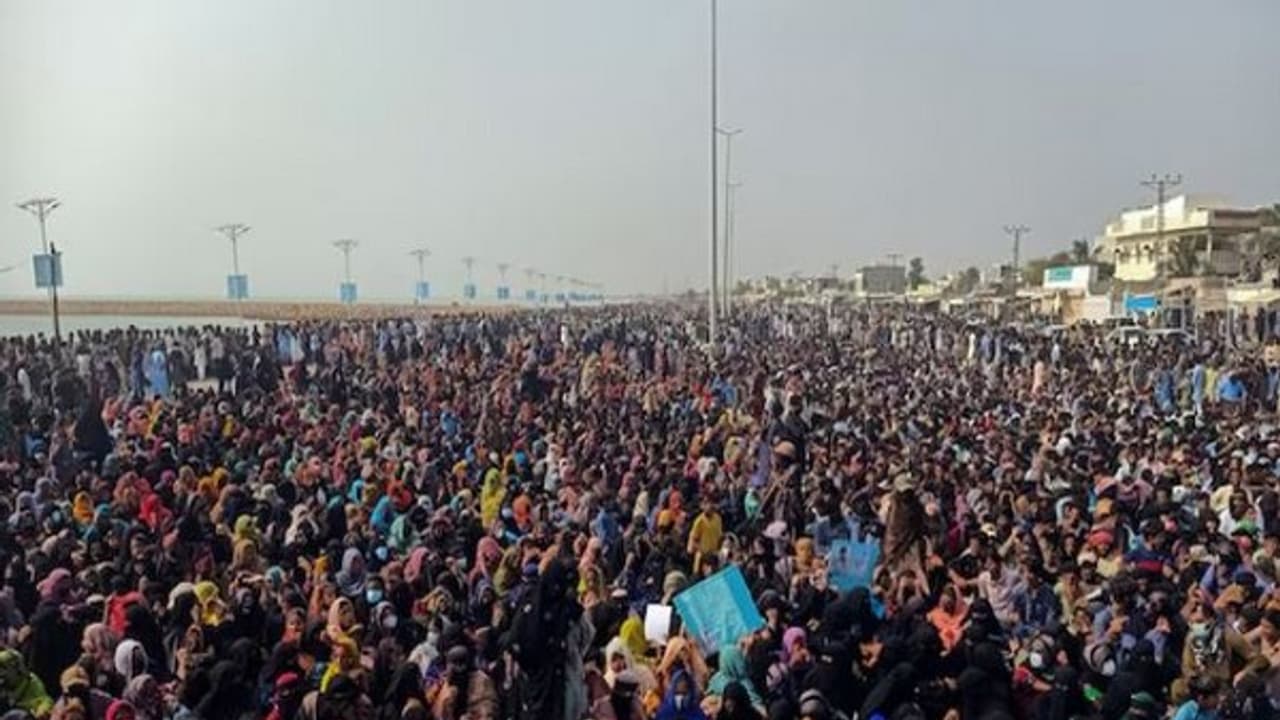
Balochistan, Pakistan’s largest province by land area, is rich in natural resources but remains one of the country’s poorest regions. Many locals say major projects like Gwadar Port and CPEC bring little benefit to them. Reports of enforced disappearances, heavy security presence and weak services have also raised concerns.
New Delhi: On 2 March, when Baloch communities marked Baloch Culture Day, the contrast between celebrations and the grim reality of life in Pakistan’s largest province could not be starker. The very assertion of cultural identity has come to coexist with a climate of fear, where enforced disappearances, militarised roads and silenced voices have become routine features of governance.

Balochistan today illustrates how a state can invoke security and “development” while hollowing out both federalism and basic human rights.
Federalism without fairness
Balochistan occupies nearly half of Pakistan’s landmass and sits atop vast reserves of gas, copper, gold and other minerals, yet it remains the country’s poorest province by most human development indicators. This paradox is not accidental; it flows from a centralising model of federalism in which decisions on resource extraction, infrastructure and revenue sharing are made in Islamabad and Rawalpindi, not in Quetta or Gwadar.
Related Articles

The financial architecture of flagship projects in the province lays bare this inequity. Official disclosures presented in Pakistan’s Senate show that 91 per cent of Gwadar Port’s revenue goes to the Chinese operator, China Overseas Ports Holding Company, and the remaining 9 per cent goes to the Gwadar Port Authority (GPA); Balochistan is granted no direct share at all. The associated free zone is similarly skewed, with 85 per cent of revenue flowing to the Chinese firm and 15 per cent to the Gwadar Port Authority, again excluding the provincial government and local bodies. For a province already distrustful of the centre, these arrangements are less like partnership and more like exploitation.
Even in high-profile mining projects like Reko Diq, the trend is revealing. Although Balochistan has been given a 25 percent stake in projects like Reko Diq alongside federal entities and a multinational mining company, many people in the province feel that the real decisions are still made elsewhere. Contracts are negotiated at the federal level.
Key terms are settled far from the communities living closest to the mines and locals often hear about developments after the fact. To many Baloch families, that 25 percent can seem symbolic — a number on paper — rather than genuine control over how their land and resources are managed.
The same anxieties surface around the China-Pakistan Economic Corridor (CPEC).
For fishermen in Gwadar, small landowners along new highway routes, or shopkeepers watching unfamiliar firms arrive, “development” can feel distant from daily life. Land acquisition, port expansion and security arrangements have brought visible change, but not always in ways that reassure local communities about jobs, consultation or long-term environmental impact. What is presented nationally as progress can, on the ground, feel like decisions made above their heads.
For many Baloch citizens, the frustration is not abstract ideology but lived experience: watching trucks carry minerals out while basic services remain weak, seeing checkpoints multiply while schools and hospitals struggle, and worrying that speaking out could invite trouble. In that emotional landscape, words like “federalism” ring hollow. What people often say they want is simpler — a real voice in decisions, a fair share of the benefits, and the dignity of being treated as partners in the future of their own province rather than bystanders to it. Job and service delivery promises are rarely kept, and this has further reinforced the perception that the social compact in Balochistan is not the same as in the rest of Pakistan.
Security state versus citizens
The presence of the security state in Balochistan is explained by Islamabad as a reaction to the threat of separatist insurgency and attacks on security forces and Chinese interests.
But Pakistan’s so-called counterinsurgency has increasingly blurred any line between militant and civilian, treating legitimate dissent, student activism and human-rights advocacy as security threats to be crushed rather than grievances to be heard.
Human Rights Watch has documented “kill and dump” operations in which suspected militants and opposition activists are abducted and later found dead, often bearing torture marks, with security agencies widely believed to be responsible.
Pakistan’s own Commission of Inquiry on Enforced Disappearances has registered thousands of cases nationwide, with Balochistan accounting for at least 2,752 of them between 2011 and early 2024; human-rights groups believe the real numbers are higher.
Amnesty International and domestic organisations describe enforced disappearances as a tool systematically used to silence Baloch students, political workers and human-rights defenders.
This trend has continued to the present day. UN human rights experts in 2025 expressed alarm at the “unrelenting use of enforced disappearances” in Balochistan and condemned reports of widespread torture, extrajudicial killings, and indiscriminate violence against peaceful protesters.
They noted that Pakistan seems to equate minority rights advocacy and peaceful protests with terrorism and drew attention to the repeated shutdowns of the internet that inhibit transparency and political engagement.
Human Rights Watch has similarly criticised large-scale detentions, excessive force against marchers highlighting abuses in Balochistan, and the routine suspension of internet services around protests in Gwadar.
For ordinary Baloch citizens, this translates into a suffocating militarisation of everyday life: ubiquitous checkpoints, intrusive surveillance and the omnipresent fear that a son leaving for university or a husband travelling for work may simply not return.
Such governance erodes any residual trust in federal institutions and pushes politics out of the constitutional arena and into the shadows.
Development under the barrel of a gun
What Pakistan markets internationally as a development corridor looks, from the ground in Balochistan, like a security corridor.
Research on CPEC’s implementation in the province highlights land grabbing, ecological damage, restricted fishing rights for traditional communities, and the silencing of local voices in environmental and social-impact decision-making.
In major coastal cities surrounding Gwadar, residents and activists often say there are more military check-points than schools or hospitals, and more security briefings than public consultations.
The federal government’s apparatus generally has a tendency to view this militarisation as a necessary price to pay for securing investments and foreign labor.
However, this is exactly the opposite, since by denying the local population a voice in the planning process and by denying them a fair share of the revenue, as well as by criminalising peaceful protest, the state is actually creating the resentment that militant groups later exploit. Mega-projects are thus at risk of becoming physical manifestations of dispossession.
This is not just a domestic failure; it also places Islamabad in breach of its international obligations. UN experts have urged Pakistan to criminalise enforced disappearances in line with international law, ratify the International Convention for the Protection of All Persons from Enforced Disappearance and ensure independent investigations into alleged abuses.
Persistent non-compliance not only damages Pakistan’s already frayed democratic credentials but also undermines any claim that its counterterrorism posture is rules based.
For Balochistan, the path out of this spiral does not lie in bigger garrisons or more opaque deals with foreign investors; it lies in reimagining Pakistan’s federal compact on genuinely democratic terms. At minimum, this requires transparent and constitutionally entrenched revenue-sharing mechanisms that guarantee the province a significant, predictable share of earnings from its gas fields, mineral deposits, fisheries and ports. Agreements over assets like Gwadar and Reko Diq must be reopened to ensure that Balochistan’s government and affected communities have veto bearing seats at the table rather than token representation.