
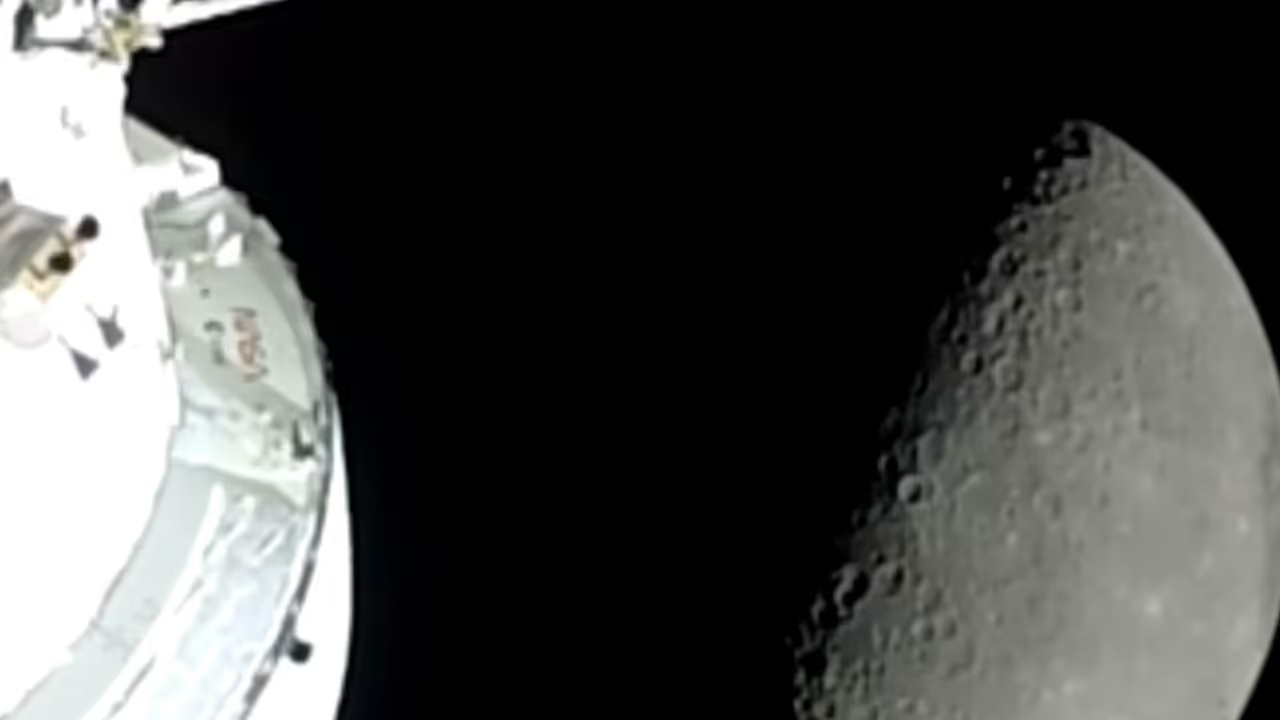
The Artemis II crew has started its moon flyby, observing the far side and specific lunar features. Astronauts reported seeing new colours like brown, providing data on mineral composition, and broke the Apollo 13 record for farthest human travel.
Observing the Far Side of the Moon
The Artemis II crew has begun the seven-hour flyby of the moon, with Astronauts observing the far side of the moon never seen by Humans. The crew is working in shifts as they make the necessary observations set by the NASA's science team that include future Commercial Lunar Payload Services (CLPS) mission landing site Reiner Gamma, a bright, mysterious swirl the origin of which scientists are still trying to understand, and Glushko, a bright, 27-mile-wide crater known for the white streaks that shoot out from it for up to 500 miles.

New Scientific Insights on Lunar Composition
"The crew reported colour nuances, which will help enhance scientific understandings of the Moon. Shades of browns and blues that can be picked out with human eyes can help reveal the mineral composition of a feature and its age. As crew reports are received, the science team is updating the observation plan based on their follow-up questions and sending up new guidance to the crew," NASA said in a blog post.
NASA astronaut Christina Koch said that the moon appears to be browner, as opposed to the shades of white and grey seen from the earth. "Something I just heard from the window team is 'the more I look at the moon, the browner and browner it looks,'" NASA astronaut Christina Koch said.
Christina Koch added that some of the moon's craters look like "a lampshade with tiny pinprick holes," "All the really bright, new craters -- some of them are super tiny, most of them are pretty small -- there's a couple that really stand out, obviously, and what it really looks like is a lampshade with tiny pinprick holes and the light shining through," she said.
Meet the Artemis II Crew
The crew includes NASA astronauts Reid Wiseman, Victor Glover, and Christina Koch, along with Canadian Space Agency astronaut Jeremy Hansen.
Breaking Human Spaceflight Records
The Artemis II mission has broken the record for the farthest distance travelled by humans from Earth, breaking the Apollo 13 mission's record of 248,655 miles The Artemis II reached a maximum distance of 252,752 miles from Earth at 1:57 pm EDT, surpassing the Apollo 13's record in 1970 by about 4,102 miles, the National Aeronautics and Space Administration (NASA) said in a post on X.
Orion Spacecraft, carrying the Artemis II crew, is expected to reach its maximum distance from our planet at 7:07 p.m. ET.
The Artemis II mission marks a key step in NASA's plans to return humans to the Moon and advance future deep space exploration. (ANI)
(Except for the headline, this story has not been edited by Asianet Newsable English staff and is published from a syndicated feed.)