
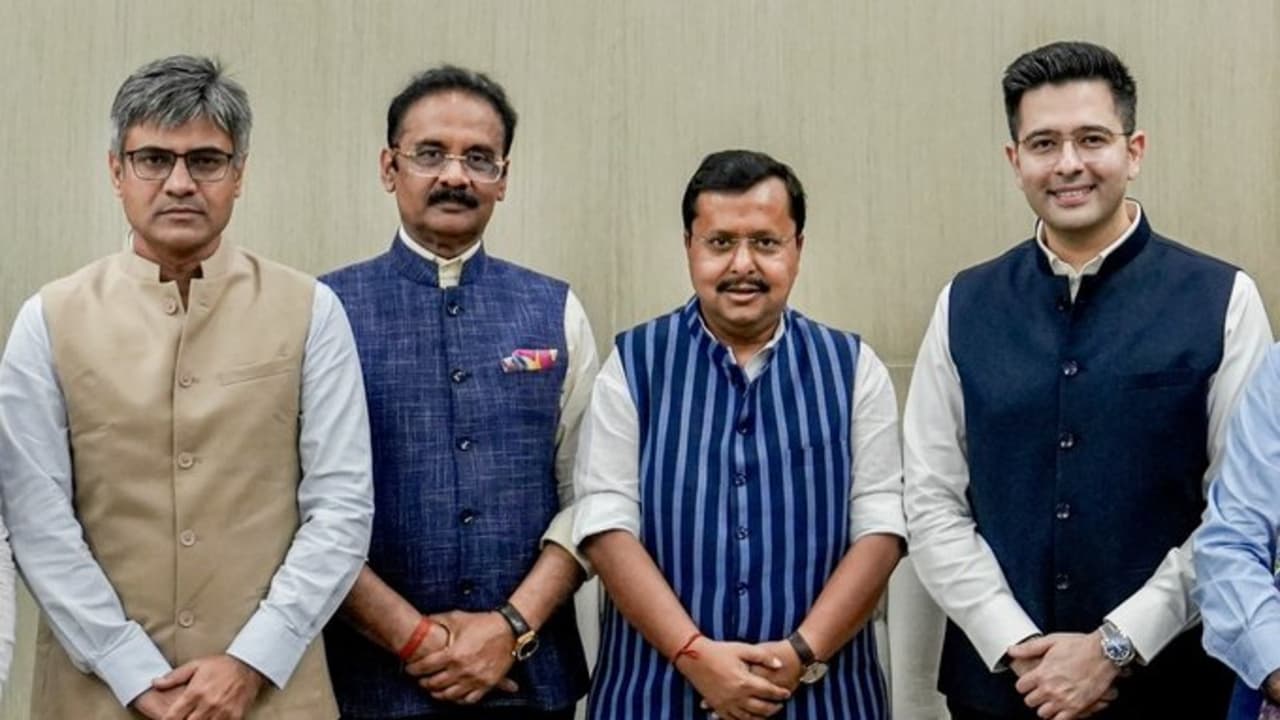
Prominent Aam Aadmi Party (AAP) leader Raghav Chadha has defected to the Bharatiya Janata Party (BJP), leading a revolt of seven Rajya Sabha MPs. This move, representing two-thirds of AAP's upper house members, allows them to merge with the BJP without disqualification.
Raghav Chadha’s decision to break away from the Arvind Kejriwal-led Aam Aadmi Party (AAP) and align with the Bharatiya Janata Party has emerged as one of the biggest political shocks in recent Indian politics. What initially appeared to be a sudden defection has now been described as a carefully planned internal revolt that unfolded over weeks, eventually culminating in seven AAP Rajya Sabha MPs leaving the party together and significantly weakening AAP’s parliamentary strength.

The move has sent ripples through national politics because Chadha was long considered one of AAP’s most prominent young leaders and among the closest faces associated with the party’s rise. His departure has not only embarrassed the party leadership but also raised larger questions about internal discontent within AAP and its future in Punjab, the only state where the party currently holds power.
How the split began
According to reports, the roots of the rebellion can be traced back to early April, when the AAP leadership removed Raghav Chadha from the post of deputy leader in the Rajya Sabha. While the decision appeared administrative on the surface, insiders say it reflected a widening rift between Chadha and the party’s central leadership.
The removal reportedly became the turning point. Soon after being sidelined, Chadha is said to have begun private discussions with other AAP MPs, many of whom had become increasingly dissatisfied with the direction of the party. Several leaders reportedly felt marginalized after the party’s recent setbacks and believed decision-making had become concentrated in a small inner circle.
What followed was not an impulsive move but a coordinated effort to gather enough lawmakers to avoid disqualification under India’s anti-defection law. Under parliamentary rules, if two-thirds of members of a legislative group split together, they can merge with another party without losing their seats.
AAP had ten members in the Rajya Sabha. Chadha succeeded in securing the support of seven — enough to cross that legal threshold.
At a press conference, Chadha confirmed the strategy, saying, "More than two-thirds of the Aam Aadmi Party's Rajya Sabha MPs are with us in this initiative. They have already signed, and this morning we submitted all the required documentation, including signed letters and other formal paperwork, to the chairman of the Rajya Sabha."
Also Read: Majithia slams AAP as Rajya Sabha MPs join BJP, cites Punjab neglect
The seven MPs who crossed over
The rebellion was not limited to one faction inside the party. The seven MPs represented different streams within AAP.
The defectors reportedly included:
• Raghav Chadha
• Sandeep Pathak
• Swati Maliwal
• Ashok Mittal
• Vikramjeet Sahney
• Rajendra Gupta
Some were long-time political faces within AAP, while others were professionals and public figures who entered politics through the party. The combination made the rebellion more damaging because it showed dissatisfaction was not confined to a single ideological group.
Among them, Chadha remained the public face of the split, while several others stayed away from the initial press conference for personal or logistical reasons. Still, Chadha insisted every member had signed the merger papers.
Chadha’s public attack on AAP
When he finally spoke publicly, Chadha delivered a sharp and emotional criticism of the party he had helped build.
He said, "AAP, that I nurtured with my blood and sweat and to which I gave 15 years of my youth, has completely strayed from its principles, values and core morals."
He added, "Over the past few years, I have increasingly felt that I am the right person in the wrong party."
Those remarks were seen as a direct attack on the leadership of Arvind Kejriwal and the current functioning of the party.
Sandeep Pathak echoed a similar sentiment, stating, "For 10 years, I remained associated with this party. And today, I am parting ways with the Aam Aadmi Party."
The language used by the rebel MPs suggested the split was rooted not just in personal ambition but also in deeper frustration over the party’s direction.
AAP’s furious response
AAP reacted strongly to the defections, accusing Chadha of betrayal and claiming the BJP had engineered the split to weaken opposition parties.
Party leaders accused Chadha of abandoning the platform that made him a national figure. One of the sharpest responses from the party said:
"Consider this: the party made Raghav Chadha an MLA and an MP. What didn't the party give him?"
The party also referred to the defectors as traitors and said voters in Punjab should remember their names.
AAP leaders argued that the BJP had once again used its political influence to break rival parties, especially in states where the opposition remains competitive.
Also Read: AAP MPs join BJP: Kejriwal, Sisodia hold late-night meet on strategy
Why Punjab matters
The political consequences of this rebellion may be most serious in Punjab. Six of the seven rebel MPs are linked to the state, where AAP governs under Chief Minister Bhagwant Mann.
The timing is particularly damaging because AAP is already preparing for the 2027 Punjab Assembly elections. Losing several prominent parliamentary faces now could weaken the party’s organization and public perception in the state.
Some analysts believe the revolt reflects a deeper divide between the Delhi leadership and the Punjab unit. The growing tensions had reportedly been building for months before finally erupting into open rebellion.
BJP’s gain
For the BJP, Chadha’s move represents a strategic victory. By bringing in young and recognizable opposition leaders, the party not only strengthens its numbers in the Rajya Sabha but also sends a message about its expanding political reach.
The BJP welcomed the leaders publicly after the announcement. Party figures described the development as proof that opposition leaders increasingly see Prime Minister Narendra Modi’s leadership as the future of Indian politics.
What happens next
The immediate next step is formal approval from the Rajya Sabha Chairman, who will review the submitted documents before recognizing the merger.
If approved, the seven MPs will officially become part of the BJP bloc in Parliament, permanently reducing AAP’s influence in the Upper House.
For Kejriwal, the rebellion is more than a parliamentary setback. It is a symbolic blow that exposes internal cracks inside a party once seen as tightly controlled and united.
For Chadha, the move marks the most dramatic political gamble of his career.
Whether it strengthens his long-term future or turns him into one of Indian politics’ most controversial defectors will become clearer in the months ahead — but one thing is already certain: this rebellion has changed the political equation for both AAP and the BJP.
Also Read: Majithia slams AAP as Rajya Sabha MPs join BJP, cites Punjab neglect
