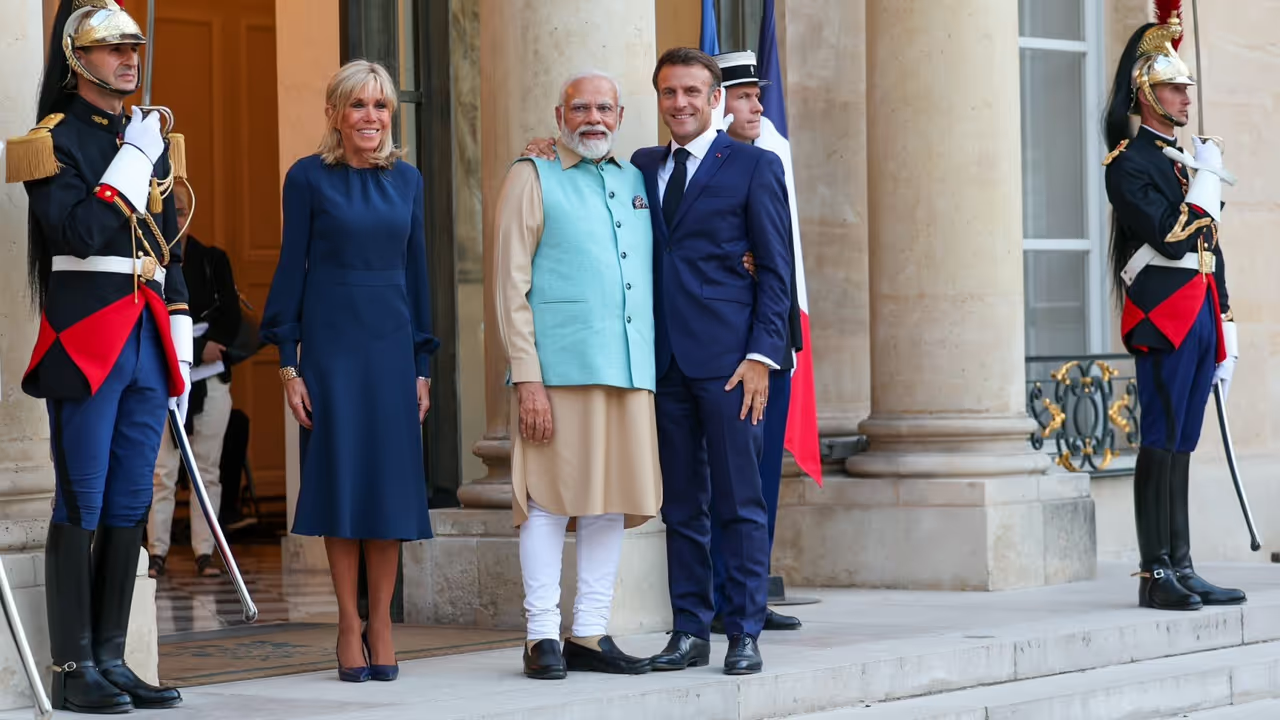
French President Emmanuel Macron is on a 3-day official visit to India, to deepen the strategic partnership with PM Modi. The agenda includes his participation in the India AI Impact Summit and bilateral talks on defence, trade, and innovation.
French President Emmanuel Macron has embarked on a significant three-day official visit to India from February 17 to February 19, 2026, marking his fourth bilateral trip since taking office in 2017. His visit reflects the deepening strategic partnership between India and France, with a broad agenda covering artificial intelligence, defence cooperation, innovation, trade, and global strategic issues.

Macron arrived in Mumbai on the evening of February 16, where he was received by senior Indian officials, including Maharashtra Governor Acharya Devvrat and Chief Minister Devendra Fadnavis. The visit was announced at the invitation of Prime Minister Narendra Modi and comes at a time when both nations are seeking to strengthen defence, technology and economic ties.
AI Impact Summit 2026
The cornerstone of Macron’s trip is his participation in the India AI Impact Summit 2026, hosted in New Delhi from February 16 to 20. The event, which builds on the 2025 AI Action Summit co-hosted by Macron and Modi in Paris, aims to bring together global leaders, policymakers, industry experts and innovators to discuss responsible and equitable AI development. The summit’s discussions are expected to explore collaboration on ethical AI frameworks, joint research, and technology partnerships that support innovation and digital growth.
Related Articles

Macron and Modi are also scheduled to hold detailed bilateral talks in Mumbai, beginning with a meeting at Lok Bhavan. These discussions are structured to review progress across strategic areas identified under the Horizon 2047 Roadmap, a long-term vision for India–France cooperation. Both leaders are expected to address regional and global issues of mutual interest, including Indo-Pacific security, economic cooperation, and shared responses to global challenges.
A major focus of the defence dialogue is a potential landmark deal for 114 additional Rafale fighter jets, which could be worth roughly ₹3.25–3.60 lakh crore (approximately $35–40 billion). This would be one of India’s largest defence acquisitions to date and would further deepen France’s role as a key defence partner. Under this framework, 18 jets are expected to be delivered in fly-away condition, while the remaining aircraft would be manufactured in India under the Make in India initiative, boosting local defence manufacturing and technology transfer.
The proposed Rafale acquisition complements broader moves by India to modernize its armed forces and reduce dependence on traditional sources for military hardware, reflecting a strategic shift toward diversified defence procurement. Additionally, French aerospace engine maker Safran has indicated its readiness to establish engine assembly capabilities in India, potentially further aligning industrial cooperation between the two nations.
Beyond defence and AI, the two leaders will formally inaugurate the India-France Year of Innovation 2026 in Mumbai. This initiative, originally announced during Macron’s 2024 state visit to India, aims to promote collaboration between start-ups, researchers, businesses and technology communities across both countries. The inauguration is expected to include interactions with industry leaders and innovators, highlighting joint efforts toward technological progress and entrepreneurship.
Other key areas on the agenda include expanding bilateral trade, strengthening supply chains, enhancing cooperation in critical minerals and advancing cultural and educational exchanges. Both sides are also expected to discuss regional matters, such as the strategic dynamics in the Indo-Pacific, and reinforce their shared commitment to global peace and stability.
Macron’s visit underscores the growing importance of India-France ties amid evolving global geopolitical landscapes. As he moves next to New Delhi for the AI summit, both nations are poised to showcase significant agreements and shared strategic commitments that could shape the future trajectory of their partnership in technology, defence and economic collaboration.