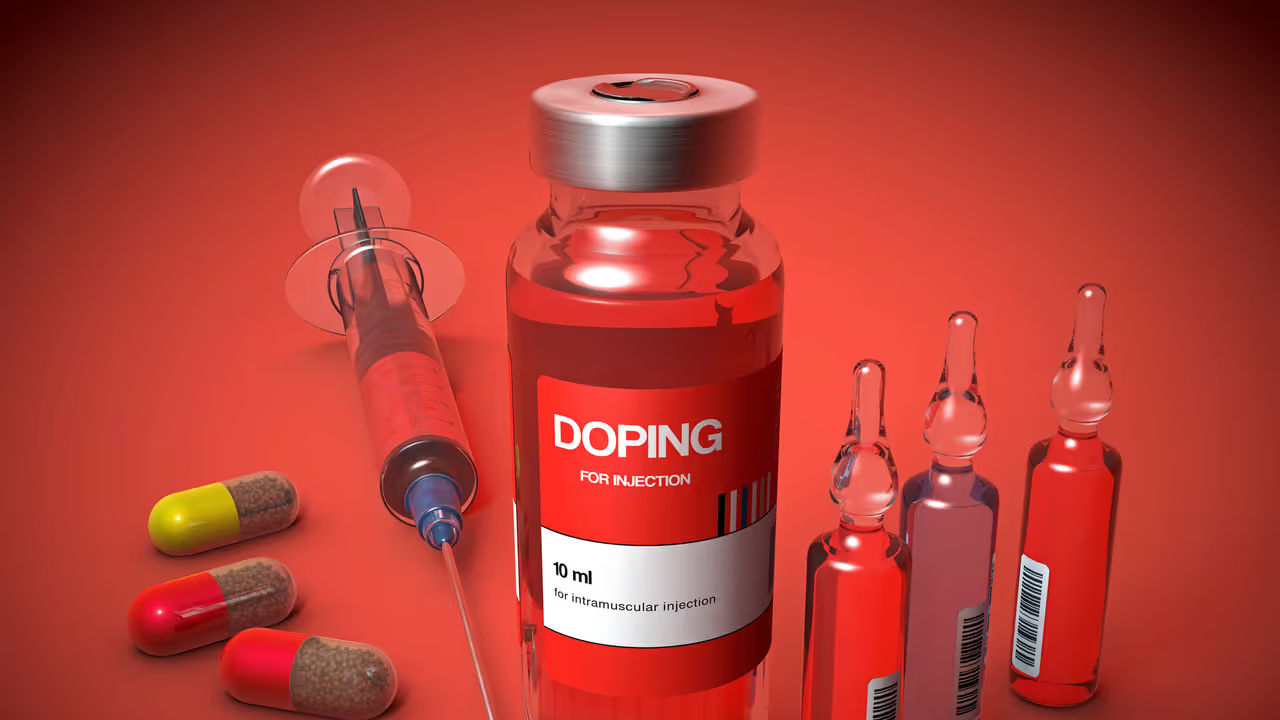
India tops global doping charts again despite expanded testing and awareness drives. As Olympic ambitions grow, high positivity rates raise tough questions about clean sport and credibility.
There appears to be no end in sight to India’s long-running battle with doping, as the country once again finds itself at the top of an unenviable global list. According to the World Anti-Doping Agency’s (WADA) Testing Figures Report for 2024, India recorded the highest number of doping violators among nations that conducted more than 5,000 tests during the year.

The data throws up uncomfortable questions at a time when India is positioning itself as a serious contender to host the 2036 Olympic Games — a bid that will inevitably come under scrutiny from the International Olympic Committee (IOC).
The Numbers That Refuse to Go Away
As per WADA’s report, India conducted 7,113 tests in 2024, comprising 6,576 urine samples and 537 blood samples. From these, 260 adverse analytical findings were recorded, resulting in a positivity rate of 3.6 per cent — the highest among all major testing nations.
Related Articles

While this marks a marginal improvement from 2023, when India posted a 3.8 per cent positivity rate after 213 adverse results from 5,606 tests, the overall picture remains troubling.
In comparative terms, the contrast is stark:
China, which carried out a massive 24,214 tests, reported a positivity rate of just 0.2 per cent.
The United States, despite conducting fewer tests than India (6,592), returned a positivity rate of 1.1 per cent.
Even Russia, long ostracised for state-sponsored doping failures, recorded a 0.7 per cent positivity rate after 10,514 tests, with only 76 adverse findings.
A handful of countries, including Pakistan and Mongolia, showed higher positivity rates than India, but they conducted far fewer tests, making comparisons uneven.
NADA’s Defence: More Tests, Not More Doping
Faced with growing criticism, the National Anti-Doping Agency (NADA) has been quick to push back against the narrative that India’s figures reflect worsening athlete behaviour.
“…this position may appear concerning at both national and international levels, it is essential to underscore that the figures are a direct outcome of India’s intensified anti-doping efforts, marked by expanded testing and stronger detection mechanisms rather than a surge in doping prevalence,” NADA said in a note explaining the high positivity rate.
According to the agency, aggressive testing and better detection — rather than an explosion in doping — is bringing more cases into the open.
“In recent years, India has witnessed a significant strengthening of its anti-doping framework. To tackle the menace of doping in sports NADA India has not only increased the number of tests but also has increased the emphasis on education and awareness,” it stated.
Early Signs of Improvement in 2025?
NADA has also pointed to early data from 2025 as evidence that its reforms may be starting to yield results.
So far this year, the agency has conducted 7,068 tests, almost matching last year’s total, but recorded only 110 adverse findings, bringing the positivity rate down to 1.5 per cent.
While officials caution against drawing long-term conclusions from partial data, the drop is being seen as an encouraging sign.
“The available data reflects that the overall anti-doping ecosystem is becoming more robust, with improvements visible across testing, awareness, and preventive mechanisms,” NADA said.
Education Over Enforcement Alone
Beyond testing, authorities are increasingly focusing on education — a shift driven by the belief that many violations stem from ignorance rather than intent, particularly in grassroots and power sports.
“In 2024, around 280 anti-doping workshops were conducted during sports events and training camps, reaching approximately 37,000 participants,” NADA said.
The effort has intensified further this year.
“Additionally, by December 16, 2025, 329 awareness programs were held, including webinars, seminars, TV sessions, ADEL courses, mega events, engaging competitions and digital campaigns to engage a wider audience,” it added.
“These initiatives have contributed to improved understanding of prohibited substances, safe medication practices, and the responsibilities expected under the anti-doping framework.”
Preventing ‘Inadvertent Doping’
One area that has drawn particular attention is unintentional doping, often caused by contaminated supplements or common medications.
To address this, NADA has rolled out the ‘Know Your Medicine’ App, which allows athletes and support staff to check whether a drug or supplement contains prohibited substances.
“… (It) enables athletes and support personnel to verify whether any substance or medication contains prohibited ingredients. As of 2024, the app has approximately recorded a cumulative 2,40,000 searches, reflecting its growing adoption as a preventive tool against inadvertent doping,” NADA said.
The agency is also working with the Food Safety and Standards Authority of India (FSSAI) and the National Forensic Science University (NFSU) to strengthen testing of nutritional supplements — a known risk area for athletes.
A Test Beyond the Track
Sports Minister Mansukh Mandaviya has repeatedly underlined the government’s commitment to tackling doping, particularly in athletics and power sports such as weightlifting, which have historically contributed a large share of violations.
Yet, despite reforms, awareness drives and early signs of improvement, the numbers continue to haunt India’s sporting reputation.
As the country dreams of hosting the Olympics, the challenge is no longer just about winning medals — it is about convincing the world that Indian sport can compete cleanly. Until the positivity rate drops decisively and consistently, India’s doping crisis will remain an obstacle no amount of ambition can wish away.