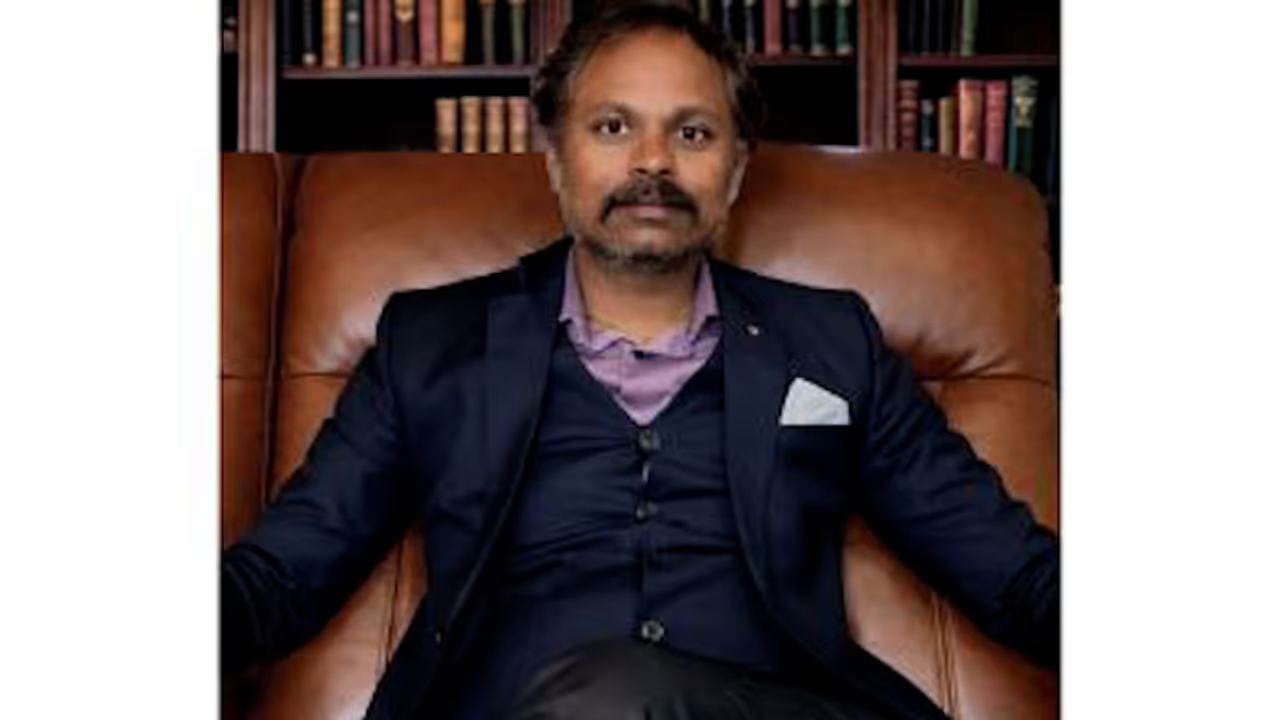
In a world where digital infrastructure behaves like a living organism—adaptive, intelligent, and deeply interconnected— Ramalingaswamy represents a new generation of technology leaders.
Sivachandar Ramalingaswamy stands as one of the rare modern technology architects whose expertise spans the full spectrum of cybersecurity, cloud engineering, data platforms, AI-driven automation, and large-scale legacy modernization. Shaped by two decades of experience inside some of America’s most regulated and mission-critical industries, he has built a career at the intersection of security, intelligence, and modernization—where the future of the nation’s digital infrastructure is being defined.

Educated in the high-pressure environments of Fortune 500 enterprises, Ramalingaswamy has architected zero-trust identity systems that reduced privileged-access risk by more than 60%, designed cloud-native data platforms that power AI-driven analytics, and modernized legacy systems that millions of Americans rely on every day. His work is increasingly infused with cutting-edge AI capabilities—from identity-aware automation to machine-learning-enabled data ecosystems—ensuring that the systems he builds are not only secure and scalable, but future-proof.
In a world where digital infrastructure behaves like a living organism—adaptive, intelligent, and deeply interconnected— Ramalingaswamy represents a new generation of technology leaders. He honors the foundations of legacy systems while boldly applying cloud, automation, and AI to modernize them at national scale. His architectural philosophy is simple: secure the core, modernize the legacy, and build platforms that can evolve for decades.
Related Articles

INTERVIEW
Your background spans some of the most regulated and mission-critical industries in the United States. What has this taught you about precision and consistency in modern technology?
My work across financial services, healthcare, insurance, and logistics has fundamentally reshaped my understanding of precision. At FedEx, State Farm, Zurich Insurance, and United Healthcare, I learned that excellence is no longer defined by performance alone. Modern enterprises must be secure, resilient, and intelligent—not just in infrastructure, but in identity, data, and innovation.
Technology is the foundation of the entire digital journey—from the login request to the transaction, the workflow, the business outcome, and ultimately the long-term trust between an organization and its customers. Just as the world’s most influential technology leaders built their companies on precise engineering, today’s enterprises must be built on zero-trust security, precise systems, and data-driven governance. Precision is no longer optional; it is the backbone of national resiliency.
You’ve modernized legacy systems that millions of Americans rely on. How has modernization changed your architectural thinking?
Modernization forced me to rethink architecture from first principles.
I’ve redesigned legacy applications using BPM solutions, re-hosted mainframe workloads to the cloud using Micro Focus, and built Medallion-layered Snowflake platforms that transform data from static assets into intelligent ecosystems. What once lived in monolithic applications and ETL jobs now exists as cloud-native pipelines—automated, observable, and protected with zero-trust authentication.
At FedEx, modernization became almost a performance art. We used threat modeling, identity-driven authentication, and workload identity to eliminate hard-coded credentials and establish cryptographic trust between services. Every service call, every pipeline, every identity path was evaluated as part of a larger system.
Modernization taught me that legacy is not a burden—it is a foundation that must be elevated, not replaced.
Identity and privileged access have become the focal point of national cybersecurity. What has been your contribution in this area?
Identity is now the true security perimeter. If identity is compromised, every other layer of security collapses.
Across multiple enterprises, I have led the design and implementation of unified privileged-access programs that reduced risk by more than 60% and established a culture of “secure by design” across hybrid cloud environments.
One of my most impactful contributions has been implementing modern workload identity practices—removing hard-coded credentials and replacing them with cryptographically verifiable authentication between systems. This eliminates one of the most common attack vectors in enterprise environments.
This work strengthens national cyber defense by:
- removing pathways for credential theft
- enforcing strict identity-driven access controls
- reducing insider-threat exposure
- aligning enterprises with national security and regulatory standards
Identity security is no longer a technical discipline—it is a national security imperative.
You’ve designed enterprise analytics platforms that support AI/ML workloads. How does this strengthen U.S. innovation?
AI is only as strong as the platform beneath it.
I’ve designed Medallion-layered data platforms and Snowflake ecosystems that enable enterprises to:
- detect fraud in real time
- improve healthcare outcomes
- optimize logistics
- reduce operational costs
- accelerate AI adoption across business units
These capabilities directly impact the lives of millions of Americans. As AI reshapes the U.S. economy, my mission is to ensure the underlying platforms are secure, governed, and scalable.
You’ve worked in environments where failure is not an option. What principles guide your architectural philosophy?
Three principles guide everything I build:
1. Secure the Core
Identity, access, and data security must be embedded—not added later.
2. Modernize Without Disruption
Legacy systems contain decades of business logic. Modernization must elevate them without interrupting the services Americans rely on.
3. Build for Evolution, Not Completion
Cloud, AI, and automation are living systems. Architecture must evolve continuously.
These principles ensure that systems are not just functional—they are resilient, intelligent, and future-ready.
Outside your professional achievements, you’ve also contributed to the arts and community. Can you share more about that?
Art and service have always been part of who I am. I’ve worked with NGOs to create model replicas of UNESCO-recognized monuments—such as the Tanjore Brihadeeswarar Temple, the Hampi Stone Chariot, and the Descent of the Ganges—using my sculpting skills. These works have been displayed at major cultural conventions like FETNA, AKKA, and TNF, where they received standing ovations. They will soon be displayed permanently at a museum in Houston, Texas.
I am also a Veenai musical artist. Performing at various cultural events helps me stay connected to my roots while giving back to the community.
How do you see your work benefiting the United States in the coming decade?
The next decade will be defined by AI, identity, cloud computing, and modernization at national scale. My contributions will focus on:
1. Strengthening National Cybersecurity
Designing zero-trust architectures, workload identity models, and PAM solutions that help U.S. enterprises stay ahead of emerging threats.
2. Modernizing Legacy Infrastructure
Millions of Americans still rely on systems built 20–40 years ago. I will continue modernizing these systems into secure, cloud-native platforms.
3. Enabling Responsible AI Adoption
AI will transform healthcare, finance, logistics, and insurance. I will continue designing secure, governed data platforms that enable responsible AI innovation.
My mission is simple:
To help build a United States where critical systems are secure, modern, and capable of supporting the next generation of innovation.
How do you balance innovation with the strict regulatory requirements of industries like healthcare and finance?
Innovation and regulation are not opposites—they are partners.
Regulation defines the guardrails; innovation defines the possibilities within them.
My approach is to design architectures where compliance is automated, auditable, and embedded into the workflow. When compliance becomes part of the system rather than a checkpoint, innovation accelerates naturally.
What leadership qualities are essential for guiding large-scale modernization programs?
Three qualities matter most:
- Clarity — Teams must understand the “why,” not just the “what.”
- Calmness — Modernization is complex; leaders must bring stability.
- Courage — Modernization requires making decisions that impact millions of users.
Leadership is not about directing technology—it’s about enabling people to build confidently.
What role does observability play in your architectural strategy?
Observability is the nervous system of modern architecture.
Without it, you are operating blind.
I design systems where logs, metrics, traces, and identity signals form a unified intelligence layer. This allows enterprises to detect anomalies early, optimize performance, and maintain trust in mission-critical systems.
What advice would you give to the next generation of architects?
- Learn identity deeply—it is the new perimeter.
- Respect legacy systems—they contain decades of wisdom.
- Build for evolution—your architecture should outlive your tools.
- Stay curious—AI, automation, and cloud are changing daily.
*Architecture is not just a job; it is a responsibility.