
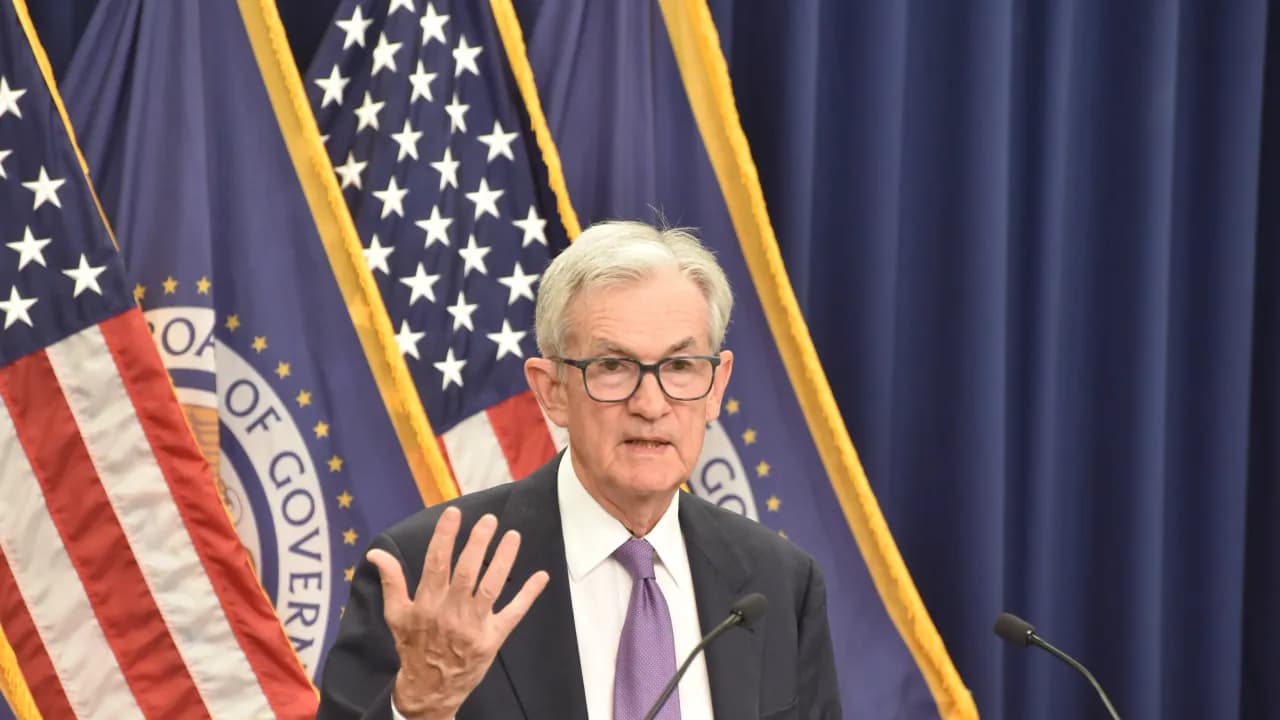
The economist said Powell’s tone on inflation, acknowledgment of labor market softness, and the shift on the balance sheet point to a more accommodative direction.
- Following the shift in Powell’s tone on inflation, Siegel noted that when the central bank stops treating every price rise as the beginning of a new inflation regime, the bar for restrictive policy falls.
- The economist added that even though Powell did not pre-commit to further rate cuts, everything else he said about the economic conditions pointed to a more accommodative stance going forward.
- Amid these labor market concerns, the economist added that jobless claims will need to be watched more closely going forward.
Jeremy Siegel, professor emeritus of finance at the University of Pennsylvania’s Wharton School of Business, on Tuesday stated that Federal Reserve Chair Jerome Powell’s “conceptual shift” on inflation was significant in a decision that he described as a dovish version of a “hawkish cut.”

“Powell emphasized that inflation pressures are concentrated in tariff-affected goods rather than services, and that much of that impulse is already behind us. He repeatedly referenced TIPS break evens as evidence that inflation expectations remain well anchored. That matters enormously,” said Siegel.
The Fed announced a 25-basis-point rate cut last week, in line with market expectations. In its announcement, the central bank noted that while inflation remained elevated, job gains had slowed down and the unemployment rate had edged up through September.
Bar For Restrictive Policy
Following the shift in Powell’s tone on inflation, Siegel noted that when the central bank stops treating every price rise as the beginning of a new inflation regime, the bar for restrictive policy falls.
The economist added that even though Powell did not pre-commit to further rate cuts, everything else he said about the economic conditions pointed to a more accommodative stance going forward.
“His tone on inflation, his acknowledgment of labor market softness, and an underappreciated shift on the balance sheet—tilted clearly in a more accommodative direction,” Siegel said.
‘Striking’ Labor Market Discussion
Siegel also noted that the discussion around the labor market was “striking.”
Following the rate cut announcement, Powell said that payrolls are estimated to have been overstated by 60,000 per month since April.
“I think you can say that the labor market has continued to cool gradually, maybe just a touch more gradually than we thought,” said Powell, while responding to reporters.
Amid these labor market concerns, the economist added that jobless claims will need to be watched more closely going forward. “The Fed is forecasting unemployment around 4.4–4.5%, and we are beginning to see early signs consistent with that path,” he said.
Meanwhile, U.S. equities declined in Tuesday’s pre-market trade. At the time of writing, the SPDR S&P 500 ETF (SPY), which tracks the S&P 500 index, was down by 0.15%, the Invesco QQQ Trust ETF (QQQ) declined 0.29%, while the SPDR Dow Jones Industrial Average ETF Trust (DIA) fell 0.1%. Retail sentiment around the S&P 500 ETF on Stocktwits was in the ‘bullish’ territory.
The iShares 7-10 Year Treasury Bond ETF (IEF) was up 0.06% at the time of writing.
For updates and corrections, email newsroom[at]stocktwits[dot]com.<
