
After SpaceChain sent and installed a blockchain hardware onto the International Space Station 9 years ago, an attempt to mine crypto in space has resurfaced.
- Tesla and Bitcoin investor Gali highlighted the possibility of Bitcoin mining in space, calling it a potential boost for decentralization.
- Starcloud CEO Philip Johnston said the company planned to place Bitcoin mining ASICs on its second spacecraft later this year.
- Johnston argued that ASIC hardware is far cheaper than GPU compute, making space-based mining economically viable.
As cryptocurrency gains momentum globally, a space infrastructure startup explored whether Bitcoin (BTC) could be mined in space.

More than a decade-long investor in Tesla (TSLA) and Bitcoin, Gali discussed whether Bitcoin mining in space could strengthen the network’s decentralization and resilience.
“Bitcoin mining in space?! Am I the only one freaking out about this? A massive needle mover for decentralization and resiliency of the world’s most powerful cryptocurrency,” he wrote on Saturday.
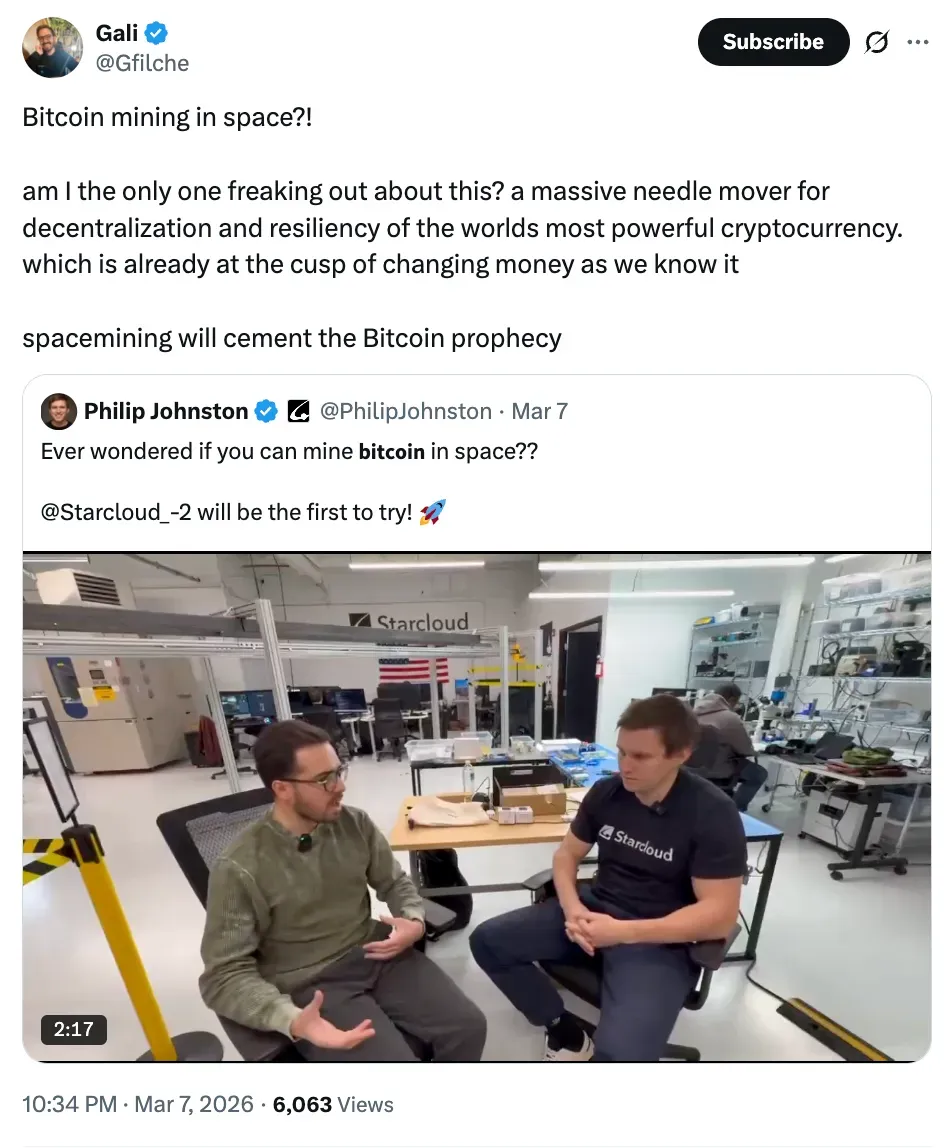
According to Gali, the concept of “spacemining” could become a significant development for Bitcoin as the asset continues to evolve as a global monetary network.
“Spacemining will cement the Bitcoin prophecy,” he said.
Bitcoin Mining ASICs In Orbit
The discussion followed comments from Philip Johnston, CEO of space infrastructure startup Starcloud, who said the company plans to place Bitcoin mining application-specific integrated circuits (ASICs) on a spacecraft launching later this year.
“We’ll have some Bitcoin mining ASICs on the second spacecraft launching later this year. This thing will be the first to mine a coin in space,” Johnston said in a recent conversation with Gali.
Johnston suggested that Bitcoin mining could become one of the most practical use cases for space-based computing infrastructure. Starcloud told PC Mag that it has submitted a request to the FCC to run 88,000 satellites for data centers in orbit.
According to Johnston, the economics of Bitcoin mining hardware made it more suitable for deployment in space than traditional AI systems. He also said Bitcoin mining was well-suited to environments with unconventional or variable energy sources.
“With Bitcoin mining, you can basically use any energy source you want anywhere in the world,” he said. He added that the launch cost break-even for GPU infrastructure could be around $500 per kilogram, while Bitcoin mining hardware could potentially work closer to $200 per kilogram.
While satellites have previously hosted Bitcoin nodes and blockchain infrastructure, such as when SpaceChain installed blockchain hardware on the International Space Station in 2018, there have been no successful attempts to mine Bitcoin in space.
Read also: Michael Saylor Says ‘Second Century Begins,’ Hints New Bitcoin Buy
For updates and corrections, email newsroom[at]stocktwits[dot]com.<
