
The move comes as the Robotaxi race heats up, with Tesla, Baidu, WeRide, and XPeng all planning major autonomous deployments this year.
- The first mass-produced bZ4X Robotaxi marks the start of scaled production and commercial deployment in China.
- The partners plan to produce over 1,000 Robotaxis in 2026.
- Pony.ai said Gen-7 autonomous systems cut hardware costs by about 70% versus the prior generation.
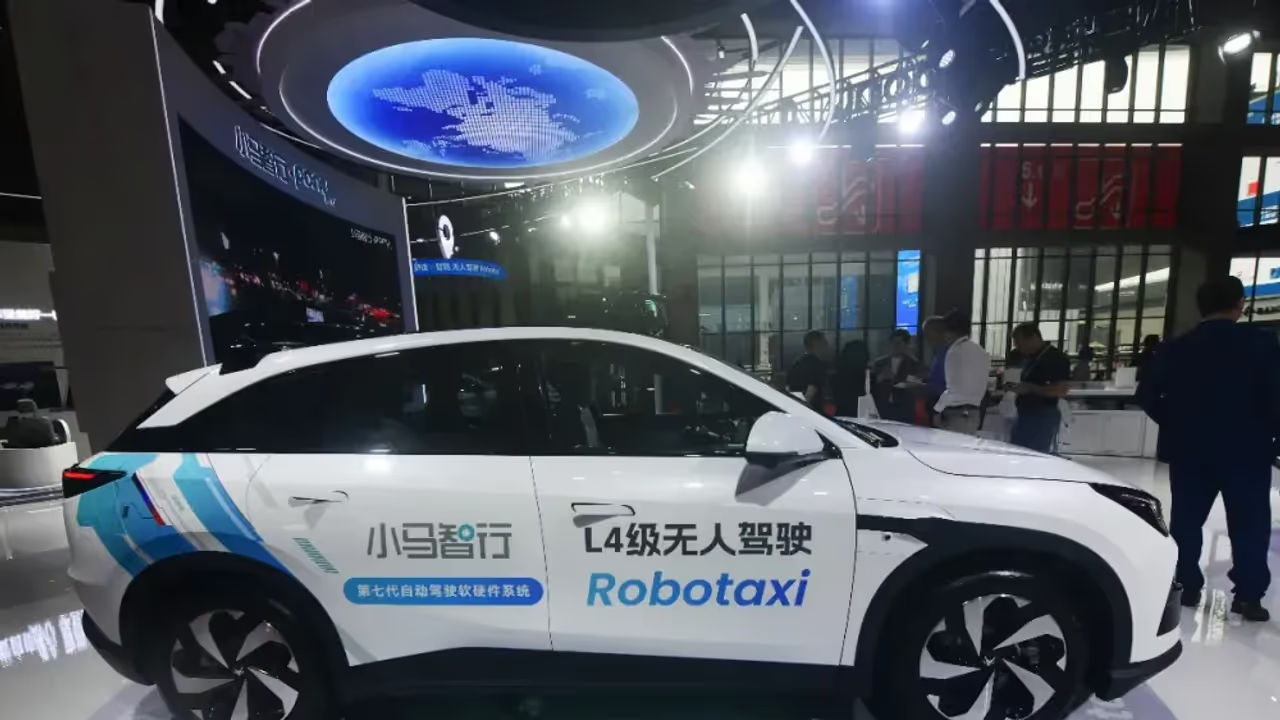
Pony.ai said the first mass-produced bZ4X Robotaxi developed with Toyota has rolled off the production line, marking the start of scaled production and commercial deployment.

Pony.ai And Toyota Target Over 1,000 Robotaxis In 2026
The partners plan to produce more than 1,000 bZ4X Robotaxis in 2026, with vehicles entering commercial service across Tier-1 cities across China. The rollout supports Pony.ai’s goal of expanding its Robotaxi fleet to over 3,000 vehicles by the end of the year.
The bZ4X Robotaxi is jointly developed by Pony.ai, Toyota Motor China, and GAC Toyota, with production handled by Pony.ai and GAC Toyota at one of Toyota’s global model plants.
The production model is equipped with Pony.ai’s seventh-generation autonomous driving system, using fully automotive-grade components. Pony.ai said the autonomous kit’s bill of materials cost has fallen by about 70% compared with the prior generation, improving deployment economics.
Gen-7 Robotaxis add features such as Bluetooth-based automatic unlocking, in-cabin voice interaction, online music, pre-trip climate control, and smoother acceleration and braking to reduce motion sickness. The partnership between Pony.ai and Toyota began in 2019 and has spanned Robotaxi design, product iteration, mass-production planning, and the creation of a joint venture focused on manufacturing and operational support.
Robotaxi Race Heats Up
The launch comes as the Robotaxi sector intensifies. Tesla recently opened unsupervised robotaxi rides to the public in Austin and is targeting about 1,000 robotaxis on the road by the end of 2026. In China, Tesla said regulators have indicated the company could receive full approval for its Full Self-Driving system by February or March 2026. It currently operates limited public trials in China.
Meanwhile, Baidu’s Apollo Go said fully driverless robotaxi rides have surpassed 250,000 per week across multiple Chinese cities as of Oct. 31, 2025. WeRide has integrated Robotaxi booking into WeChat and is targeting tens of thousands of vehicles for expansion by 2030, while XPeng plans to launch three Robotaxi models in 2026.
How Did Stocktwits Users React?
On Stocktwits, retail sentiment toward Pony.ai was ‘bearish’ amid ‘low’ message volume, while sentiment toward Toyota Motor was ‘neutral’ amid ‘high’ message volume.


One bullish user said, “For every Robotaxi deployed by WeRide in Abu Dhabi, Pony needs to deploy 2 Robotaxis in Guangzhou to generate the same revenue. Meanwhile, the market still counts fleet numbers.”
While Pony.ai’s stock has risen 8% over the past 12 months, U.S.-listed shares of Toyota Motor have climbed 32% over the same period.
For updates and corrections, email newsroom[at]stocktwits[dot]com.<
