
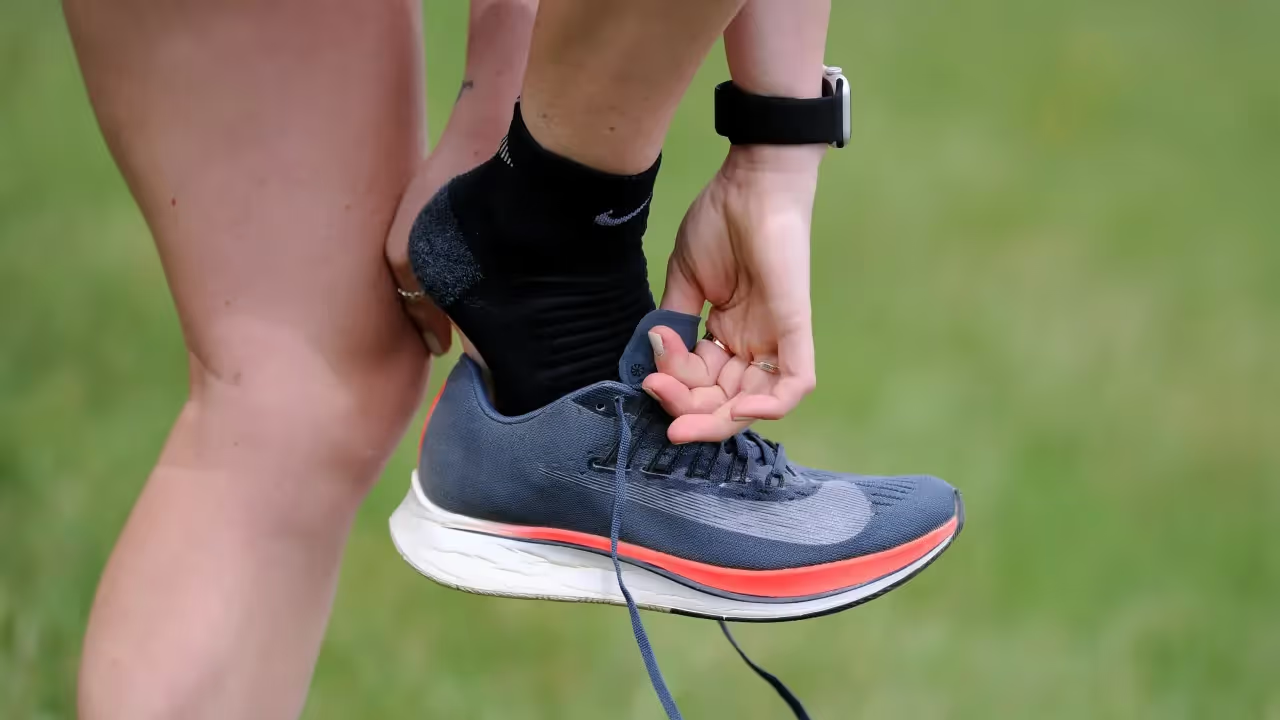
Nike lost a good chunk of its “cool” factor in just a few years, with missteps at the top resulting in a downturn. CEO Elliott Hill’s turnaround is happening, but just not as fast as many expected.
- CEO Hill said on Thursday that Nike is in the “middle innings” of its comeback.
- Nike’s North America wholesale revenue rose 20% in the second quarter, with significant growth coming from existing partners.
- China sales have not yet rebounded, market share losses to more regional brands and also upcoming global brands are still hurting.
With Elliott Hill at the helm for over a year, Nike’s quarterly earnings from last night do offer some relief, but is it the beginning of a revival at the sportswear giant? Maybe not yet, as it is taking longer than expected to undo just a few years of off-track performance and a lapse in innovation.

Nike, which was once the go-to brand for everyone in the running and performance categories, as well as for sportspeople, has lost its charm and is rebuilding itself in various ways, more or less from scratch. As CEO Hill put it during the post-earnings call on Thursday, Nike is in the “middle innings” of its comeback, which may not be at the speed the company had initially hoped for last year.
Is Nike Back To Full Potential?
Hill on the call said the company’s results were slightly better than anticipated 90 days ago, but noted, “we're nowhere near our potential.”
“Our comeback continues to move at different speeds. It won't be a straight line, but we're acting decisively to accelerate the lagging areas, with China at the top of that list,” Hill said.
Nike has been attempting to rebuild its relationship with wholesale retailers as part of its turnaround effort, following an initial shift in focus under previous CEO John Donahoe’s leadership that prioritised direct-to-consumer sales.
This pulled Nike back from its game and resulted in the company losing customers who began looking for other shoes in the running and performance category, with wholesalers also embracing Hoka and Roger Federer-backed On.
“While these are softish results, Nike remains in the midst of a recovery program, and it is not yet back to full health,” GlobalData analyst Neil Saunders said in a LinkedIn post. “Just as it would be unreasonable to expect a record finish time from a marathon runner who is still recuperating from the flu, Nike has to be given a little slack.” He added that what we need to see are signs that the new strategies are starting to work.
Nike’s second-quarter revenue and profit beat expectations even though the company forecast the holiday quarter revenue to decline in the low-single-digit percentage range.
North America’s Story Is Finally Turning Around
Nike’s North America business lagged in recent years, shifting from a key growth engine to a pressure point. But under Hill’s leadership, the region is beginning to show signs of a turnaround.
“The geography that is leading the way for Nike right now is North America. As our largest business, that’s where much of our focus has been,” Hill said. He added that Nike is working with a diverse wholesale landscape in the region, partnering strategically to segment and differentiate its multi-brand, multi-sport, and multi-price portfolio.
The numbers back that up. Nike’s North America wholesale revenue rose 20% in the second quarter, primarily driven by growth from existing partners. Inventory levels have also improved, with the company noting that stock in the region is now “clean” following last year’s decision to curb overproduction of Air Jordans and Air Force 1s.
As Nike pushes to drive more full-price sales, North America has also made progress in repositioning Nike Digital as a more premium channel, with fewer promotional days, lower markdown rates, and stronger demand at full price.
China: A Comeback Taking Longer
China sales have not yet rebounded, market share losses to more regional brands and also upcoming global brands are still hurting Nike. Hill said the company is still facing a “longer road to a healthier business.”
Nike has worked on its product innovation and brand presentation in the region, but Hill noted that it is a start and not happening at the level or pace the company needs to drive a wider change.
“The next step is to further adapt our approach to fit China's unique monobrand footprint and digital-first marketplace,” Hill said. Across China, Nike has seen declines. In Greater China, second-quarter revenue declined 16% with Nike Direct falling 18% and Nike Digital down 36%.
Trump Tariffs Are Still A Bitter Spot
The company has been battling increasing headwinds from higher tariffs that took effect once U.S. President Donald Trump took office. Nike has forecast $1.5 billion of annualized incremental product costs due to higher U.S. tariffs.
Nike said that in the second quarter, gross margins declined 300 basis points to 40.6% on a reported basis, primarily due to higher product costs from North American tariffs. In part, the decline was also driven by inventory obsolescence in Greater China that was not contemplated 90 days ago.
Has Innovation Come Back?
Under Hill, Nike has fast-tracked its innovations, mainly in the running and performance categories, and has also accelerated launches to regain market share.
“Numbers were far better than forecast, which is positive. And growth is coming through in North America, partly thanks to traction in the running category - where Nike is innovating more,” Saunders said. He added that if Nike can replicate what it has done in running to other sports, it should be able to drive the numbers even higher.
What Is Retail Thinking?
Retail sentiment on Nike jumped to ‘extremely bullish’ from ‘bullish’ territory a day ago, with message volumes at ‘extremely high’ levels, according to data from Stocktwits.
A user on Stocktwits said that Nike “delivered a nice beat … but margins slid, DTC was down, and China remains weak. After-hours selling shows investors still skeptical on [the] turnaround.”
Shares of Nike have lost more than 13% of their value so far this year, while On Holding stock is down 11% and Hoka’s parent Deckers Outdoor has lost more than half of its value year-to-date.
For updates and corrections, email newsroom[at]stocktwits[dot]com.<
