

The energy industry is dominated by integrated oil companies, upstream producers, and midstream operators.
The energy industry in the U.S. remains one of the most significant forces in the overall equity market, with companies spanning crude oil, natural gas, refining, and the crucial midstream infrastructure. Despite global efforts to transition to green energy, the largest publicly traded U.S. oil companies by market value remain firm, with steady earnings and robust profits.

While oil prices have remained volatile this year, the S&P 500 energy sector has still eked out narrow gains in 2025.
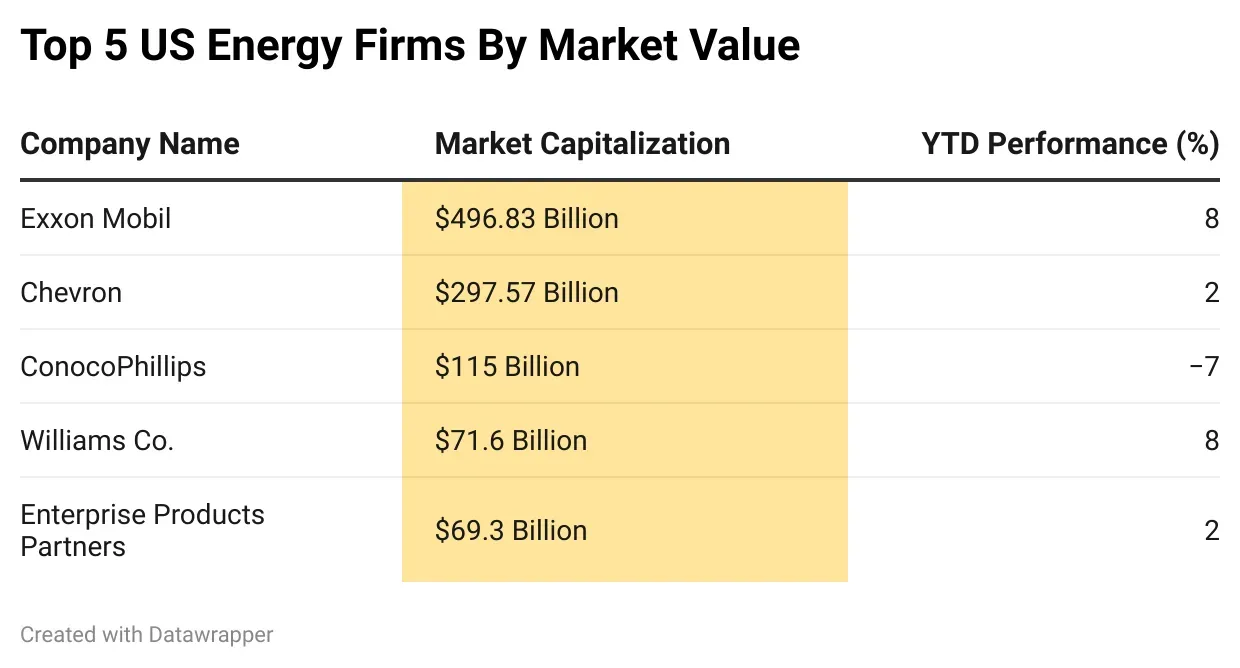
Here are the top 5 U.S. energy firms by market value as of Dec. 19:
ExxonMobil Corp
Market Cap: $496.83 Billion
YTD Returns: 8.3%
ExxonMobil is the largest publicly traded energy company in the U.S. by market value and one of the world’s largest oil and gas companies. As indicated on its official website, its current business streams include exploration and production, refining, products and specialties, and lower-carbon solutions. The company is also getting into lithium mining, betting on the white metal used in electric vehicle batteries.
The company has emphasized large-scale projects in Guyana and the Permian Basin, and cost efficiencies to support long-term returns. The oil major now expects $25 billion in earnings and $35 billion in cash flow growth in 2030, an improvement of $5 billion in both metrics compared with its previous plan.
Chevron Corp
Market Cap: $297.57 Billion
YTD Returns: 2%
Chevron ranks second among U.S. energy firms by market value. The company describes itself as a global integrated energy business with significant upstream and downstream operations, as well as growing exposure to renewable fuels and carbon reduction technologies. Like its rival Exxon, the company also entered the lithium sector in mid-2025 and aims to use the novel direct lithium extraction technology to produce the metal in Arkansas.
Alongside the Permian Basin, Chevron’s $53 billion buyout of Hess included a stake in a Guyana project, with the South American country emerging as one of the fastest-growing oil producers.
ConocoPhillips
Market Cap: $115 Billion
YTD Returns: -7%
ConocoPhillips is the largest independent exploration and production company in the U.S. Unlike Exxon and Chevron, the company is almost entirely dedicated to upstream production. Its diversified portfolio spans the Lower 48, Alaska, Canada, and international assets.
Like peers Exxon and Chevron, ConocoPhillips has also beefed up in recent years, primarily through its acquisition of Marathon Oil for $22.5 billion, which has helped it rein in costs. The company is also spending billions of dollars on the Willow project in Alaska, which could help bolster its reserves.
The Williams Co.
Market Cap: $71.6 billion
YTD Returns: 8.4%
Narrowly coming ahead of rival Enterprise at the time of writing, Williams relies heavily on its natural gas infrastructure. The firm has a robust pipeline and processing operations designed to deliver natural gas to major markets in the U.S. In 2024, the company announced six transmission projects to add 885 million cubic feet per day (mmcf/d) of capacity to serve key demand centers.
5. Enterprise Products Partners
Market Cap: $69.3 Billion
YTD Returns: 2%
Enterprise Products is one of the largest midstream energy corporations in North America. Its primary operations include pipelines, storage, natural gas processing plants, and export terminals, as described on its official website.
Since Enterprise Products derives most of its revenue from fees, it's often seen as less affected by price volatility. The company has also benefited from soaring U.S. oil and gas production and power demand, driven by the growth of artificial intelligence data centers. By 2035, Deloitte estimates that power demand from AI data centers in the United States could grow more than thirtyfold, reaching 123 gigawatts, requiring further power generation.
Together, these five companies show how the energy industry is dominated by integrated oil companies, upstream producers, and midstream operators. While the industry is sensitive to cyclical changes, scale and stability have become the key drivers of the sector's biggest companies.
For updates and corrections, email newsroom[at]stocktwits[dot]com.<
