

VanEck’s Matthew Sigel said Coinbase was already expected to adjust its agreement with Circle under the GENIUS Act.
- According to the head of digital assets research at VanEck, the OCC’s proposed guidance only formalizes provisions that were already embedded in the law.
- The new rules for the GENIUS Act would effectively limit each permitted payment stablecoin issuer to a single branded stablecoin.
- The revenue-sharing deal between Coinbase and Circle is due for renewal later this year.
Matthew Sigel, the head of digital assets research at VanEck, said that while there is a lot of panic being created around the proposed GENIUS rules restricting stablecoin rewards, it was already known that Coinbase Global (COIN) would have to redraw its agreement with Circle (CRCL).

In a post on X, the analyst said that Coinbase has setup with deal with Circle to look more like a loyalty program than interest on deposits. “The OCC guidance just codifies what's already in GENIUS,” he wrote.

The deal between the companies is that Coinbase gets 100% of the interest it generates on its platform from USDC holdings, while it shares 50% revenue from off-platform USDC. The deal, set up in 2023, is up for renewal this year.
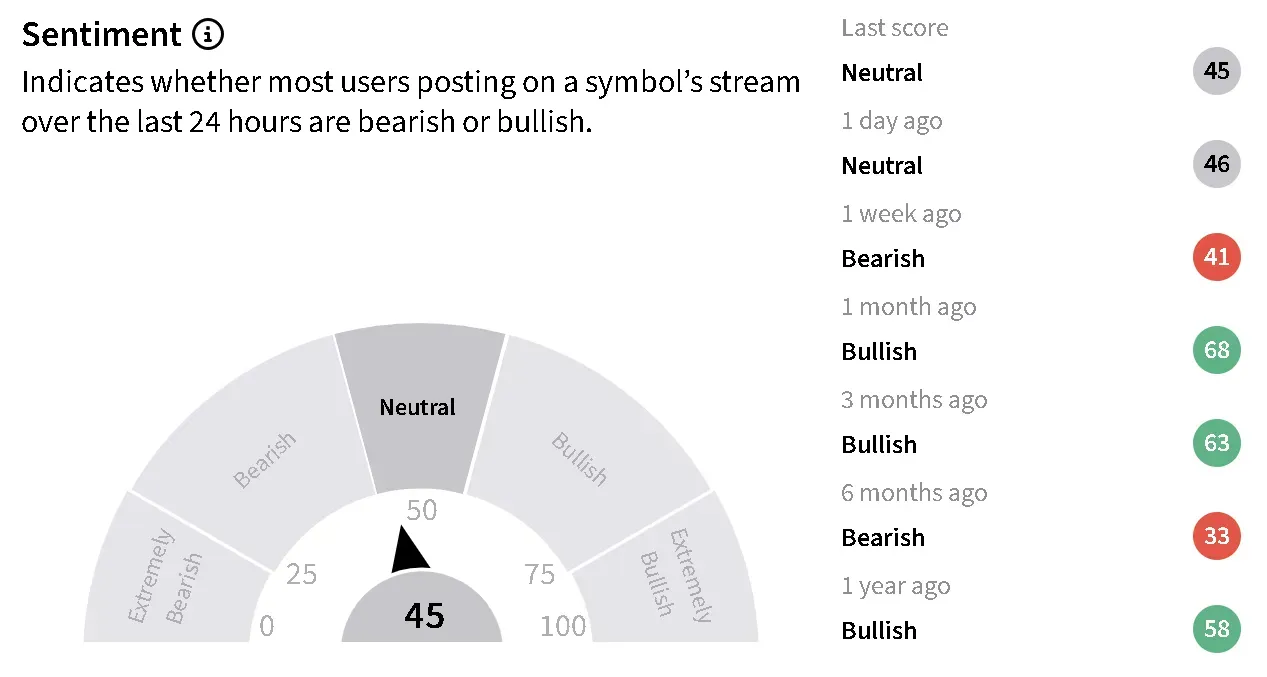
COIN’s stock dipped another edged 0.7% higher in pre-market trade on Friday, after a fall of 1.5% during the previous session. The correction came after the shares jumped more than 13% following the company's foray into tokenized stocks. On Stocktwits, retail sentiment around the company remained in ‘neutral’ territory over the past day.
OCC Pushes Back On Stablecoin Reward Loopholes
So far, the crypto industry has assumed that the GENIUS Act's ban on yield or rewards offered by stablecoin issuers doesn't extend to third parties that can offer their own reward programs on those issuers' tokens, such as at Coinbase. However, the new rules say such arrangements could be used to bypass the law’s intent.
“If you look in our proposal, which we released yesterday, we have hard-wired a number of things into our proposal that we believe would tend to reduce the probability of deposit flight,” Jonathan Gould, head of the OCC, said at a Senate Banking Committee hearing on Thursday. “If a deposit flight were to occur, I think we would notice it, meaning it wouldn’t occur under cover of darkness, where no one would see it and fail to react to it.”
One Stablecoin Per Issuer Under Review
This would effectively limit each permitted payment stablecoin issuer to a single branded stablecoin. If adopted, the restriction would be paired with a streamlined approval process for issuers seeking regulatory authorization.
Such a change could have wide-ranging implications. For example, Paxos’ arrangement to issue PayPal Holdings’ (PYPL) dollar-pegged stablecoin PayPal USD (PYUSD), which currently offers rewards of roughly 4% on customer balances.
PayPal’s stock edged 0.5% in pre-market trade on Friday, following a dip of 3.75% in the previous session after the company denied there were any ongoing talks of a sale to Stripe. Retail sentiment on Stocktwits around the company remained in ‘extremely bullish’ territory over the past day, with chatter at ‘high’ levels.
The GENIUS Act will take effect either 18 months after being passed or 120 days after regulators finalize the proposed rules, whichever happens first.
Read also: If Bitcoin’s Price Falls 20% Tomorrow, Most Retail Traders Are Ready To Buy The Dip
For updates and corrections, email newsroom[at]stocktwits[dot]com.<
