The Centre has flagged concerns over Karnataka’s Namma Metro Red Line double-decker project connecting Hebbal and Sarjapur. The Union Ministry has asked for a full DPR review, citing potential risks to mass transit objectives.
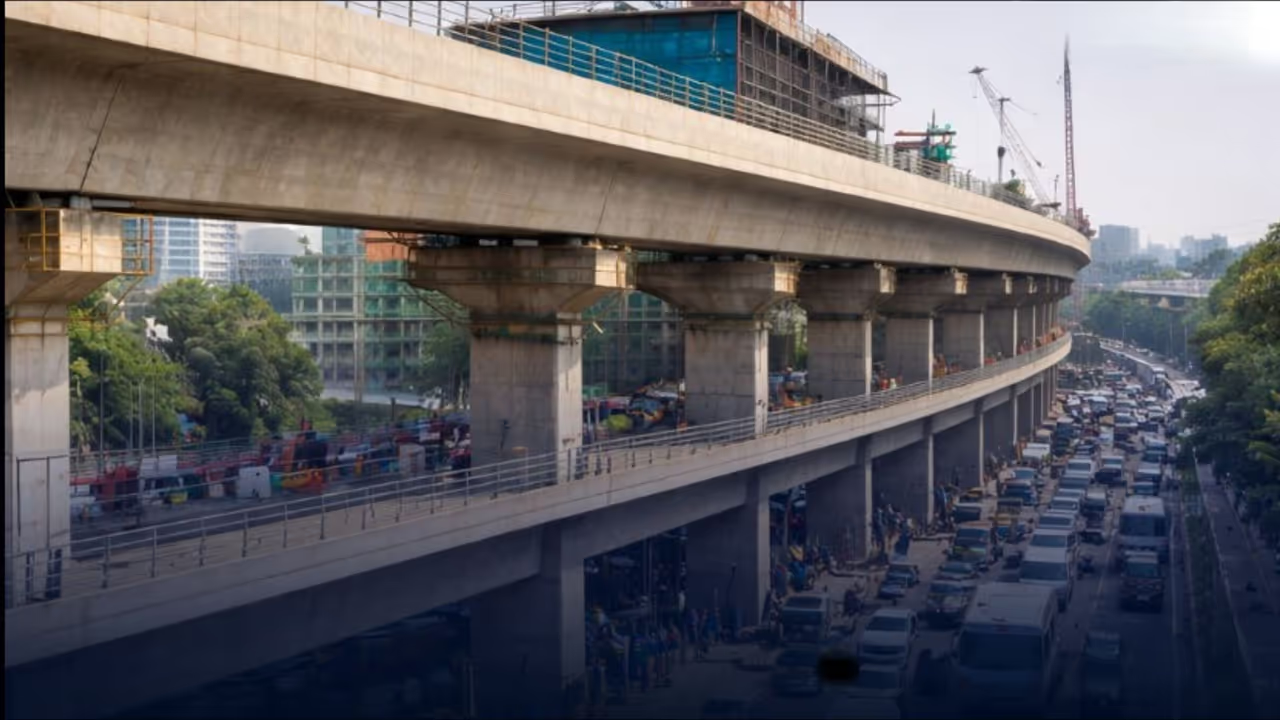
The Central Government has once again raised objections to the proposed Red Line of Namma Metro, asking the Karnataka Government to reconsider the ambitious double-decker road-cum-metro corridor connecting Hebbal and Sarjapur. For the second time, the Union Ministry of Housing and Urban Affairs has returned the Detailed Project Report (DPR), stating that the design could weaken the fundamental objective of a mass transit system.

This development comes at a time when tensions between the Centre and the State over metro fare revisions have not yet subsided. The latest objection to the double-decker concept is likely to trigger another round of political and administrative debate between the two governments.
Second Review Sought for Phase 3A Project
The proposed corridor is part of Bangalore Metro Rail Corporation Limited’s (BMRCL) Phase 3A project. This marks the second instance of the Centre seeking a review of the DPR.
Related Articles

In December 2024, the State Cabinet approved the project at an estimated cost of ₹28,405 crore. With a projected expenditure of ₹776.3 crore per kilometre, it was considered the most expensive project in the history of Namma Metro. The Union Ministry had earlier objected to the high cost and directed the State Government to revise the estimates.
Subsequently, BMRCL appointed the French multinational consultancy firm Systra to reassess the cost projections. After analysing metro systems in Chennai and other cities, the firm recommended reducing the length of underground stations from 210 metres to 170 metres. This revision lowered the overall estimated cost by ₹2,920 crore, and a revised DPR was submitted. However, the Centre has reportedly expressed dissatisfaction once again and has instructed a comprehensive review before the submission of a fresh proposal.
Concerns Over Double-Decker Design
Bengaluru MP Mohan took to X, stating that the State Government had failed to secure central approval for the Hebbal-Sarjapur metro corridor. According to him, the Union Ministry warned that the project’s current design could adversely affect public transport objectives.
He noted that while a double-decker structure might be justifiable at select junctions, extending it along the entire corridor could create parallel infrastructure. The Centre believes this may encourage private vehicle usage, reduce metro ridership, and undermine expected social benefits such as pollution control and reduced congestion.
Project Details and Likely Delay
The proposed corridor spans 36.59 km, comprising 22.14 km of elevated track and 14.15 km of underground section. It is planned to include 28 stations, of which 17 will be elevated and 11 underground. The line is intended to connect the IT corridor with North Bengaluru and integrate with four major interchange routes.
The project was initially expected to be completed by 2031. However, with the Centre’s renewed objections to the DPR, further delays appear likely. Any postponement could also result in cost escalation.
In October last year, BMRCL awarded a ₹6.86 crore tender to conduct a geotechnical survey across four packages for the project, and the report has since been received.
Double-Decker Is the Best Option: D.K. Shivakumar
Deputy Chief Minister D.K. Shivakumar has strongly defended the double-decker model. He argued that road widening in Bengaluru has become both extremely difficult and prohibitively expensive.
According to him, constructing a road at ground level, a flyover above it, and the metro line above the flyover within the same corridor is the most viable solution. He also clarified that the project cost would be shared in a 50:50 ratio between the State Government and BMRCL and would not impose a significant financial burden on the Centre.
Shivakumar further maintained that road users and metro commuters represent different segments and that the presence of a flyover would not reduce metro ridership. He added that discussions would be held with the Union Minister to address the concerns raised.