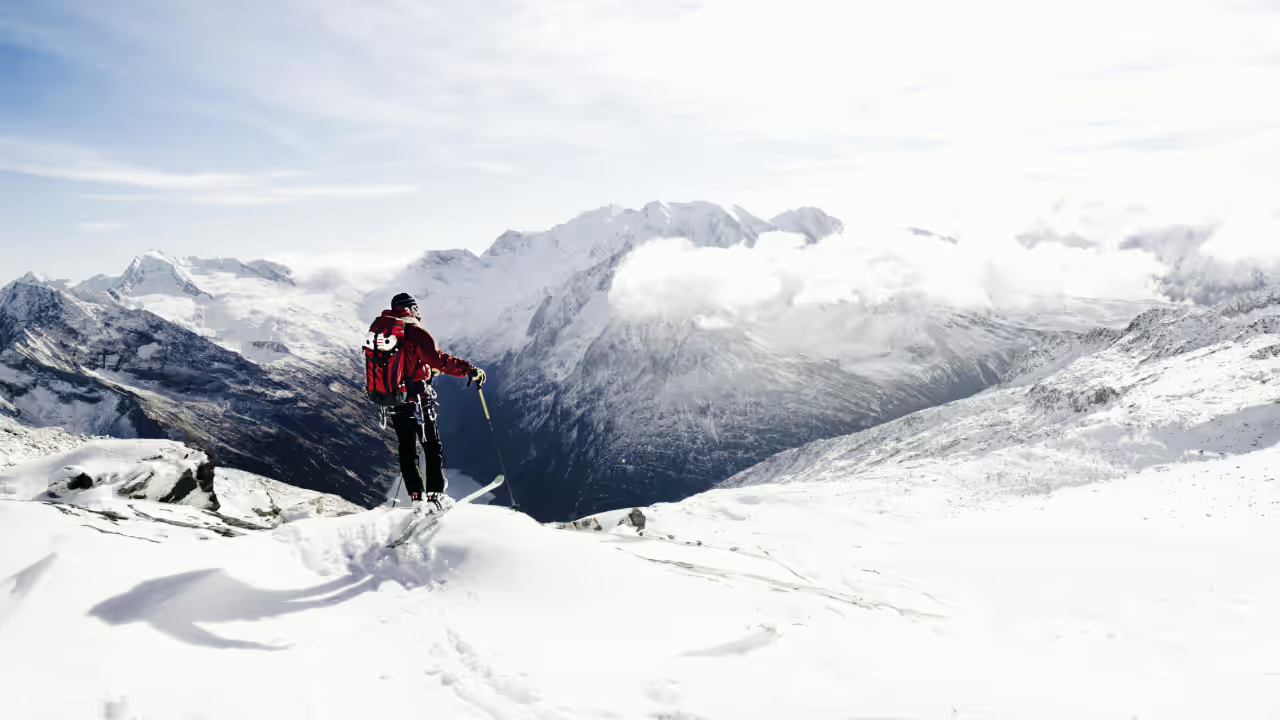
The Alps' glaciers are melting fast, with peak extinction predicted by 2033. Learn how climate change could end the ski season and impact winter tourism forever.
The well-known glaciers of the European Alps are rapidly disappearing, and scientists are now warning that thousands of them might vanish completely in the next few decades. A recent study suggests that the Alps may reach a critical point called "peak glacier extinction" as early as 2033. This refers to the year when the number of glaciers lost each year is at its highest.

Researchers used advanced computer models to predict how many glaciers might survive until the end of this century. Currently, the Alps have approximately 3,000 glaciers. However, the study shows that if the planet warms by 1.5°C above pre-industrial levels, only about 430 Alpine glaciers would remain by 2100.
Alarming Predictions Ahead
If global temperatures rise further, the situation becomes even worse. A warming of 2.7°C would leave just 110 glaciers in the Alps, while a 4°C increase could result in only around 20 glaciers surviving. In this worst-case scenario, even the Aletsch Glacier, the largest glacier in the Alps, would no longer exist as a single mass of ice. Instead, it would break into much smaller pieces.
Related Articles

The research, published in the journal Nature Climate Change, was conducted by scientists from ETH Zurich and other institutions. According to lead author Dr Lander Van Tricht, areas with many small glaciers at lower elevations are particularly at risk. The Alps fit into this category, making them one of the most vulnerable glacier regions in the world.
Peak Glacier Loss
The findings show that in such areas, more than half of all glaciers could disappear within the next 10 to 20 years. Medium-sized glaciers like the Rhône Glacier are also expected to shrink significantly or disappear entirely as temperatures rise.
This swift loss of ice will impact the landscape and also have major consequences for tourism. Many ski resorts depend on glaciers to provide consistent snow, especially during early winter, late spring, and summer. While not all ski areas are built directly on glaciers, their presence often allows for longer ski seasons.
Ski Seasons Shrinking
Dr Van Tricht explained that when glaciers disappear, tourism in the surrounding valleys can be severely affected. Skiing on glacier ice becomes more difficult or impossible. Some resorts have already begun relocating ski lifts, altering slopes, or closing parts of their facilities.
The issue is not limited to the Alps. The study shows that glacier loss is occurring worldwide. In the Rocky Mountains, around 75% of current glaciers could disappear under a 1.5°C warming scenario. In the Andes and Central Asia, more than half of all glaciers may vanish. Even more concerning, there is no region on Earth where glacier numbers are stable or increasing.
Global Glacier Decline
Even the Karakoram region in Central Asia, where some glaciers briefly expanded in the early 2000s, is expected to experience widespread glacier loss in the coming decades.
Professor Daniel Farinotti, a co-author of the study, said the results highlight the need for strong and urgent efforts to cut global greenhouse gas emissions. Limiting warming could still save many glaciers, even though most will continue to shrink.
Urgent Climate Action
The study also notes that glaciers attract millions of visitors each year and are vital to winter tourism economies. Under a 1.5°C warming scenario, the number of glaciers lost over the next 20 to 30 years would be roughly half of those lost under a 4°C scenario, showing that climate action can make a meaningful difference.
Another study published last year adds to the concerns. Researchers found that by the end of the century, one in eight ski resorts worldwide may have no snow at all. Looking at major skiing regions, including the Alps, the Andes, and the Rockies, they found that under high-emission scenarios, 13% of ski areas could become completely snow-free between 2071 and 2100. Together, these findings paint a concerning picture for the future of glaciers and skiing, and they underline how closely our climate choices are tied to the survival of these iconic landscapes.