
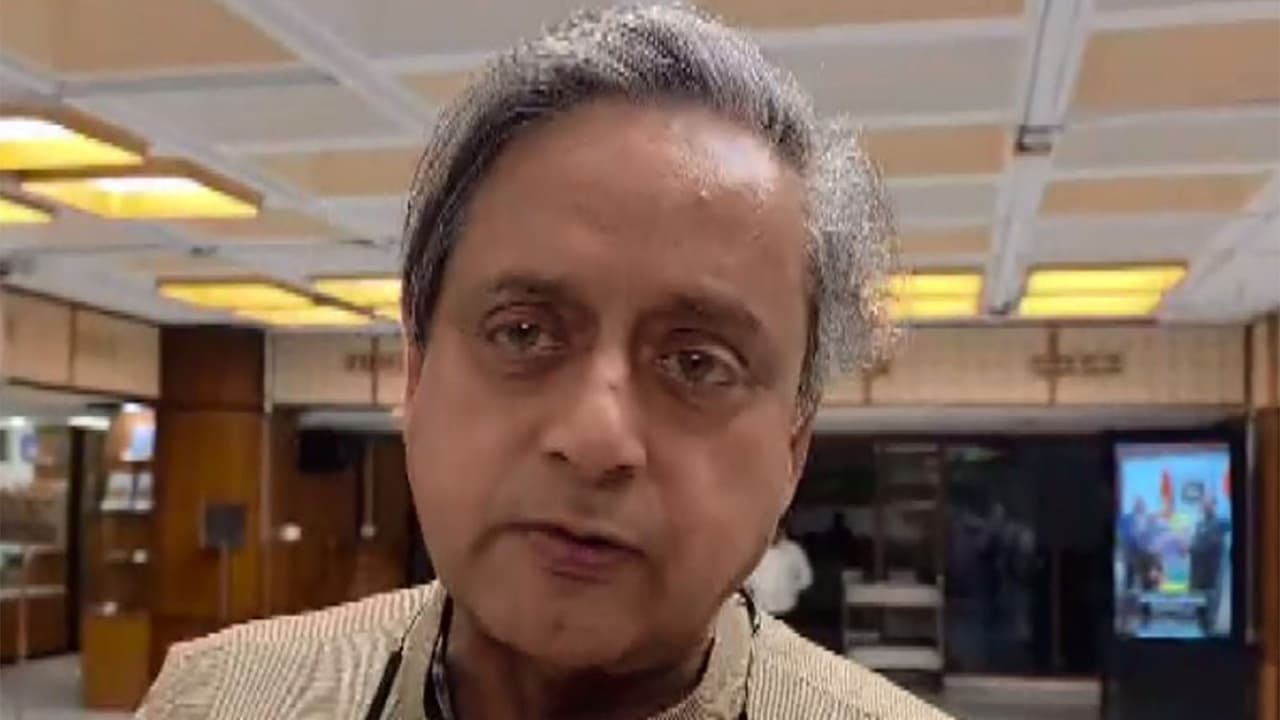
The Parliamentary Standing Committee on External Affairs, chaired by Shashi Tharoor, discussed the impact of the West Asia conflict. Concerns were raised over the safety of Indian nationals, the diaspora, oil supplies, and students' CBSE exams.
Parliamentary Standing Committee on External Affairs on Wednesday held a comprehensive discussion on the impact of conflict in West Asia with members asking questions and sharing concerns about the overall situation, safety of Indian nationals and the diaspora, besides oil and gas supplies.

Comprehensive Discussion on West Asia
Congress MP Shashi Tharoor, who chairs the Standing Committee on External Affairs, said the committee asked about the difficulties of students in West Asia whose CBSE exams have been postponed. He said everything affecting the well-being of the Indian diaspora was discussed.
"It was a very good discussion... . As you can see, it ran very long. The first discussion on West Asia was the most comprehensive. We had 17 members attending, and every single one of them spoke. Everyone had questions and concerns about the overall situation, the impact, the safety and security of our nationals, the diaspora, the oil and gas supplies, and the works... We got some answers, but didn't get all. Foreign Secretary was himself not available but on many issues, we got fairly comprehensive confirmations," Tharoor told mediapersons.
AI Summit and Tech Diplomacy
He said the second part of the meeting was on the AI impact summit, its consequences, and its implications for India's tech diplomacy as well as for our relations with countries in the global south. "It was a good, comprehensive forum meeting".
Specific Concerns Raised in Meeting
Answering a query about Prime Minister Narendra Modi's visit to Israel, Tharoor said it was raised by members. "That was also raised, but I cannot go into the internal discussions of the committee. But you can imagine that MPs will raise every issue that is on their minds, and you can be pretty sure there is no question that they will not come up."
Asked about the number of Indian nationals still stuck in Iran, he said there are about 9,000 still in the Gulf country "but not all of them necessarily wish to leave".
"The situation in the Gulf countries is that it's fairly easy to come in and out by commercial means. Flights are operating out of the UAE, Saudi Arabia, and Oman, less so from Qatar and Bahrain, which are more affected. Anyone can come and go; it's no longer a question of being stranded," he said
Tharoor said there are still other complications. "For example, our class 10 and class 12 children have not been able to write their CBSE examinations. I asked if any steps could be taken to address their plight, and I gather that there have already been consultations between the MEA and the Ministry of Education about ensuring that CBSE makes remedial arrangements for the 23,000 students in the Gulf who could not write the exams... Everything affecting the well-being of our Indian diaspora was also discussed," he said.
Asked about how many ships are still stuck with petroleum, Tharoor said "they did not have an exact number for the number of ships, but there are a few."
Briefings from MEA and IT Ministry
Representatives of the Ministry of External Affairs briefed the members on safety, security and repatriation of diaspora during the ongoing conflict in West Asia.
The Committee was also briefed by the representatives of the Ministry of External Affairs and the Ministry of Electronics and Information Technology on the outcomes of the recent Al Summit.
Background of the Escalating Conflict
The meeting took place amid the escalating conflict in West Asia. Iran's Supreme Leader, Ayatollah Ali Khamenei, was killed in joint military strikes by the US and Israel on February 28. In response, Iran has been targeting US assets in several Gulf countries and tensions have disrupted international supply chains.
Iran has virtually closed the Strait of Hormuz, a critical transit route for global energy supply. Mojtaba Khamenei, son of Ayatollah Ali Khamenei, has been appointed the new Supreme Leader of the Islamic Republic.
Israeli Defence Minister Israel Katz confirmed on Tuesday that Ali Larijani, Iranian Secretary of the Supreme National Security Council, was killed in an overnight airstrike in Tehran. (ANI)
(Except for the headline, this story has not been edited by Asianet Newsable English staff and is published from a syndicated feed.)