
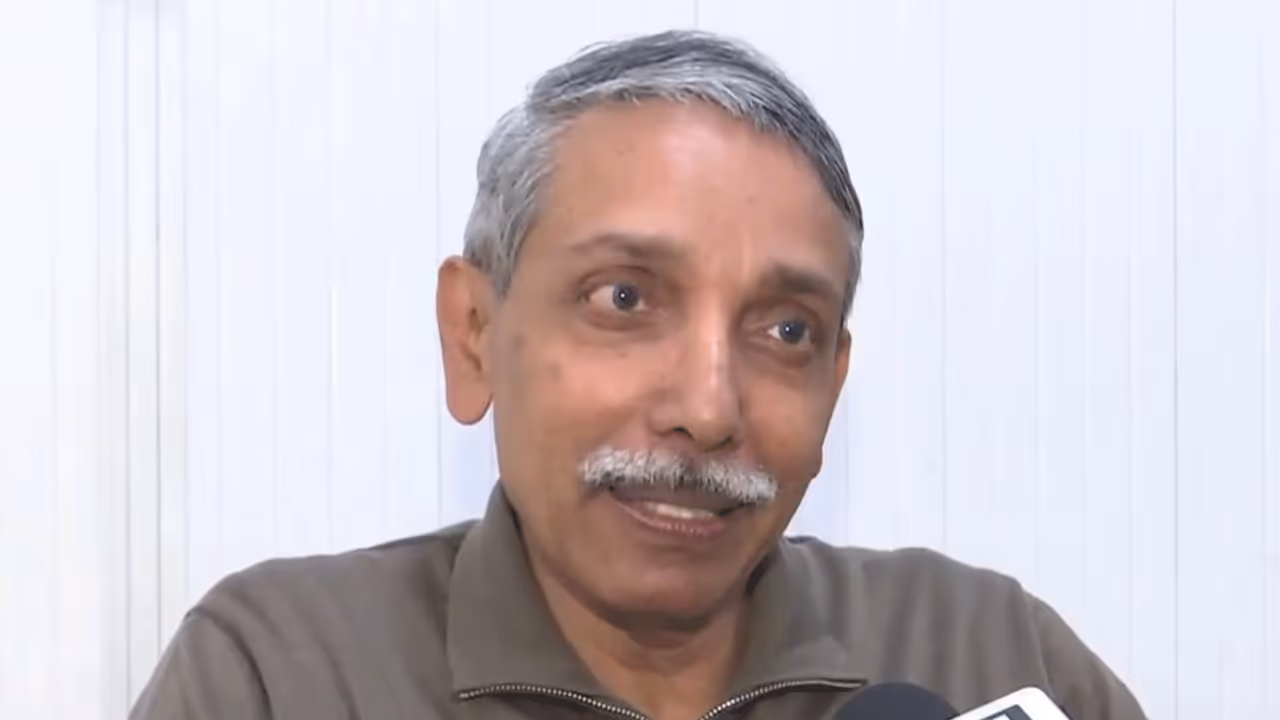
Ex-UGC head M. Jagadesh has defended the Viksit Bharat Shiksha Adhishtan Bill against claims of centralisation. He termed it a collaborative, 'light but tight' framework and addressed criticisms on funding, Hindi imposition, and state representation.
Former University Grants Commission (UGC) Chairperson M. Jagadesh has rejected allegations that the Viksit Bharat Shiksha Adhishtan Bill seeks to centralise power with the Ministry of Education, stating that the proposed legislation is not a top-down mechanism but a collaborative and inclusive framework.

Speaking to ANI, Jagadesh, who was closely involved during the composition of the bill, lauded the proposed law, saying it follows the "light but tight approach" and will ensure that the regulatory system in the country is simple, predictable, and at the same time accountable. "The former UGC chairman spoke in detail on controversies surrounding the bill, including allegations of Hindi imposition, funding being routed directly through the Education Ministry, limited state representation, and the penalty clause."
The Viksit Bharat Shiksha Adhishthan Bill, 2025--formerly the Higher Education Commission of India (HECI) Bill--aims to replace the University Grants Commission (UGC), the All India Council for Technical Education (AICTE), and the National Council for Teacher Education (NCTE). The new bill also brings Institutes of National Importance (INIs) under the regulatory framework for the first time, whereas until now they functioned largely outside such oversight.
The Education Minister, Dharmendra Pradhan, introduced it in Parliament on Monday. The Lok Sabha adopted a resolution to refer a Bill to a joint committee of Parliament. "The VBSA follows a light but tight approach that will ensure that the regulatory system in our country is simple, is predictable, so that our education, higher education system will grow and enable our students to become nation builders," he said.
The VBSA is based on the recommendations of the National Education Policy (NEP). The NEP proposed a four-vertical structure for higher education regulation: regulation, academic standards, funding, and accreditation. However, the bill talks about only three verticals. As per the bill, funding to institutions will be directly disbursed by the Ministry of Education.
'Not a top-down system'
Former UGC Chairperson M Jagadesh played down criticism by academicians that the proposed system would lead to centralisation of power in the hands of the Education Ministry, saying it would be a consultative mechanism and not a top-down approach. "First of all, the new system is not a top-down system. Yes, it is more of a collaborative, inclusive system. Let me explain. In each of these councils--regulatory, accreditation, and standard-setting--you will have state government representatives. You will have representatives of state universities. You will have representatives of IITs, and whatever regulations and frameworks are going to come will emerge through broad-based, roundtable-kind consultations," he said.
"So therefore, there is no centralisation of any power here, because it is more of a collaborative and participative system," he added.
Funding mechanism explained
He also explained the funding mechanism for universities, saying that the concerns were misplaced. "We have 1,200 universities in our country. We have 540 private universities and 514 state-funded universities. So more than 1,000 universities are actually established by state governments, and they are established through state assemblies. Therefore, there is no question of anybody stopping funding to those institutions, because it is the state government which funds them," he said.
"For central institutions, their funding is associated with performance and outcome-based education. The Ministry of Education has said that it will consult the Regulatory Council, assess how these institutions are performing, and link funding to performance and outcome-based education," he added.
'Take pride in Indian roots'
The name of the bill has also drawn flak from a section of parliamentarians, who have termed it an attempt at Hindi imposition. The bill was earlier called the Higher Education Commission of India (HECI) and was later renamed the Vikshit Bharat Shiksha Adhiniyam (VBSA).
Responding to the criticism, former UGC Chairperson M Jagadesh said the use of Indian terms should be seen as a matter of pride rather than imposition. "There are four words in the name. 'Bharat' is a word every Indian knows. 'Vikshit' is also familiar across the country, including in South Indian languages, where it conveys progress and development. 'Shiksha' is again a widely understood term. These are words most Indians are familiar with," he said.
"It is important for us to take pride in our Indian roots and Indian languages. I am very happy that Indian words are being used in this new system. Of course, English terms like Regulatory Council, Accreditation Council and Standards Council can also be used, but we are simultaneously working to give importance to Indian language mediums even in higher education," he added.
He further said the UGC is working on developing digital resources and new textbooks in Indian languages. "So, as Indians, all of us should take pride in naming the new regulatory system using Indian words, most of which are familiar across the country," he said.
Addressing other concerns
On government's final say
Addressing concerns about a clause in the bill that gives the government the final say in case of disagreement, the former UGC chairperson said the provision is consistent with how central legislation operates. "This Act will be cleared by Parliament. The UGC Act was also passed by Parliament in 1956. Under the existing system, if a state government brings in an Act that is in direct conflict with a central law passed by Parliament, the central Act prevails. This is not new and is not limited to higher education alone. In several areas of governance, central Acts supersede state Acts in case of conflict. The same principle is being followed here," Jagadesh said.
On appointments to apex body
On criticism that appointments to the apex body and councils would fall under the government's influence, as members are to be appointed by the President, M Jagadesh said similar procedures are already in place across higher education institutions. "The qualifications of members are clearly laid out in the bill. They are required to be eminent academicians with over 10 years of experience as professors and must have strong administrative knowledge of the higher education system," he said.
He further noted that heads of central institutions, including institutions of national importance and central universities, are already appointed by the President of India. "So this is not something new that has been introduced under the VBSA. The same established procedure is being followed," he added.
On state representation
Responding to concerns over limited state representation, with critics arguing that only two seats per vertical would reduce states' participation, Jagadesh said states would continue to have a meaningful role through representation across councils and through consultations. (ANI)
(Except for the headline, this story has not been edited by Asianet Newsable English staff and is published from a syndicated feed.)