India’s recent trade and diplomatic engagements reflect a conscious attempt to navigate an increasingly fragmented global order while safeguarding strategic autonomy.
By Dr. Subodha Kumar Rautaray: India’s recent trade and diplomatic engagements reflect a conscious attempt to navigate an increasingly fragmented global order while safeguarding strategic autonomy. Nowhere is this more evident than in the evolving trajectory of India’s relationship with the United States, particularly amid stalled trade negotiations, tariff threats, and geopolitical divergences.

For much of the past year, India-US trade talks remained deadlocked. Washington sought multiple concessions from New Delhi, including restrictions on the purchase of Russian oil, greater access to India’s agricultural markets, and constraints on India’s participation in alternative multilateral platforms such as BRICS. India, however, chose not to concede under pressure and instead diversified its economic outreach, reinforcing partnerships beyond its traditional allies.
Simultaneously, the United States faced diplomatic setbacks under President Donald Trump’s assertive foreign policy. Contentious positions on Venezuela, Iran, and Greenland strained relations with Europe, culminating in a visible rift between Washington and the European Union. These tensions reduced the US’s leverage and created space for India to manoeuvre diplomatically.
Related Articles

Against this backdrop, India accelerated negotiations with the European Union, leading to the signing of the India-EU Free Trade Agreement on January 27, 2026. The agreement marked a significant milestone in India’s trade diplomacy, strengthening access to one of the world’s largest markets. The US response was critical, with Treasury Secretary Scott Bessent expressing concerns that India’s continued import of Russian oil could indirectly support Moscow’s war efforts. Despite such objections, economic and strategic realities compelled Washington to recalibrate its position.
India’s broader diplomatic signalling during this period was equally telling. Prime Minister Narendra Modi declined a bilateral meeting with President Trump during the G-7 Summit in Canada in June 2025, citing prior domestic commitments. Later, he also skipped the ASEAN Summit in Kuala Lumpur, delegating representation to External Affairs Minister S. Jaishankar. These decisions were widely interpreted as deliberate assertions of India’s independent foreign policy rather than diplomatic oversights.
Concerns in Washington deepened following the Shanghai Cooperation Organisation (SCO) Summit in China in September 2025, where cooperation among Russia, India, and China drew attention. Within the US policy establishment, questions emerged over whether aggressive diplomacy was inadvertently pushing India away. This unease was reflected even within segments of the Republican Party, which criticised the administration’s confrontational approach.
Economic indicators further underscored India’s growing leverage. According to the IMF’s Global Real GDP Growth projections for 2026, India is expected to record a growth rate of 17%, ranking second globally after China, and ahead of the United States. Among developed economies, only Germany features in the top ten, with marginal growth. These projections reinforced India’s position as a major engine of global growth.
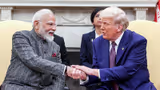
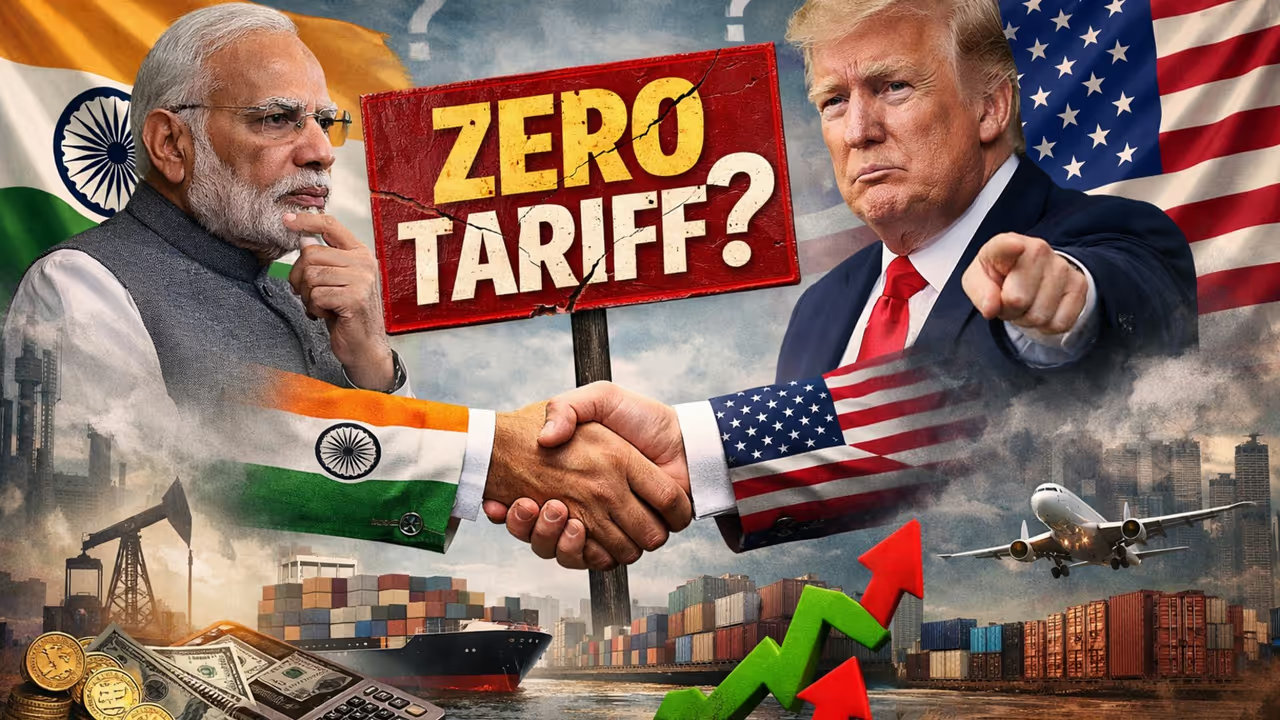
It is in this context that President Trump announced a reduction in tariffs on Indian goods from 50% to 18% and indicated willingness to pursue a more liberal US-India trade agreement, albeit with conditions related to Russian oil imports. The reversal was notable, especially given earlier threats of imposing tariffs as high as 100% on Indian exports.
The implications for India’s economy could be substantial. Sectors such as pharmaceuticals, garments, leather, and seafood stand to gain from improved market access. Positive movements in the stock market following the announcement suggest investor confidence in India’s trade trajectory. At the same time, the US is likely to benefit from deeper access to India’s vast consumer market.
That said, unpredictability remains a defining feature of the current US administration. India’s challenge will be to consolidate recent gains without assuming permanence in diplomatic outcomes. Strategic patience, economic resilience, and policy consistency will remain essential.
What is clear, however, is that India’s refusal to succumb to pressure—combined with diversification of trade partnerships—has strengthened its negotiating position. In an era of shifting alliances, India’s calibrated approach may well serve as a template for balancing economic growth with strategic autonomy.
(Dr. (Er.) Subodha Kumar Rautaray, a PhD in Civil Engineering with M-Tech and MBA, is a former leader in national volleyball and women’s football associations. An ex-president of Rotary Club, Cuttack East, he is also a committed social worker, philanthropist, and passionate gardener. You can read him at: subodhroutray@yahoo.co.in)
Disclaimer: The opinions expressed are solely those of the author and do not reflect the views or stance of the organization. The organization assumes no responsibility for the content shared.