
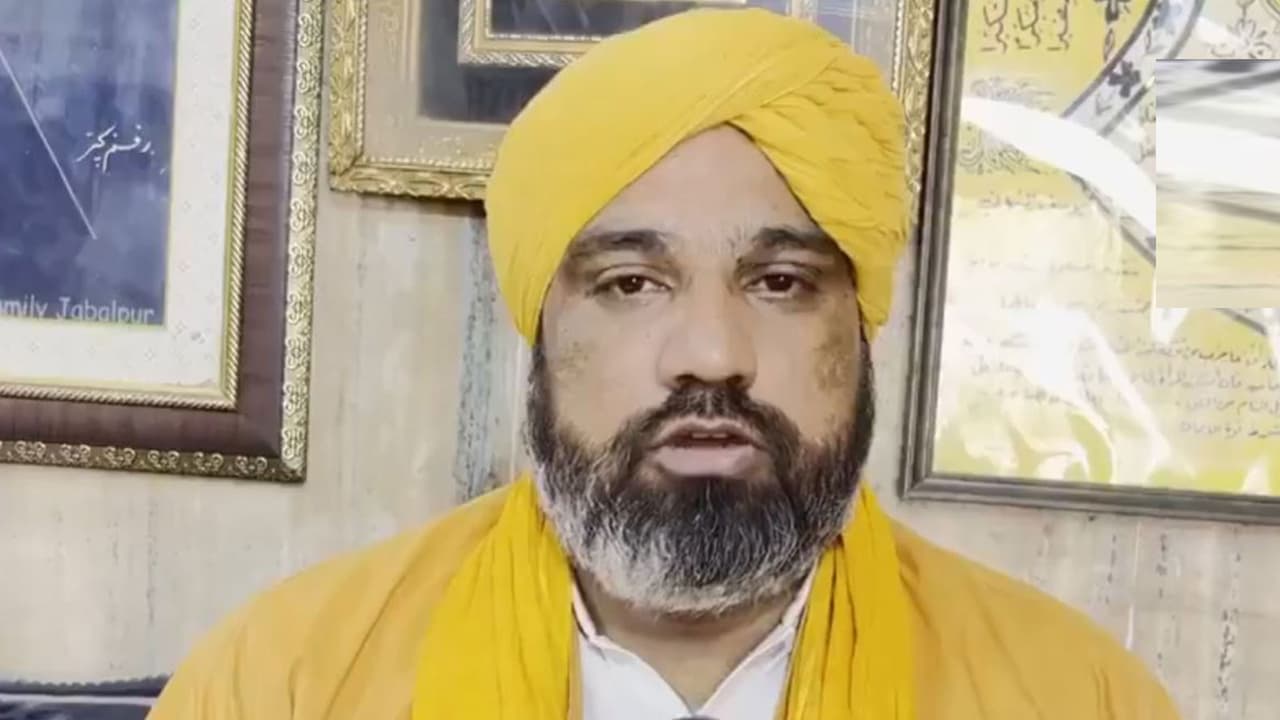
Syed Naseruddin Chishty hailed the Supreme Court's SC/ST Act verdict as historic, saying it strengthens rights. The ruling clarifies SC status is for Hindus, Sikhs, or Buddhists, and is lost upon conversion to other religions like Christianity.
Sufi Council Head Hails 'Historic' Verdict
Following the recent Supreme Court verdict on the SC/ST Act, Syed Naseruddin Chishty, President of the All India Sufi Sajjadanashin Council, praised the decision as a historic one, asserting that it would strengthen the rights and protection of Scheduled Castes and Scheduled Tribes.

Speaking to ANI, Chishty emphasised, "Today's decision is a historic one; it will further strengthen the rights of Scheduled Castes and Tribes... It will provide protection to the rights of the Scheduled Castes and Tribes, and give strength to their rights. This decision will pave the way forward... The rights of the weaker sections of our country should be respected, and work should be done to safeguard their rights."
Supreme Court Clarifies Scheduled Caste Status
The Supreme Court's ruling clarified that only persons professing Hinduism, Sikhism, or Buddhism can claim Scheduled Caste status under the Constitution (Scheduled Castes) Order, 1950. It laid down a set of governing principles (postulates) to determine when a person can claim Scheduled Caste (SC) or Scheduled Tribe (ST) status.
The Court clarified that a person must clearly establish, through cogent and unimpeachable evidence, that they belong to a caste or tribe specifically notified under the Constitution (Scheduled Castes) Order, 1950 or the Constitution (Scheduled Tribes) Order, 1950. It underscored that the restriction under Clause 3 of the Constitution (Scheduled Castes) Order, 1950 is absolute - only persons professing Hinduism, Sikhism or Buddhism can be recognised as Scheduled Castes.
Strict Test for Reconversion Claims
Conversion to any other religion leads to an immediate and complete loss of SC status, irrespective of birth, and such a person cannot claim any reservation, protection, or statutory benefit linked to that status, the Court noted. The Court further held that a person cannot simultaneously profess another religion and claim Scheduled Caste status, as the two are legally incompatible and mutually exclusive under the constitutional scheme.
To validate claims of SC/ST status in cases where the claimants have reconverted (back to SC/ST community status), the Court laid down a strict three-fold test: the individual must prove original membership of a notified Scheduled Caste, demonstrate genuine and complete reconversion with actual adherence to the original religion's practices and establish acceptance by the concerned caste community. All three conditions are mandatory, and the burden of proof lies entirely on the claimant. The judgment also clarified that once SC status is lost due to conversion, all associated statutory benefits and protections automatically cease.
Distinction Drawn for Scheduled Tribe Status
With respect to Scheduled Tribes, however, the Court drew a distinction, noting that the Constitution (Scheduled Tribes) Order, 1950, does not impose a religion-based bar. Instead, ST status depends on the continued existence of tribal characteristics such as customs, social organisation, and community recognition. Conversion alone is not what matters; what matters is whether the person remains integrated with and accepted by the tribal community.
The Court noted that once a person converts to another religion, they lose their Scheduled Caste status and the associated protections, effectively ruling out caste-based claims for those who have embraced religions like Christianity. This ruling strengthens the core objectives of the SC/ST Act, which is aimed at preventing atrocities against the members of these communities. (ANI)
(Except for the headline, this story has not been edited by Asianet Newsable English staff and is published from a syndicated feed.)