
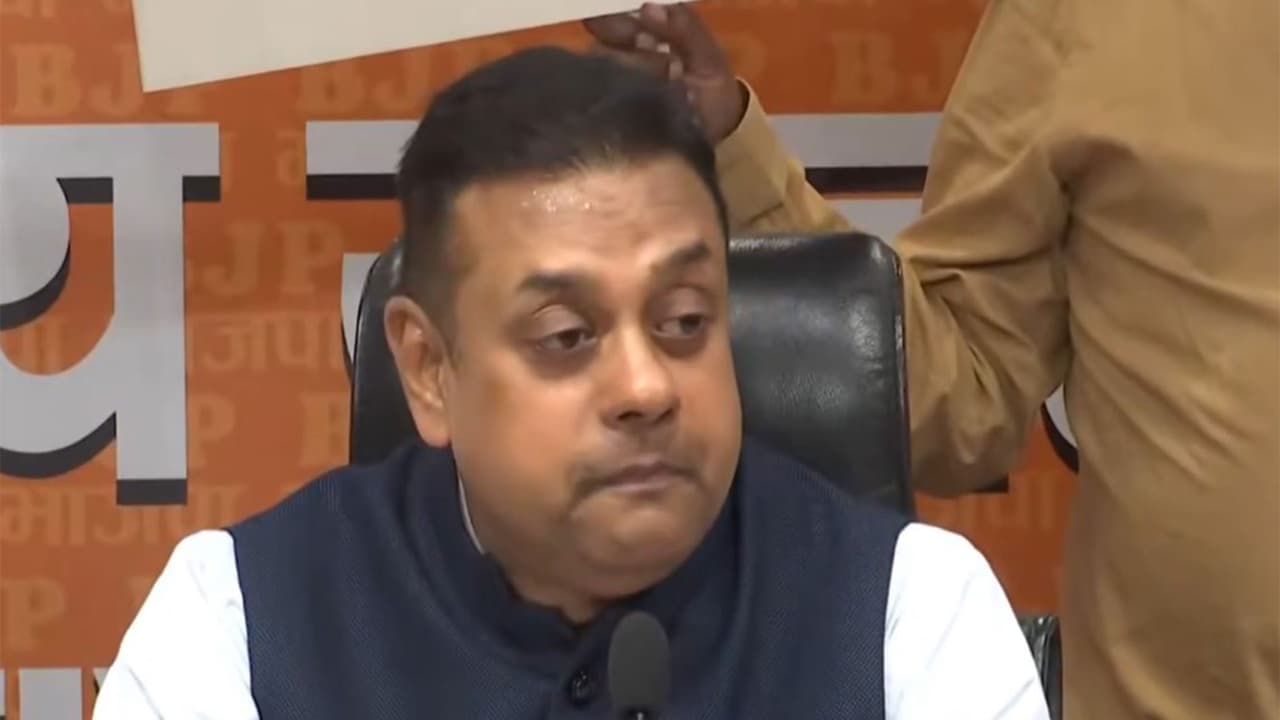
BJP MP Sambit Patra hit back at Congress, calling Nehru 'compromised chacha.' He alleged Nehru's PMO had CIA and KGB agents and that he wrongly rejected the Gwadar port offer, questioning his motives for giving away Indian territory.
Amid allegations from the Congress party that Prime Minister Narendra Modi was "compromised" in relation to the India-US interim trade arrangement, BJP MP Sambit Patra strongly responded, turning the criticism toward India's first Prime Minister, Jawaharlal Nehru, whom he referred to as "compromised chacha."

Patra Alleges Foreign Influence in Nehru's PMO
Speaking at a press conference in New Delhi, Patra alleged that Nehru's former private secretary, MO Mathai, had been described as an "American agent." He further claimed that during the 1960s, agents of the KGB, the Soviet intelligence agency, were present in the Prime Minister's Office. "Today, we want to reveal who the real compromiser is. In this context, Nehru's name comes first in this entire series. How Nehru was compromised and how the compromise of Nehru compromised the country...The CIA had such a strong presence in the secretariat of 'Compromised Chacha', that his special assistant or special secretary, whose name was M.O. Mathai, was called an American agent and in the nineteen sixties, agents of the KGB, which is a Russian agency, were also present in the office of Chacha Compromised," Sambit Patra said.
According to Patra, both the CIA and the KGB had significant influence within Nehru's administration, and it was widely believed at the time that sensitive documents were easily accessible to both the United States and the Soviet Union. He questioned why national security was allegedly weakened to such an extent that confidential documents could have been exposed to foreign powers. "So whether it was M.O. Mathai or KGB agents, the CIA and KGB had a stronghold in Chacha Nehru's office, and in the 1960s and 1970s, it used to be said about Nehru's regime, that any document that the foreign dispensation needed was readily available for the US and for Russia... That was the situation, a grim situation...Why was national security made so hollow that secret documents of the country were handed over to foreign hands," Sambit Patra added.
Gwadar Port Offer 'Rejected' by Nehru: Patra
Patra also brought up the issue of Gwadar port, claiming that in 1958, the Sultan of Oman had offered to hand over Gwadar to India. He claimed that Nehru declined the offer and argued that Gwadar has since become strategically important for China and Pakistan. According to Patra, India is now facing the consequences of that decision. "In 1958, the Sultan of Oman offered to give Gwadar port to India. The Sultan of Oman said that if India wished, he would like to hand over Gwadar port to India. Nehru rejected it, saying that India would not take Gwadar port. Today, you can see how strategically important Gwadar port has become for China and Pakistan. The consequences of Nehru's compromise are being borne by India today," said Patra.
Patra Questions Nehru's Motives for 'Gifting' Indian Land
Additionally, Patra questioned why Nehru allegedly discussed giving Indian territory to foreign countries, asking under what pressure such decisions were made. He raised speculative questions about whether there were external incentives or influence behind those actions and suggested that such issues should be addressed by the current leadership of the Congress party. "There is one question whose answer is hard to understand: why did Nehru talk about giving India's land as a gift to foreign countries? Under what pressure was he acting, and why was this done? Was there some big reward behind it? Did China and Pakistan bribe Nehru? Was Nehru bribed by China and Pakistan, and was that the reason he gifted Indian lands to both these nations? Is this something that we should be asking the present dispensation of the Congress party?," said Patra.
Congress Accused of Paying for Anti-AI Summit Social Media Posts
In a separate allegation, Patra claimed that social media users had shared posts and reels stating they received messages from Congress offices or senior leaders offering monetary incentives ranging from Rs 25,000 to Rs 1.5 lakh to post content critical of the AI Impact Summit. "Reels are also trending on social media and people have tweeted and shared through Reels that they received messages from the Congress office and senior Congress leaders that if they tweet or make a Reel against the World AI Summit, they will be given Rs 25,000, Rs 50,000 or even Rs 1.5 lakh. We are seeing many such examples on social media and these are authentic because the messages have been posted and shown," said Sambit Patra. (ANI)
(Except for the headline, this story has not been edited by Asianet Newsable English staff and is published from a syndicated feed.)