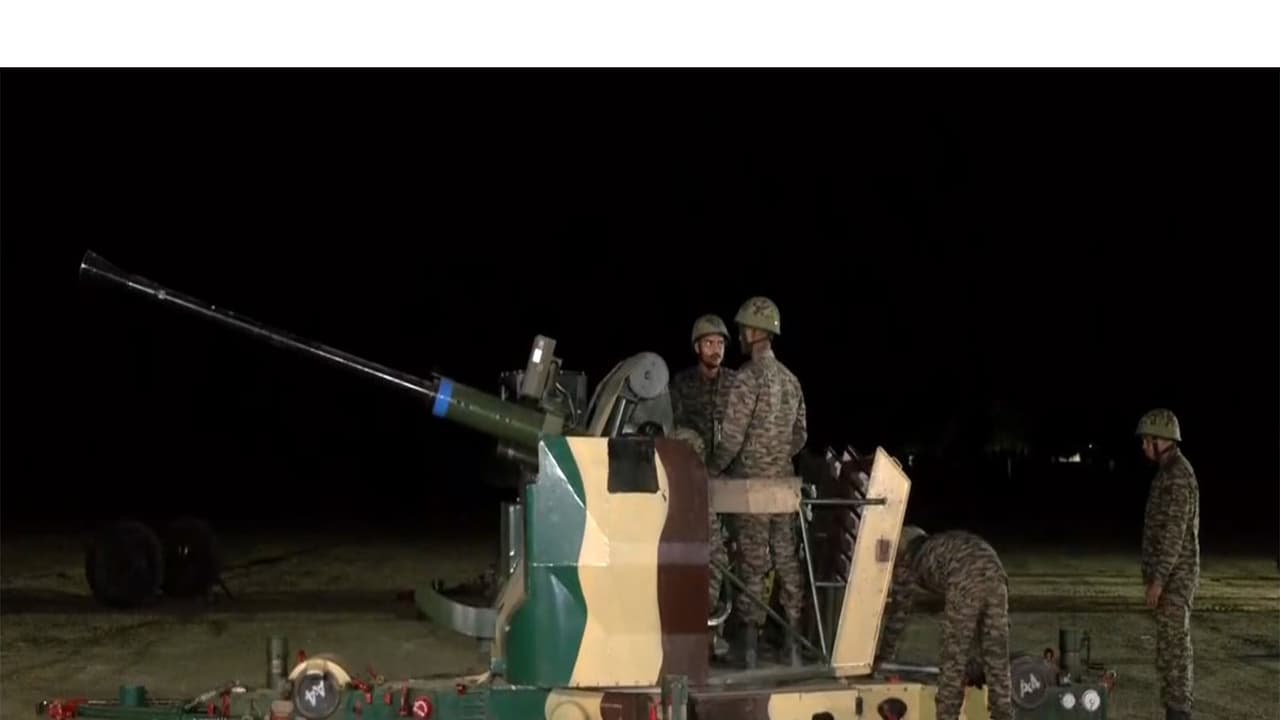
Marking one year of Operation Sindoor, the Indian Army showcased L70 air defence guns, drones, and amphibious drills, highlighting combat readiness while reaffirming a strong message against terrorism.
Bhuj, Gujarat: As India approaches the first anniversary of Operation Sindoor, the Indian Army's Air Defence regiment showcases the L70 air defence guns, a symbol of vigilance, precision, and unwavering readiness.

These guns played a crucial role during Operation Sindoor, effectively countering enemy drone threats and reinforcing India's air defence shield.
Related Articles

Army Showcases Tactical Prowess
The Indian Army demonstrated its technological edge by deploying advanced drones during Operation Sindoor. During the exercise the Indian Army's AD showcased unmanned aerial systems for surveillance, target acquisition, and real-time intelligence gathering across challenging terrain.
Indian Army exhibited its formidable tactical prowess in waterborne operations, with specialised battle groups swiftly manoeuvring through shallow waters in agile assault boats.
During Operation Sindoor, these highly versatile vessels were deployed in a state of high readiness, fully prepared to intercept and neutralise any enemy ships attempting to approach India's borders.
The amphibious operation drill by the Indian Army to carry out an attack and dominate the enemy territory showcased how the Indian Army dominated the Creek Area during Operation Sindoor both on land and in water.
'Justice Will Be Served': India Commemorates Anniversary
Earlier, marking one year since the deadly terror attack in Pahalgam that claimed 26 lives, the Indian Army reiterated its resolve against terrorism, remembering the decisive military response under 'Operation Sindoor' and warning assured retaliation for acts against India.
Commemorating the anniversary, in a post on X, the Additional Directorate General of Public Information (ADG PI) of the Indian Army wrote, "For acts against India, the response is assured. Justice will be served. Always," along with a Sindoor graphic which read, "Operation Sindoor continues..."
Meanwhile, Prime Minister Narendra Modi paid homage to the 26 victims of the attack, reiterating the country's unified stand against terrorism. In a post on X, the Prime Minister said the lives lost would "never be forgotten" and expressed solidarity with grieving families.
"As a nation, we stand united in grief and resolve. India will never bow to any form of terror. The heinous designs of terrorists will never succeed," Modi stated.
Operation Sindoor: The Decisive Response to Terror
The terror attack, carried out in Pahalgam, one of Jammu and Kashmir's prominent tourist destinations, had shocked the nation after Pakistan-backed terrorists entered a village and killed 26 civilians. The assailants reportedly targeted victims based on their religious identity, drawing widespread condemnation and outrage across the country.
In response, India launched Operation Sindoor on May 7, 2025, targeting terror infrastructure in Pakistan and Pakistan-occupied Jammu and Kashmir (PoJK). The Indian armed forces struck multiple terror launchpads linked to groups such as Lashkar-e-Taiba, Jaish-e-Mohammed, and Hizbul Mujahideen, significantly damaging their operational capabilities.
The operation triggered retaliatory actions from Pakistan, including drone attacks and cross-border shelling, leading to a brief four-day military escalation. Indian forces responded with precision strikes, reportedly targeting key radar installations in Lahore and areas near Gujranwala.
Following the escalation, both countries agreed to a ceasefire on May 10 after communication between their respective Directors General of Military Operations (DGMO).
(Except for the headline, this story has not been edited by Asianet Newsable English staff and is published from a syndicated feed.)