
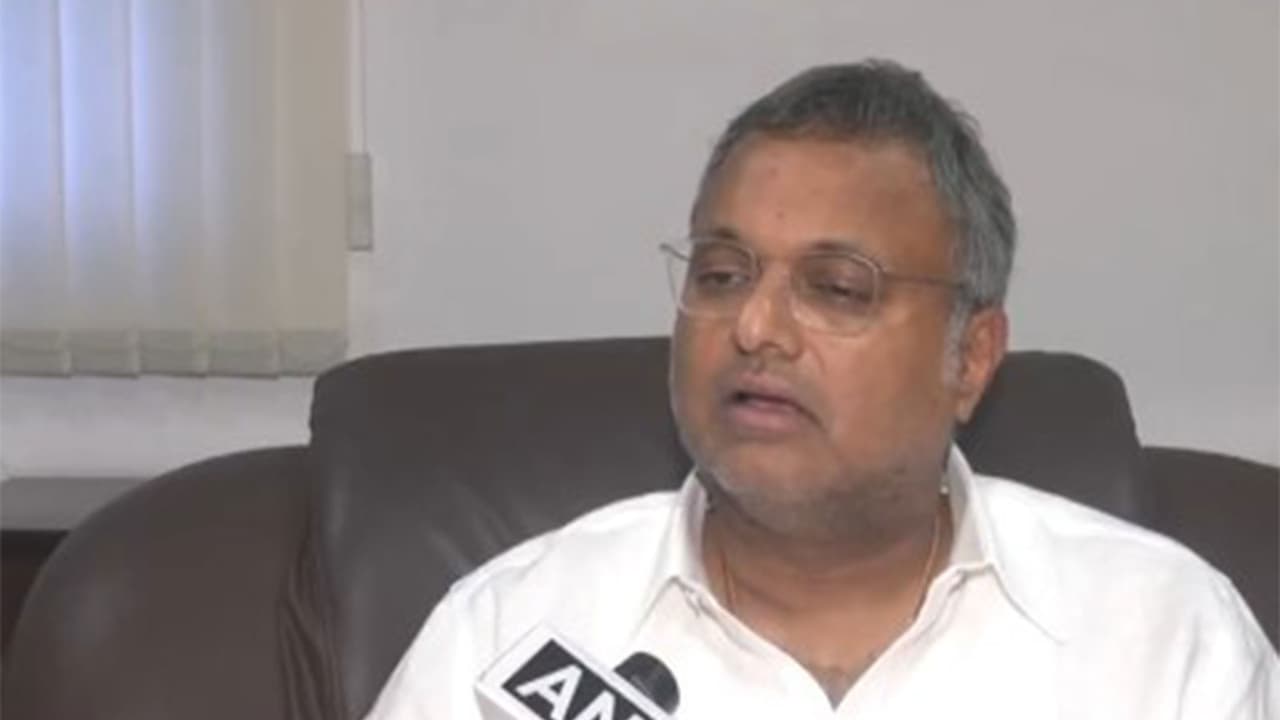
Congress MP Karti Chidambaram defended TN CM MK Stalin's cash transfer scheme, calling it a strong economic tool to 'seed' the rural economy. He dismissed the 'freebie' label and praised Direct Benefit Transfer as a form of universal basic income.
Karti Chidambaram Defends Cash Transfer as 'Good Economics'
Congress leaders and Sivaganga MP Karti Chidambaram on Sunday defended Tamil Nadu Chief Minister MK Stalin's Rs 5,000 cash transfer to 1.31 crore women under the Kalaignar Women's Rights Scheme. Speaking with ANI, he dismissed the "freebie" label often attached to cash transfers by critics. Instead, he framed it as a strategic tool to "seed" the rural economy.

Karti Chidambaram praised Direct Benefit Transfer (DBT) as a form of "universal basic income" that boosts rural economies. He highlighted that funds are deposited directly into women's bank accounts, stimulating local economies, reducing administrative hurdles, and allowing recipients to choose how to spend, with contributions to the exchequer through GST. "I wholeheartedly welcome it. I've been a consistent supporter of direct cash transfers. This is akin to a universal basic income. This money goes directly into the women's bank account. There is no leakage. Women spend the money locally, which seeds the local economy. In my opinion, this is a strong economic tool for seeding the local economy. This is much better than complicated government programs where people don't understand how to access the benefit, and the administration doesn't know how to administer it. And there is so much bureaucracy. This cuts through all the red tape. It is deposited directly into their bank account. I think we should give a universal basic income to all people in this country. 5,000 rupees a month directly to your bank account. How is it not a freebie then? It's not a freebie. In fact, it is good economics," he said.
Stimulating the Grassroots Economy
Chidambaram argued that bypassing the "labyrinth of bureaucracy" in favour of direct deposits--specifically into women's hands--is the most efficient way to stimulate the grassroots economy. "Where do the people spend the money? They're not going to take the money and open an account in the Cayman Islands. They will spend the money within a 2 km or 3 km radius of their house. It will seed the local economy. This is the best way to seed the rural economy. We're not bringing any large factories to rural areas. Our farming is the most rudimentary farming. We can talk about 100,000 things in farming, but if you go to any district, you will hardly find 10 progressive farmers," he said.
A Trend Across Political Parties
The Sivaganga MP also acknowledged other parties, like BJP and DMK, implementing similar cash transfer schemes (Ladki Behen, Ladli Behen). He supported this trend and welcomed others adopting this idea, highlighting its benefits for rural economies and empowerment "But isn't the BJP doing that when they're giving the Ladki Behen, Ladli Behen, all these, they're giving it to women? I think you should... Everybody is doing it. Basically, everyone is doing it now. CM Stalin's budget last year was... But many schemes can be scrapped. I think many other schemes can be scrapped. You can make this little... There's nothing wrong with cash transfers. Cash transfers might be a great tool for winning elections, but I also believe it's good economic. It seeds the local economy. Otherwise, how do you give liquidity to a district which is so far flung off, where there is no modern economic activity? How do you seed that economy? That is what I have. You are having a good idea. So why don't your party take it up? My idea is that I have great ideas," he said.
Economic Rationale: Local Spending and GST Collection
Chidambaram praised Direct Benefit Transfer (DBT) as a form of "universal basic income" that boosts rural economies and allows recipients to choose how to spend, thereby contributing to the exchequer through GST. "They have the freedom to spend it on what they want, and they will spend it and everything comes under the ambit of GST. Tax collection comes back to the government, and it helps the local economy because where do they spend? If you conduct a study, it will be within a radius of 2 to 3 kilometres. They will go to a speed shop. They might go to a tailor, make some clothes for themselves, and buy a notebook for the child. Maybe, you know, whatever. Everything is in the local economy. They are not going elsewhere to spend the money, and this is the best way to seed the rural economy. Manufacturing will not create the jobs we expect in the future, as it will become highly automated and knowledge-driven. We only need to be a service-oriented country. In the rural economy, there's little happening. This is a strong impetus to sustain the rural economy. And I, I, in fact, I'm a wholehearted supporter of this from an economic point of view, and a UBI, universal basic income is a good idea," he said.
Acknowledging the Incumbent's Advantage
Chidambaram admitted that incumbents have a massive psychological advantage. They can deliver cash before an election, whereas the opposition can only offer a manifesto promise. "I personally do not criticise direct cash transfers. Yes, the incumbent government has an advantage over the challenger because it can do this before the election. Whereas the challenger can only promise, and the person who does it has always better goodwill than the person who promises. I agree. I agree that there is an advantage for the party in opposition. and is gravely advantageous to the party in government. I agree with that. Is this the situational problem? What's the limit, though? Where do we keep going from this?" he said.
Criticism of Election Commission's Role
Chidambaram criticises the Election Commission's handling of welfare announcements, calling it a "sorry organisation" for allowing governments to bypass the Model Code of Conduct by framing late-stage disbursements as "continuing programs." "See, the Election Commission is not behaving as a neutral arbitrator in this country. Let's be very frank about it. The Election Commission was a storied organisation, but it's now a very sorry organisation. If they can put standard protocols in place, say three months before, six months before, or something like that, and stick to them. But then they came up with an ingenious argument, saying this was a continuing program, so there was no embargo," he said.
'DMK Used the Pitch Available to Bat'
Regarding recent payments in Tamil Nadu, he clarified that Chief Minister MK Stalin was simply navigating the "pitch" provided by the EC, releasing two months of funds in advance plus a "summer bonus" before the election window closes. "So, I mean, everybody gets wiser by looking at what's happening, and the DMK has just used the pitch which is there to bat. I think the critics over here are saying that, you know, these transfers were paused for a while. There is an additional summer allowance of 2000. All at once, it was sent out. That is not true. What he said is clear: I heard the chief minister speak today. He has said the Election Commission will be on hold for the next two months. I'm giving you the next two months' notice. And I'm also giving you a summer bonus. That's all he has," he said.
A Vision for Universal Basic Income Over Product Distribution
Karti Chidambaram argued that the government should stop distributing products and start distributing purchasing power. By empowering women as the primary financial gatekeepers of the household, Chidambaram believes the state can bypass the administrative "dead weight" of traditional schemes and revitalise the far-flung districts of India. "I would do only a cash transfer because the people must have the freedom to decide what they want to spend it on. Some of them might save it. Some of them buy something that is much more durable. Therefore, freedom must be granted to people. I don't believe in giving products. I only believe in direct cash transfer. I call it, let's start calling it universal basic income from now on. Let's get this term going now. UBI. It's not da irect cash transfer. If I become the chief minister of Tamil Nadu, I will implement a universal basic income of 5000 rupees per month for women. I will cut many other unnecessary schemes," said Karti Chidambaram. (ANI)
(Except for the headline, this story has not been edited by Asianet Newsable English staff and is published from a syndicated feed.)