
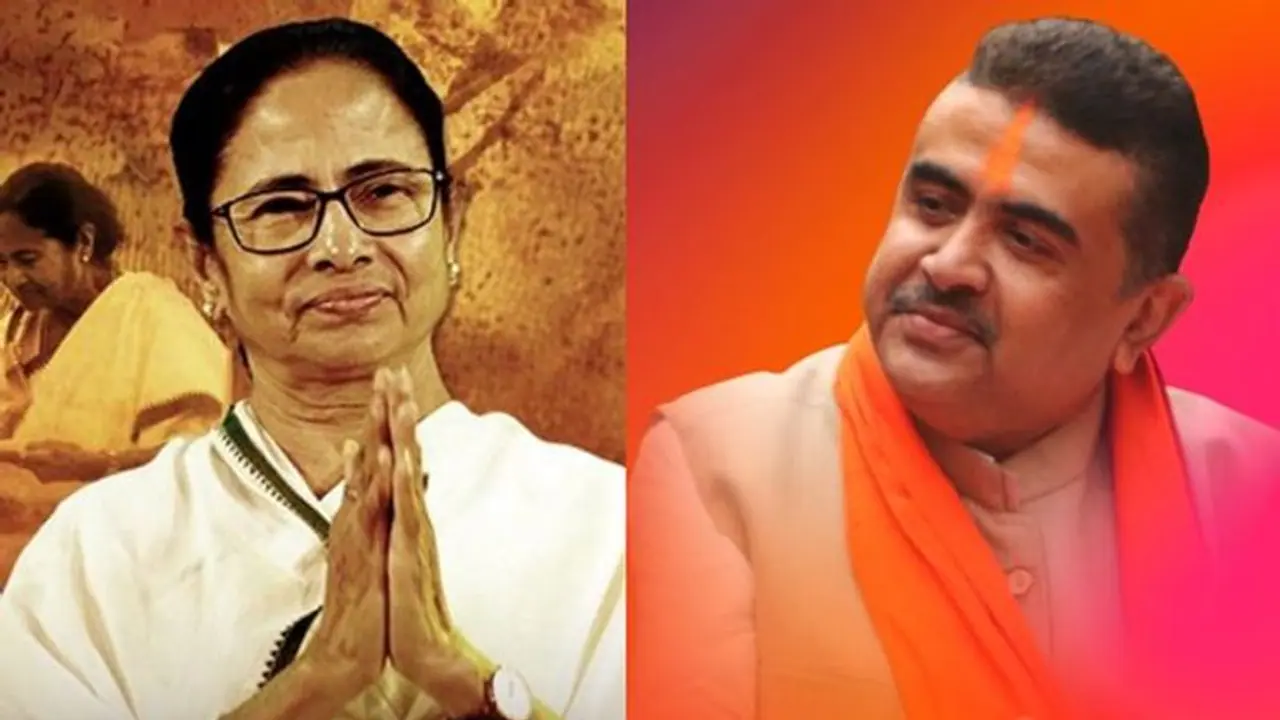
The intense political rivalry between West Bengal Chief Minister Mamata Banerjee and her former protégé, Suvendu Adhikari, is a central focus for the 2026 election. After Adhikari, now with the BJP, defeated Banerjee in 2021, he is set to challenge her again, this time in her Bhabanipur stronghold.
The 2026 West Bengal Assembly election has once again brought into sharp focus one of India’s most intense political rivalries—between Chief Minister Mamata Banerjee and her former protégé-turned-arch rival Suvendu Adhikari. Five years after Adhikari delivered what many described as the most humiliating electoral setback of Banerjee’s career in Nandigram, the question dominating this election cycle is simple yet profound: can he do it again?

At its core, this is more than just a constituency-level contest. It is a battle of legacy, perception, and political momentum, with implications not just for Bengal but also for the broader national political landscape.
From Mentor-Protégé to Bitter Rivals
The Mamata Banerjee–Suvendu Adhikari rivalry is rooted in a dramatic political transformation. Once close allies within the Trinamool Congress (TMC), the two leaders shared a common political journey that began during the 2007 Nandigram movement. Adhikari played a crucial role in mobilising grassroots support during the anti-land acquisition protests, earning Banerjee’s trust and rising rapidly within the party ranks.
However, this relationship began to unravel amid internal power struggles and shifting political dynamics. In 2020, Adhikari defected to the Bharatiya Janata Party (BJP), turning from a trusted lieutenant into Banerjee’s fiercest challenger almost overnight.
The fallout set the stage for one of the most dramatic contests in recent Indian political history—the 2021 Nandigram election. Banerjee chose to contest from Adhikari’s stronghold, only to be defeated in a nail-biting finish. The loss was symbolic, even though the TMC went on to retain power comfortably in the state.
The 2026 Rematch: Stakes Higher Than Ever
Fast forward to 2026, and the rivalry has entered a new phase. This time, the battleground has shifted to Bhabanipur, Banerjee’s home turf, where Adhikari has taken the fight directly to her stronghold.
The symbolism of this move is hard to ignore. In 2021, Banerjee ventured into Adhikari’s territory and lost. Now, Adhikari is attempting a mirror strategy—challenging her in her own bastion to prove that his earlier victory was not a one-off.
This high-profile contest has turned Bhabanipur into the epicentre of Bengal’s political battle, attracting national attention. It is widely seen as a prestige fight for both leaders, with reputations and political futures on the line.
Also Read: WB polls: Mamata Banerjee regains narrow lead over Suvendu Adhikari
Contrasting Narratives and Campaign Strategies
The election has also highlighted sharply contrasting political narratives. Mamata Banerjee has framed the contest as a fight to protect Bengal’s identity and autonomy. Positioning herself as a defender of regional pride, she has repeatedly accused the BJP of being an “outsider” force attempting to dominate the state’s politics.
She asserted confidently during the campaign, “I have full faith in people… this fight is not just mine but our party’s fight.”
Adhikari, on the other hand, has projected the election as an opportunity for “poribortan” (change), leveraging anti-incumbency and dissatisfaction among sections of voters. His campaign draws heavily on his 2021 victory, using it as proof that Banerjee’s dominance can be challenged.
The BJP has backed this narrative with an aggressive campaign, deploying top leadership and focusing on governance issues, corruption allegations, and political violence.
A Statewide Battle Beyond One Seat
While the Mamata vs Suvendu clash dominates headlines, the broader election remains a statewide contest between the TMC and BJP. Key constituencies across North Bengal, industrial belts, and minority-dominated regions are expected to influence the final outcome.
The BJP is seen to have an advantage in parts of North Bengal, while the TMC continues to hold strong organisational ground in districts like Birbhum and West Burdwan. However, several regions remain highly competitive, reflecting a closely fought election.
High voter turnout and intense campaigning have further added to the unpredictability of the results. Both parties have claimed momentum, turning the election into a high-stakes political showdown.
Can Suvendu Repeat History?
The central question remains whether Adhikari can replicate his 2021 success. His earlier victory demonstrated that Banerjee could be defeated in a direct contest, breaking the perception of her invincibility.
However, repeating that feat in Bhabanipur presents a different challenge altogether. Unlike Nandigram, which was Adhikari’s stronghold, Bhabanipur has long been considered Banerjee’s political fortress. She has consistently enjoyed strong support in the constituency, making it a tougher battleground for the BJP leader.
At the same time, the BJP’s growing vote share and organisational expansion in urban areas suggest that the contest may not be as one-sided as in the past.
Also Read: West Bengal Elections: BJP edges closer to victory, leads on 121 seats
More Than a Personal Rivalry
Ultimately, the Mamata Banerjee vs Suvendu Adhikari contest transcends individual ambition. It represents a broader ideological and political clash between regional dominance and national expansion, between continuity and change.
For Banerjee, a victory would reaffirm her grip over Bengal and reinforce her position as a key national opposition leader. For Adhikari and the BJP, another win against her would be a major symbolic breakthrough, signalling that the party can challenge even the strongest regional leaders on their home turf.
As counting day approaches, all eyes remain on this high-voltage rematch. Whether Adhikari can “beat Mamata twice” or whether Banerjee reasserts her dominance will not only shape the future of West Bengal politics but also influence the trajectory of national political contests in the years ahead.
