
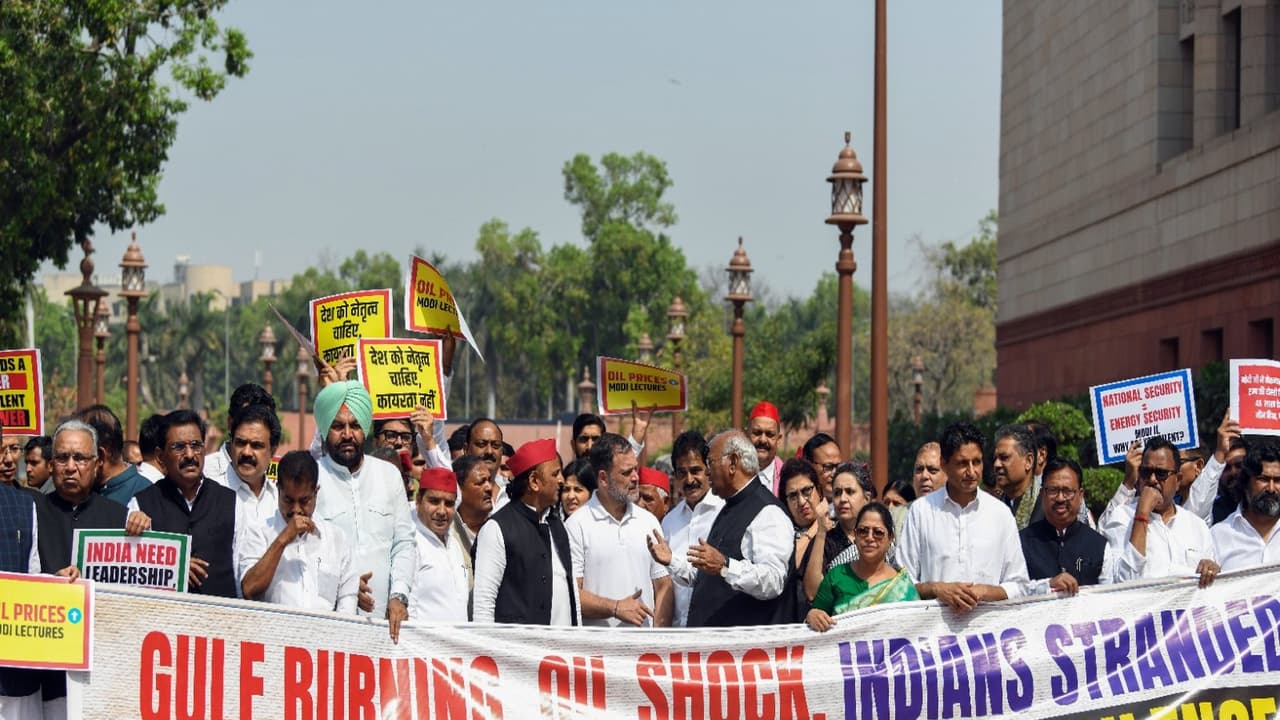
Lok Sabha's session was disrupted by opposition protests demanding a debate on the West Asia crisis. EAM S Jaishankar briefed Parliament on the conflict, highlighting concerns for Indian nationals, energy security, and trade interests.
Lok Sabha Disrupted Over West Asia, Speaker's Removal Motion
Lok Sabha witnessed noisy scenes on Monday, the first day the House met following an inter-session break, with the opposition parties demanding a discussion on the crisis in West Asia, even as the External Affairs Minister S Jaishankar made a suo moto statement.

The government accused the Congress and other opposition parties of stalling the proceedings when the House was to take up the resolution given by the opposition members for the removal of Lok Sabha Speaker Om Birla. The opposition parties do not have the numbers to carry the resolution in the House.
The House was first adjourned till 12 noon, 3 pm and later for the day as opposition members resorted to sloganeering against the government.
When the House met at 3 pm, the opposition members continued with their protests. BJP member Jagdambika Pal, who was in the Chair, told the opposition members that the External Affairs Minister had made a comprehensive statement to address concerns of members about the situation in West Asia.
Earlier, when the House met at 12 noon after its first adjournment, the chair, said that the opposition members had brought a resolution for the removal of Speaker, they are now protesting over another issue. He said the government is ready for debate on the opposition resolution. He also objected to opposition members displaying posters.
Parliamentary Affairs Minister Kiren Rijiju also slammed the Congress and other opposition parties. Targeting Congress, he said he had not seen "a more irresponsible" opposition party.
EAM Jaishankar Briefs Parliament on West Asia Crisis
In his remarks, which he made both in Lok Sabha and Rajya Sabha, Jaishankar said that the recent developments in West Asia are a cause of deep concern. He said this round of conflict started on February 28 and it has witnessed not only fighting between Israel and the United States on one side and Iran on the other, but also attacks on a number of Gulf States. There have been numerous casualties, including at the leadership level in Iran, as well as the destruction of infrastructure in the region.
He said the government had issued a statement on February 28 expressing its deep concern and urging all sides to exercise restraint, avoid escalation and prioritize the safety of civilians. "We believed and we continue to believe that dialogue and diplomacy should be pursued to de-escalate tensions and address underlying issues. It is also imperative that the sovereignty and territorial integrity of all states in the region be respected," he said.
Cabinet Committee of Security's Concerns
He said the Cabinet Committee of Security (CCS) met on March 1 and was briefed on the airstrikes in Iran and the subsequent attacks in several Gulf countries. "The CCS was concerned over the safety and security of the Indian community in the region. It also focused on the implications for regional security and for economic and commercial activities. The Committee was apprised of difficulties faced by Indian travellers transiting the region and by students appearing for scheduled examinations in these countries," the minister said.
He said the CCS directed all concerned Ministries and Departments to take appropriate measures to respond to these problems. "Prime Minister continues to closely monitor emerging developments and the relevant Ministries are coordinating to ensure effective responses," he said.
The minister said that conflict has continued to intensify and the security situation in the region has deteriorated significantly. "We have noted that, in fact, the conflict has spread to other nations with mounting destruction and deaths. Normal life and economic activities in the entire region were visibly affected and, in some cases, have come to a halt. We, therefore, reiterated our call on March 3 for dialogue and diplomacy and spoke up for an early end to the conflict."
India's Stakes in the Region
Jaishankar said that while any development that negatively impacts peace and security in the world is deeply troubling, this ongoing conflict is an issue of particular concern for India. "We are a neighbouring region and understandably, have obvious stakes in West Asia remain stable and peaceful. There are almost one crore Indian citizens who live and work in the Gulf nations. In Iran too, there are a few thousand Indians who are there for study and employment. The region is key to our energy security and includes many important suppliers of oil and gas," the minister said.
Jaishankar said that the Gulf region is also a major trade partner, accounting for USD 200 billion almost annually. "The House is also aware that in the last decade, there have been significant investments from the region into the Indian economy. Therefore, the serious supply chain disruptions and climate of instability that we perceive are indeed serious issues. Furthermore, these include attacks on merchant shipping where Indian nationals often constitute a large proportion of the crews. We have sadly already lost two Indian mariners and one remains missing in such incidents," he said.
Government's Response and Diplomatic Efforts
The Government, Jaishankar said, has been assessing the situation in West Asia continuously since the 12-day war in June 2025. "We noted the indications of growing tension and cautioned the Indian community in Iran accordingly. Jaishankar said that the Embassy in Tehran remains fully operational. "They are totally committed to supporting the Indian community in this difficult situation and in assisting Indian nationals who may wish to cross international borders."
He said that insofar as the United States is concerned, India has maintained regular contacts through diplomatic channels.
The minister said that while attempts have been made, contacts with Iran at the leadership level are obviously difficult at this time. He spoke with Iranian Foreign Minister Araghchi on February 28 and March 5. "We will continue these high-level conversations in the coming days. The House will also be interested in the issue of an Iranian vessel that is currently docked in Kochi. The Iranian side have requested permission on February 28 for three ships in the region to dock at our ports. This was accorded on March 1 . IRIS LAVAN actually docked on March 4 in Kochi. The crew is currently in Indian naval facilities. We believe that this was the right thing to do and the Iranian Foreign Minister has expressed his country's thanks for this humane gesture."
Energy Security and National Interest
Referring to energy security , Jaishankar said the interests of the Indian consumer have and will always be the overriding priority. "Where required, Indian diplomacy has supported the endeavours of our energy enterprises in this volatile situation."
He said India is in favour of peace and urges a return to dialogue and diplomacy and advocates de-escalation, restraint and ensuring the safety of civilians. He said the well-being and security of the Indian community in the region is government's overriding priority. "We will continue to work with the Governments of the region towards that end. Our national interest, including energy security and trade flows, will always be paramount," Jaishankar said.
INDIA Bloc Protests at Parliament
Earlier, the INDIA bloc MPs protested at the Makar Dwar of Parliament, raising slogans against the Centre over the West Asia conflict. Leader of Opposition in Lok Sabha, Rahul Gandhi and LoP in Rajya Sabha, Mallikarjun Kharge, were among the leaders who took part in the protest.
The budget session of Parliament began on January 28. The first part of the session continued till February 13 and the second part of the budget session will conclude on April 2. (ANI)
(Except for the headline, this story has not been edited by Asianet Newsable English staff and is published from a syndicated feed.)