
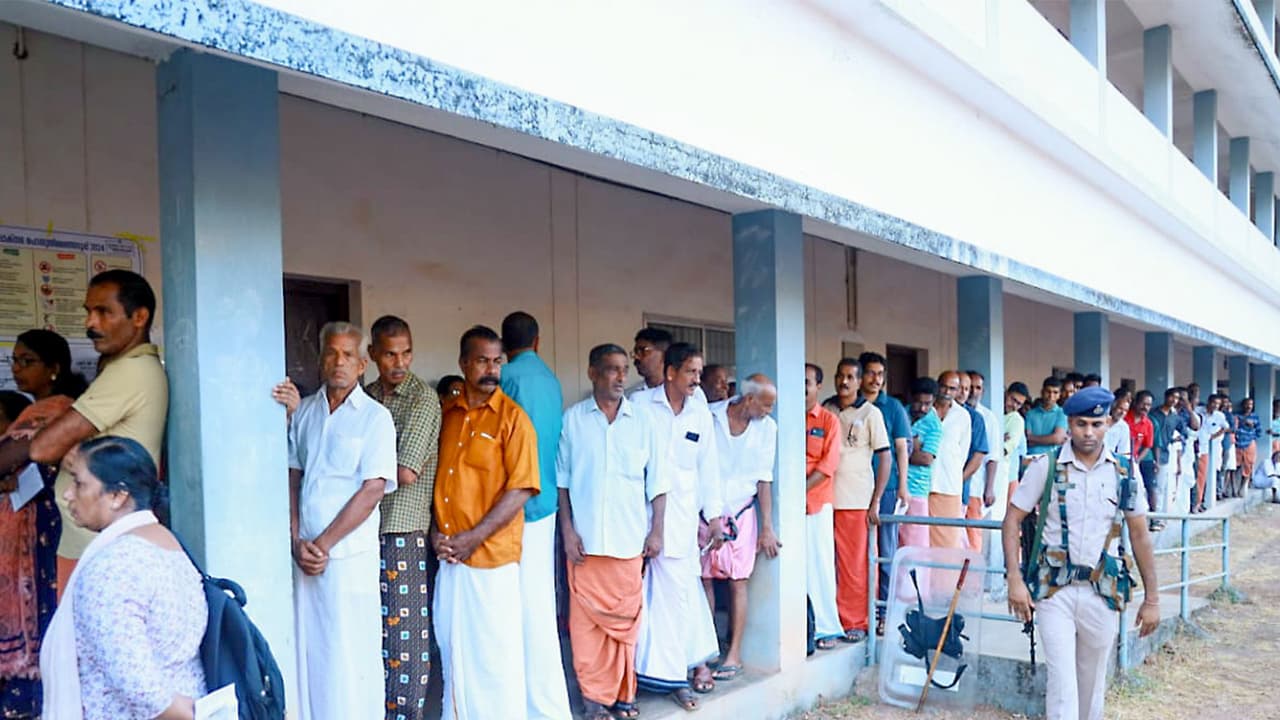
The Election Commission announced the 2026 Kerala Legislative Assembly elections will occur in a single phase on April 9, with vote counting on May 4. The Model Code of Conduct is now active for the 140-member assembly polls.
2026 Kerala Election Schedule Announced
The 2026 Kerala Legislative Assembly elections will be held in a single phase on April 9, the Election Commission of India announced on Sunday, with the counting of votes scheduled to take place on May 4.

The Model Code of Conduct comes into place from today, setting in process elections to the 140-member State Assembly, which is also known as the Kerala Niyamasabha. The tenure of the current assembly is scheduled to end on May 23, 2026.
Electorate and Voter List Details
Addressing a press conference in the national capital, Chief Election Commissioner Gyanesh Kumar said in a press conference said "Voting will be held across 2.19 lakh polling stations in four states and one UT, with 25 lakh election officials on duty." CEC Kumar said that around 2.7 crore electors are expected to participate in the elections in Kerala.
The last date for filing nominations is March 23, with scrutiny of nominations on March 24 and the last date for withdrawal of candidatures on March 26. Following the completion ennumeration excercise of the Special Intensive Revision (SIR) of the state electoral roll, the ECI released Kerala's final voter list on February 21. According to the Kerala CEO, the revision was conducted with January 1 as the qualifying date, and a total of 2,69,53,644 voters were registered in the state through the process. The final voter list comprises 1,31,26,048 male voters, 1,38,27,319 female voters, and 227 third-gender voters. Within this total, 4,24,518 voters belong to the younger electorate of the 18-19 age group. The Kerala CEO further mentioned that around 53,229 individuals have been deleted from the voters' list. The process of SIR was conducted from November 11, 2025, to January 30, 2026.
Political Landscape and CM's Outlook
The main electoral contest in the State is expected between the Left Democratic Front (LDF), led by the Communist Party of India (Marxist), and the United Democratic Front (UDF), led by the Indian National Congress. The National Democratic Alliance (NDA), led by the Bharatiya Janata Party, is also in the fray for the Assembly polls. Notably, CM Pinarayi Vijayan, on March 12, while speaking at the NDTV Keralam Power Play summit, expressed confidence that the Left Democratic Front (LDF) will win more seats in the upcoming state elections than in 2021. Vijayan said there is no anti-incumbency in the state, adding that the people hold a positive view of the government and its policies and believe only the current administration can take Kerala forward.
Recap of 2021 Assembly Elections
In the Kerala Legislative Assembly election, held in a single phase on April 6, 2021, with results being declared on May 2, 2021. The incumbent LDF retained power with 99 seats, marking the first time since 1977 that a ruling alliance secured consecutive terms in the state. The UDF won 41 seats, while the NDA saw a decline in vote share and lost its only seat in the Assembly.
Following the victory, Pinarayi Vijayan became the first Chief Minister of Kerala to be re-elected after completing a full five-year term in office.
In terms of vote share, the LDF received 41.5 per cent of the total votes, significantly ahead of the UDF, which secured 38.4 per cent. The National Democratic Alliance (NDA), led by the Bharatiya Janata Party (BJP), secured 11.4 per cent of the votes but failed to win a single seat in the election.
Among individual parties in 2021, the Communist Party of India (Marxist) (CPI(M)) emerged as the single largest party with 62 seats and a vote share of 25.5 per cent. The Indian National Congress (INC) won 21 seats with a comparable vote share of 25.2 per cent, while the Communist Party of India (CPI) secured 17 seats. The Indian Union Muslim League (IUML), a key UDF ally, won 15 seats.
The 2016 Assembly elections had also seen the LDF come to power, winning 77 seats with a vote share of 34.8 per cent. The UDF secured 47 seats with 38.2 per cent of the votes, reflecting a closely contested political environment at the time. A comparison between the two elections shows a consolidation of support for the LDF between 2016 and 2021, with the alliance increasing its seat tally by 17 seats. The UDF, meanwhile, saw its representation in the Assembly decline from 47 seats in 2016 to 40 seats in 2021.
2016 Assembly Election Outcome
The elections also highlighted Kerala's traditionally high voter participation, with turnout in many constituencies exceeding 80 per cent. In constituencies such as Kuttiadi and Taliparamba, turnout figures crossed the 85 per cent mark.
Furthermore, in 2016 Kerala Assembly elections saw the LDF return to power with 91 seats in the 140-member assembly. The alliance secured 34.8 per cent of the vote share, while the UDF obtained a slightly higher vote share of 38.2 per cent but managed to win only 47 seats due to constituency-level outcomes. The CPI(M) won 58 seats in 2016, followed by the Congress with 22 seats, the CPI with 19 seats, and the IUML with 18 seats. Notably, the BJP registered its first-ever assembly victory in Kerala that year when O Rajagopal won the Nemom seat.
Polls Announced for Other States and UT
Meanwhile, dates for Assembly elections in West Bengal, Tamil Nadu, Assam and the Union Territory of Puducherry were also announced today. In West Bengal, polling will be conducted in two phases on April 23 and April 29, while Assam will vote in a single phase on April 9. Tamil Nadu will go to the polls on April 23, and voting in Puducherry will also be held on April 9. Counting of votes in all four states and Puducherry will be done on May 4, the CEC announced.
(Except for the headline, this story has not been edited by Asianet Newsable English staff and is published from a syndicated feed.)